

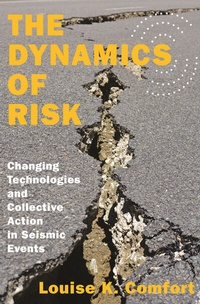
The Dynamics of Risk
Changing Technologies and Collective Action in Seismic Events
1st Edition
Published on 17. June 2019
336 pages
978-0-691-18602-3 (ISBN)
Description

Earthquakes are a huge global threat. In thirty-six countries, severe seismic risks threaten populations and their increasingly interdependent systems of transportation, communication, energy, and finance. In this important book, Louise Comfort provides an unprecedented examination of how twelve communities in nine countries responded to destructive earthquakes between 1999 and 2015. And many of the book's lessons can also be applied to other large-scale risks.
The Dynamics of Risk sets the global problem of seismic risk in the framework of complex adaptive systems to explore how the consequences of such events ripple across jurisdictions, communities, and organizations in complex societies, triggering unexpected alliances but also exposing social, economic, and legal gaps. The book assesses how the networks of organizations involved in response and recovery adapted and acted collectively after the twelve earthquakes it examines. It describes how advances in information technology enabled some communities to anticipate seismic risk better and to manage response and recovery operations more effectively, decreasing losses. Finally, the book shows why investing substantively in global information infrastructure would create shared awareness of seismic risk and make postdisaster relief more effective and less expensive.
The result is a landmark study of how to improve the way we prepare for and respond to earthquakes and other disasters in our ever-more-complex world.
The Dynamics of Risk sets the global problem of seismic risk in the framework of complex adaptive systems to explore how the consequences of such events ripple across jurisdictions, communities, and organizations in complex societies, triggering unexpected alliances but also exposing social, economic, and legal gaps. The book assesses how the networks of organizations involved in response and recovery adapted and acted collectively after the twelve earthquakes it examines. It describes how advances in information technology enabled some communities to anticipate seismic risk better and to manage response and recovery operations more effectively, decreasing losses. Finally, the book shows why investing substantively in global information infrastructure would create shared awareness of seismic risk and make postdisaster relief more effective and less expensive.
The result is a landmark study of how to improve the way we prepare for and respond to earthquakes and other disasters in our ever-more-complex world.
More details
Language
English
Place of publication
Princeton, NJ
United States
Publishing group
De Gruyter
Target group
Professional and scholarly
Edition type
Digital original
Product notice
Reflowable
Illustrations
20 b/w illus. 43 tables. 7 maps.
ISBN-13
978-0-691-18602-3 (9780691186023)
Schweitzer Classification
Other editions
Additional editions

Book
06/2019
Princeton University Press
€116.50
Article not available at the moment
Book
06/2019
Princeton University Press
€42.00
Shipment within 10-20 days
Person
Louise K. Comfort is professor at the Graduate School of Public and International Affairs and former director of the Center for Disaster Management at the University of Pittsburgh. Her previous books include Shared Risk: Complex Systems in Seismic Response.
Content
- Cover
- Title Page
- Copyright Page
- CONTENTS
- List of Figures
- List of Tables
- Preface
- 1 Redefining Risk on a Global Scale
- 2 Risk in Complex Systems
- 3 Assessing Risk in Complex Systems: Data, Methods, and Measurement
- 4 Risk in Practice
- 5 Toward an Auto- adaptive System: The 2013 Lushan County, China, Earthquake
- 6 Operative Adaptive Systems: 1999 Duzce, Turkey
- 2009 Padang, Indonesia
- 2011 Tohoku, Japan
- and 2015 Nepal Response and Recovery Systems
- 7 Emergent Adaptive Systems: 1999 Marmara, Turkey
- 1999 Chi Chi, Taiwan
- 2005 Pakistan
- and 2008 Wenchuan, China, Earthquake Response Systems
- 8 Nonadaptive Systems: 2001 Bhuj, Gujarat, India, Earthquake
- 2004 Sumatra, Indonesia, Earthquake/Tsunami
- and 2010 Haïti Earthquake Response Systems
- 9 Evolving Patterns of System Response
- 10 The Logic of Resilience
- Appendix I: Tables of Transactions by Classes of Adaptation
- Appendix II: Sources of Electronic Data, 2013 Lushan Earthquake
- Notes
- References
- Index
