

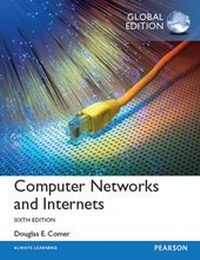
Computer Networks and Internets, Global Edition
Description

Appropriate for all introductory-to-intermediate courses in computer networking, the Internet, or Internet applications; students need no background in networking, operating systems, or advanced mathematics.
Leading networking authority Douglas Comer presents a wide-ranging, self-contained tour of the concepts, principles, and technologies that enable today's Internet to support applications ranging from web browsing to telephony and multimedia. Comer begins by illuminating the applications and facilities offered by today's Internet. Next, he systematically introduces the underlying network technologies and protocols that make them possible. With these concepts and technologies established, he introduces several of the most important contemporary issues faced by network implementers and managers, including quality of service, Internet telephony, multimedia, network security, and network management. Comer has carefully designed this book to support both top-down and bottom-up teaching approaches. Students need no background in operating systems, and no sophisticated math: Comer relies throughout on figures, drawings, examples, and analogies, not mathematical proofs.
The full text downloaded to your computer
With eBooks you can:
- search for key concepts, words and phrases
- make highlights and notes as you study
- share your notes with friends
eBooks are downloaded to your computer and accessible either offline through the Bookshelf (available as a free download), available online and also via the iPad and Android apps.
Upon purchase, you'll gain instant access to this eBook.
Time limit
The eBooks products do not have an expiry date. You will continue to access your digital ebook products whilst you have your Bookshelf installed.
All prices
More details
Other editions
Additional editions
Content
- Chapter 1 Introduction And Overview
- Chapter 2 Internet Trends
- Chapter 3 Internet Applications And Network Programming
- Chapter 4 Traditional Internet Applications
- Chapter 5 Overview Of Data Communications
- Chapter 6 Information Sources And Signals
- Chapter 7 Transmission Media
- Chapter 8 Reliability And Channel Coding
- Chapter 9 Transmission Modes
- Chapter 10 Modulation And Modems
- Chapter 11 Multiplexing And Demultiplexing (Channelization)
- Chapter 12 Access And Interconnection Technologies
- Chapter 13 Local Area Networks: Packets, Frames, And Topologies
- Chapter 14 The IEEE MAC Sublayer
- Chapter 15 Wired LAN Technology (Ethernet And 802.3)
- Chapter 16 Wireless Networking Technologies
- Chapter 17 Repeaters, Bridges, And Switches
- Chapter 18 WAN Technologies And Dynamic Routing
- Chapter 19 Networking Technologies Past And Present
- Chapter 20 Internetworking: Concepts, Architecture, And Protocols
- Chapter 21 IP: Internet Addressing
- Chapter 22 Datagram Forwarding
- Chapter 23 Support Protocols And Technologies
- Chapter 24 UDP: Datagram Transport Service
- Chapter 25 TCP: Reliable Transport Service
- Chapter 26 Internet Routing And Routing Protocols
- Chapter 27 Network Performance (QoS And DiffServ)
- Chapter 28 Multimedia And IP Telephony (VoIP)
- Chapter 29 Network Security
- Chapter 30 Network Management (SNMP)
- Chapter 31 Software Defined Networking (SDN)
- Chapter 32 The Internet Of Things
- Chapter 33 Trends In Networking Technologies And Uses
- Appendix 1 A Simplified Application Programming Interface
