

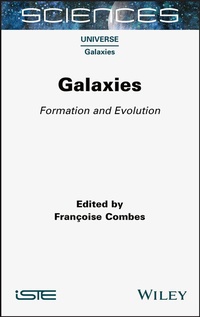
Galaxies
Formation and Evolution
1st Edition
Published on 5. March 2021
288 pages
978-1-119-81799-4 (ISBN)
Description

Galaxies are vast ensembles of stars, gas and dust, embedded in dark
matter halos. They are the basic building blocks of the Universe,
gathered in groups, clusters and super-clusters. They exist in many
forms, either as spheroids or disks. Classifications, such as the Hubble
sequence (based on mass concentration and gas fraction) and the colormagnitude diagram (which separates a blue cloud from a red sequence)
help to understand their formation and evolution. Galaxies spend a large
part of their lives in the blue cloud, forming stars as spiral or dwarf
galaxies. Then, via a mechanism that is still unclear, they stop forming
stars and quietly end in the red sequence, as spheroids. This
transformation may be due to galaxy interactions, or because of the
feedback of active nuclei, through the energy released by their central
super-massive black holes. These mechanisms could explain the history
of cosmic star formation, the rate of which was far greater in the first half
of the Universe s life.
Galaxies delves into all of these surrounding subjects in six chapters
written by dedicated, specialist astronomers and researchers in the field,
from their numerical simulations to their evolutions.
matter halos. They are the basic building blocks of the Universe,
gathered in groups, clusters and super-clusters. They exist in many
forms, either as spheroids or disks. Classifications, such as the Hubble
sequence (based on mass concentration and gas fraction) and the colormagnitude diagram (which separates a blue cloud from a red sequence)
help to understand their formation and evolution. Galaxies spend a large
part of their lives in the blue cloud, forming stars as spiral or dwarf
galaxies. Then, via a mechanism that is still unclear, they stop forming
stars and quietly end in the red sequence, as spheroids. This
transformation may be due to galaxy interactions, or because of the
feedback of active nuclei, through the energy released by their central
super-massive black holes. These mechanisms could explain the history
of cosmic star formation, the rate of which was far greater in the first half
of the Universe s life.
Galaxies delves into all of these surrounding subjects in six chapters
written by dedicated, specialist astronomers and researchers in the field,
from their numerical simulations to their evolutions.
More details
Other editions
Additional editions
Book
07/2021
1st Edition
ISTE Ltd
€164.50
Shipment within 3-4 weeks
Person
Francoise Combes is a Professor at College de France on the Chair of
Galaxies and Cosmology. She is a specialist of galaxy evolution through
bars and spiral waves, and has uncovered dynamical mechanisms to
fuel central black holes in active galaxy nuclei.
Galaxies and Cosmology. She is a specialist of galaxy evolution through
bars and spiral waves, and has uncovered dynamical mechanisms to
fuel central black holes in active galaxy nuclei.
Content
- Cover
- Half-Title Page
- Title Page
- Copyright Page
- Contents
- Introduction
- 1 The Classification of Galaxies
- 1.1. Introduction
- 1.2. Classes of galaxies
- 1.3. Elliptical galaxies
- 1.4. Spiral galaxies
- 1.5. SO galaxies
- 1.6. Magellanic spiral and irregular galaxies
- 1.7. Dwarf elliptical, SO, and spheroidal galaxies
- 1.8. Edge-on galaxies
- 1.9. Morphology of interacting and merging galaxies
- 1.10. General properties along the CVRHS sequence
- 1.10.1. Morphological systematics
- 1.10.2. Astrophysical systematics
- 1.11. Other approaches to galaxy classification
- 1.12. Interpretations of morphology
- 1.13. Artificial galaxies and the future of galaxy classification
- 1.14. References
- 2 Our Galaxy, the Milky Way
- 2.1. Introduction
- 2.2. Baryonic discs and their spiral structure
- 2.2.1. Neutral, ionized and molecular gas
- 2.2.2. Thin and thick stellar discs
- 2.2.3. Spiral structure from gaseous and stellar tracers
- 2.3. The central kiloparsecs: the bar and the bulge
- 2.4. The stellar halo
- 2.5. On the dark matter content and shape, as inferred from rotation curves and stellar streams
- 2.6. Dissecting the global structure: stellar kinematics, abundances and ages
- 2.6.1. Setting the scene: the solar vicinity
- 2.6.2. Zooming out on a several kpc scale
- 2.6.3. Digging into the bulge
- 2.7. Reconstructing the Milky Way evolution
- 2.8. Perspectives
- 2.9. References
- 3 Early-type Galaxies
- 3.1. Introduction
- 3.2. General properties: components and morphology
- 3.2.1. Discs and bars
- 3.2.2. Gas and dust content
- 3.2.3. Dark matter and halo
- 3.2.4. Globular clusters
- 3.2.5. Light and mass profiles
- 3.2.6. Extreme cases: brightest cluster galaxies and ultra-diffuse galaxies
- 3.3. Zoom on the stellar component
- 3.3.1. Scaling relations: Faber-Jackson, fundamental plane and virial plane
- 3.3.2. Age and metallicity
- 3.3.3. Initial mass function
- 3.4. Dynamics of ETGs
- 3.4.1. Observations
- 3.4.2. Toward a kinematic classification of ETGs
- 3.4.3. Modeling
- 3.4.4. Supermassive black holes
- 3.5. Formation and evolution processes
- 3.5.1. Perspective at z = 0: the mass-radius plane
- 3.5.2. Growth, mergers and transformations
- 3.5.3. Ex situ versus in situ
- 3.5.4. Environment
- 3.6. Conclusion
- 3.7. References
- 4 Spiral Galaxies
- 4.1. Introduction
- 4.2. Blue and red galaxies: quenching star formation
- 4.2.1. Definition of bimodality
- 4.2.2. The parameters that determine the red sequence
- 4.2.3. Mechanisms for quenching star formation
- 4.3. Spiral galaxies: density waves or not?
- 4.3.1. The winding problem
- 4.3.2. The theory of density waves
- 4.3.3. Role of gas and star formation
- 4.4. Bars: drivers of evolution
- 4.4.1. Formation of bars
- 4.4.2. Orbits in a barred galaxy
- 4.4.3. Response of gas to a barred potential
- 4.4.4. Vertical resonances and peanuts
- 4.4.5. Dark matter and bars
- 4.5. Environment of spiral galaxies
- 4.5.1. Morphological segregation
- 4.5.2. The problem of bulgeless galaxies
- 4.6. Conclusion
- 4.7. References
- 5 Galaxy Mergers and Interactions through Cosmic Time
- 5.1. Introduction
- 5.2. The physics of merging
- 5.3. The merger history of galaxies
- 5.3.1. Defining mergers and merging
- 5.3.2. Merger rates in the nearby universe
- 5.3.3. Galaxy merger fraction evolution to z = 6
- 5.3.4. Galaxy merger rates
- 5.4. The added value of mergers
- 5.4.1. Galaxy and black hole assembly through interactions and mergers
- 5.4.2. Cosmological relevance
- 5.4.3. Future uses and methods
- 5.5. Summary
- 5.6. Acknowledgments
- 5.7. References
- 6 Cosmic Evolution of Galaxies
- 6.1. Introduction
- 6.2. Characteristics of galaxies used to define their cosmic evolution
- 6.2.1. Decoding multi-wavelength radiation
- 6.2.2. Populations of galaxies
- 6.3. Starbursts, secular evolution and universality of star formation
- 6.3.1. Definition of a starburst
- 6.3.2. The SFMS and the secular evolution of galaxies
- 6.3.3. Origin of starbursts
- 6.3.4. Secular evolution and the influence of the galactic environment
- 6.4. Detection of distant galaxies
- 6.4.1. Deep surveys of the Universe
- 6.4.2. Large samples of distant galaxies
- 6.4.3. K correction
- 6.5. Cosmic history of galaxies
- 6.5.1. History of star formation
- 6.5.2. Evolution of the stellar mass function and formation of the red galaxy sequence
- 6.5.3. Evolution of the metallicity and of the average size of galaxies
- 6.5.4. Evolution of the galaxy merger and starburst rates
- 6.6. Origin of the cosmic history of galaxies
- 6.6.1. The diffuse cosmic background as a signature of the cosmic history of galaxies
- 6.6.2. Unraveling the origin of the cosmic history of galaxies by studying their reservoirs of interstellar matter
- 6.7. Conclusion
- 6.8. References
- List of Authors
- Author Biographies
- Index
- EULA
