

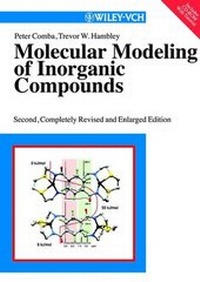
Molecular Modeling of Inorganic Compounds
2nd Edition
Published on 11. July 2008
XIII, 324 pages
978-3-527-61299-4 (ISBN)
Description

In many branches of chemistry, Molecular Modeling is a well-established and powerful tool for the investigation of complex structures. The second completely revised and enlarged edition of this highly recognized book shows how this method can be successfully applied to inorganic and coordination compounds.
The first part of the book gives a general introduction to Molecular Modeling, which will be of use for chemists in all areas. The second part discusses numerous carefully selected examples, chosen to illustrate the wide range of applicability of molecular modeling to metal complexes and the approaches being taken to dealing with some of the difficulties involved. While the general outline is similar to that of the first edition, many of the examples chosen for discussion reflect the changes of the past five years. In the third part, the reader learns how to apply Molecular Modeling to a new system and how to interpret the results. The accompanying software features 20 tutorial lessons based on examples from the literature and the book itself. The authors take special care to highlight possible pitfalls and offer advice on how to avoid them. Therefore, this book will be invaluable to everyone working in or entering the field.
The first part of the book gives a general introduction to Molecular Modeling, which will be of use for chemists in all areas. The second part discusses numerous carefully selected examples, chosen to illustrate the wide range of applicability of molecular modeling to metal complexes and the approaches being taken to dealing with some of the difficulties involved. While the general outline is similar to that of the first edition, many of the examples chosen for discussion reflect the changes of the past five years. In the third part, the reader learns how to apply Molecular Modeling to a new system and how to interpret the results. The accompanying software features 20 tutorial lessons based on examples from the literature and the book itself. The authors take special care to highlight possible pitfalls and offer advice on how to avoid them. Therefore, this book will be invaluable to everyone working in or entering the field.
Reviews / Votes
'For those who want to develop and use force fields, the book provides a good grounding.'Chemistry in Britain
'... it is an excellent book, which gives a clear introduction to molecular mechanics in general and applications to coordination compounds in particular.'
Recueil des Traveaux Chimiques des Pays-Bas
"...a book for several audiences...discusses the recent developments that permit the modeling of larger inorganic compounds." The Chemist
More details
Other editions
New editions
Peter Comba | Trevor W. Hambley | Bodo Martin
Molecular Modeling of Inorganic Compounds
E-Book
07/2009
3rd Edition
Wiley-VCH
€183.99
Available for download
Additional editions

Peter Comba | Trevor W. Hambley
Molecular Modeling of Inorganic Compounds
Book
01/2001
2nd Edition
Wiley-VCH
€149.00
Article exhausted; check for reprint
Persons
Content
Preface
Preface to the 2nd Edition
Contents
PART I: THEORY
Introduction
Methods of Molecular Modeling in Brief
Parameterization, Approximations and Limitations
Computation
The Multiple Minima Problem
Conclusions
PART II: APPLICATIONS
Structural Aspects
Stereoselectivities
Metal Ion Selectivity
Spectroscopy
Electron Transfer
Electronic Effects
Bioinorganic Chemistry
Organometallics
Compounds with s,p and f Elements
PART III: PRACTICE OF MOLECULAR MECHANICS
The Model, the Rules and the Pitfalls
Tutorial
Preface to the 2nd Edition
Contents
PART I: THEORY
Introduction
Methods of Molecular Modeling in Brief
Parameterization, Approximations and Limitations
Computation
The Multiple Minima Problem
Conclusions
PART II: APPLICATIONS
Structural Aspects
Stereoselectivities
Metal Ion Selectivity
Spectroscopy
Electron Transfer
Electronic Effects
Bioinorganic Chemistry
Organometallics
Compounds with s,p and f Elements
PART III: PRACTICE OF MOLECULAR MECHANICS
The Model, the Rules and the Pitfalls
Tutorial
