

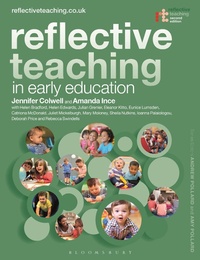
Reflective Teaching in Early Education
1st Edition
Published on 14. January 2021
504 pages
978-1-350-12761-6 (ISBN)
Description

The book you can trust to guide you through your career in the early years, as the expert authors share tried and tested techniques in a range of early years settings. For this new edition, Jennifer Colwell and Amanda Ince have drawn together an expert author team to bring you guidance from top practitioners that is both cohesive and that continues to evolve to meet the needs of today's early years practitioners. It is designed for trainees whether in universities or early years settings and looks across the full early years spectrum, from birth to 8 years old.
Reflective Teaching in Early Education uniquely provides two levels of support:
- Practical, evidence-based guidance on key early years issues - including relationships, behaviour, inclusion, curriculum planning and learning, and teaching strategies
- Evidence-informed 'principles' and 'concepts' to help you to understand the theories informing practice, offering ways for you to continue to develop your skills and understanding of early years practice in early childhood education and care
New to this edition:
- Case Studies which illustrate the impact Reflective Teaching can have on your practice and your setting
- New Reflective Activities
- Updated references and guidance on Key Readings
- Updates to reflect recent changes in curriculum and assessment across the UK
reflectiveteaching.co.uk provides a treasure trove of additional support.
Readings for Reflective Teaching in Early Education, the supporting 'portable library' volume, is signposted throughout this book and provides convenient access to key texts.
Reflective Teaching in Early Education uniquely provides two levels of support:
- Practical, evidence-based guidance on key early years issues - including relationships, behaviour, inclusion, curriculum planning and learning, and teaching strategies
- Evidence-informed 'principles' and 'concepts' to help you to understand the theories informing practice, offering ways for you to continue to develop your skills and understanding of early years practice in early childhood education and care
New to this edition:
- Case Studies which illustrate the impact Reflective Teaching can have on your practice and your setting
- New Reflective Activities
- Updated references and guidance on Key Readings
- Updates to reflect recent changes in curriculum and assessment across the UK
reflectiveteaching.co.uk provides a treasure trove of additional support.
Readings for Reflective Teaching in Early Education, the supporting 'portable library' volume, is signposted throughout this book and provides convenient access to key texts.
More details
Series
Edition
1. Auflage
Language
English
Place of publication
London
United Kingdom
Publishing group
Bloomsbury Publishing PLC
Target group
Professional and scholarly
Illustrations
45 bw illus
ISBN-13
978-1-350-12761-6 (9781350127616)
Copyright in bibliographic data and cover images is held by Nielsen Book Services Limited or by the publishers or by their respective licensors: all rights reserved.
Schweitzer Classification
Other editions
Additional editions
Jennifer Colwell | Amanda Ince | Helen Bradford
Reflective Teaching in Early Education
Book
01/2021
2nd Edition
Bloomsbury Academic
€55.89
Shipment within 15-20 days
Persons
Jennifer Colwell is an Educational Consultant and Research Fellow in the Education Research Centre at the University of Brighton, UK.
Amanda Ince is a Principal Teaching Fellow at IOE, UCL's Faculty of Education and Society, University College London, UK.
Helen Bradford (Independent Educational Consultant, UK) | Eleanor Kitto (IOE, UCL's Faculty of Education and Society, University College London, UK | Julian Grenier (Headteacher, Sheringham Nursery School and Children's Centre, UK) | Eunice Lumsden (University of Northampton, UK) | Catriona McDonald and Sheila Nutkins (University of Aberdeen, UK) | Mary Moloney (Mary Immaculate College, Ireland) | Ioanna Palaiologou (Canterbury Educational Services, UK) | Helen Edwards and Juliet Mickelburgh (Foundation Stage Forum, UK) | Rebecca Swindells (Independent Early Years Consultant, UK) | Deborah Price (Independent Early Years Consultant, UK)
Amanda Ince is a Principal Teaching Fellow at IOE, UCL's Faculty of Education and Society, University College London, UK.
Helen Bradford (Independent Educational Consultant, UK) | Eleanor Kitto (IOE, UCL's Faculty of Education and Society, University College London, UK | Julian Grenier (Headteacher, Sheringham Nursery School and Children's Centre, UK) | Eunice Lumsden (University of Northampton, UK) | Catriona McDonald and Sheila Nutkins (University of Aberdeen, UK) | Mary Moloney (Mary Immaculate College, Ireland) | Ioanna Palaiologou (Canterbury Educational Services, UK) | Helen Edwards and Juliet Mickelburgh (Foundation Stage Forum, UK) | Rebecca Swindells (Independent Early Years Consultant, UK) | Deborah Price (Independent Early Years Consultant, UK)
Content
Introduction
Using this book
A summary of the book
Part I: Becoming a reflective professional
1. Identity: Who are we and what do we stand for?
2. Learning: How can we understand learner development?
3. Reflection: How can we develop the quality of our practice?
4. Principles: What are the foundations of effective teaching and learning?
Part II: Creating conditions for learning
5. Contexts: What is, and what might be?
6. Relationships: How are we getting on together?
7. Engagement: How are we managing behaviour?
8. Spaces: How are we creating environments for learning?
Part III: Teaching for learning
9. Curriculum: What is taught in the early years?
10. Planning: How are we implementing the curriculum?
11. Pedagogy: How can we develop effective strategies?
12. Communication: How does language support learning?
13. Assessment: How can assessment enhance learning?
Part IV: Reflecting on consequences
14. Outcomes: How do we capture learning achievements?
15. Inclusion: How are we enabling learning opportunities?
Part V: Deepening understanding
16. Expertise: Conceptual tools for career-long fascination?
17. Professionalism: How does reflective teaching contribute to society?
Acknowledgements
Bibliography
Index
Using this book
A summary of the book
Part I: Becoming a reflective professional
1. Identity: Who are we and what do we stand for?
2. Learning: How can we understand learner development?
3. Reflection: How can we develop the quality of our practice?
4. Principles: What are the foundations of effective teaching and learning?
Part II: Creating conditions for learning
5. Contexts: What is, and what might be?
6. Relationships: How are we getting on together?
7. Engagement: How are we managing behaviour?
8. Spaces: How are we creating environments for learning?
Part III: Teaching for learning
9. Curriculum: What is taught in the early years?
10. Planning: How are we implementing the curriculum?
11. Pedagogy: How can we develop effective strategies?
12. Communication: How does language support learning?
13. Assessment: How can assessment enhance learning?
Part IV: Reflecting on consequences
14. Outcomes: How do we capture learning achievements?
15. Inclusion: How are we enabling learning opportunities?
Part V: Deepening understanding
16. Expertise: Conceptual tools for career-long fascination?
17. Professionalism: How does reflective teaching contribute to society?
Acknowledgements
Bibliography
Index
