

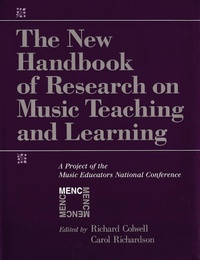
The New Handbook of Research on Music Teaching and Learning
A Project of the Music Educators National Conference
Published on 18. April 2002
1249 pages
978-0-19-977152-3 (ISBN)
Description

Featuring chapters by the world's foremost scholars in music education and cognition, this handbook is a convenient collection of current research on music teaching and learning. This comprehensive work includes sections on arts advocacy, music and medicine, teacher education, and studio instruction, among other subjects, making it an essential reference for music education programs. The original Handbook of Research on Music Teaching and Learning, published in 1992 with the sponsorship of the Music Educators National Conference (MENC), was hailed as "a welcome addition to the literature on music education because it serves to provide definition and unity to a broad and complex field" (Choice). This new companion volume, again with the sponsorship of MENC, explores the significant changes in music and arts education that have taken place in the last decade. Notably, several chapters now incorporate insights from other fields to shed light on multi-cultural music education, gender issues in music education, and non-musical outcomes of music education. Other chapters offer practical information on maintaining musicians' health, training music teachers, and evaluating music education programs. Philosophical issues, such as musical cognition, the philosophy of research theory, curriculum, and educating musically, are also explored in relationship to policy issues. In addition to surveying the literature, each chapter considers the significance of the research and provides suggestions for future study.
Covering a broad range of topics and addressing the issues of music education at all age levels, from early childhood to motivation and self-regulation, this handbook is an invaluable resource for music teachers, researchers, and scholars.
More details
Other editions
Additional editions
Richard Colwell | Carol Richardson
The New Handbook of Research on Music Teaching and Learning
A Project of the Music Educators National Conference
Book
05/2002
Oxford University Press Inc
€377.58
Shipment within 15-20 days
Persons
Richard Colwell is Professor Emeritus of Music Education at the University of Illinois and Adjunct Professor of Music Education at the University of Michigan. He is the founding editor of the Bulletin of the Council for Research in Music Education and the Quarterly Journal of Music Teaching and Learning. He is also a Guggenheim scholar.
Carol Richardson is Associate Professor and Chair of Music Education at the School of Music, University of Michigan. She currently chairs t e Music Education SIG of the American Educational Research Association. She received a National Acade
Content
- Cover
- Contents
- Contributors
- Reviewers
- Part I: Policy and Philosophy
- Introduction
- 1 Policy Frameworks, Research, and K-12 Schooling
- 2 MENC: A Case in Point
- 3 Recent Trends and Issues in Policy Making
- 4 Law Research and Music Education
- 5 Philosophical Issues in Curriculum
- 6 Educating Musically
- 7 Philosophical Perspectives on Research
- Part II: Educational Context and the Curriculum
- Introduction: Toward an Understanding of the "Aims" of Music Education
- 8 Contemporary Curriculum Practices and Their Theoretical Bases
- 9 Theory, Research, and the Improvement of Music Education
- 10 Critical Thinking
- 11 Improvisation
- 12 Improvisation and Curriculum Reform
- 13 Adult Education
- 14 Music and Early Childhood Education
- 15 Systematic Research in Studio Instruction in Music
- 16 Distance Learning and Collaboration in Music Education
- Part III: Musical Development and Learning
- Introduction: Looking Multiple Ways in Research
- 17 Learning Theories as Roots of Current Musical Practice and Research
- 18 Systematic Instruction
- 19 Behavioral Research on Direct Music Instruction
- 20 Self-Regulation of Musical Learning: A Social Cognitive Perspective
- 21 Motivation and Achievement
- 22 Developmental Characteristics of Music Learners
- 23 Creativity Research in Music, Visual Art, Theater, and Dance
- 24 Computer-Based Technology and Music Teaching and Learning
- Part IV: Musical Cognition and Development
- Introduction: Music Perception and Cognition
- 25 The Neurobiology of Music Cognition and Learning
- 26 Cognitive Constraints on Music Listening
- 27 The Development of Musical Abilities
- 28 A Comparative Review of Human Ability Theory: Context, Structure, and Development
- 29 Making Music and Making Sense Through Music: Expressive Performance and Communication
- 30 Taking an Acquired Skills Perspective on Music Performance
- Part V: Social and Cultural Contexts
- Introduction: Social and Cultural Contexts of Music Teaching and Learning
- 31 The Sociology of Education and Connections to Music Education Research
- 32 Perspectives from the Sociology of Music
- 33 Social Psychology and Music Education
- 34 Music, Culture, Curriculum, and Instruction
- 35 Feminism, Feminist Research, and Gender Research in Music Education: A Selective Review
- 36 The Social Construction of Music Teacher Identity in Undergraduate Music Education Majors
- 37 Transforming Research in Music Education History
- 38 Music Transmission and Learning: A Conspectus of Ethnographic Research in Ethnomusicology and Music Education
- 39 Community Music: Toward an International Overview
- Part VI: Music Teacher Education
- Introduction: Fuzzy Teacher Education
- 40 Reform-Minded Music Teachers: A More Comprehensive Image of Teaching for Music Teacher Education
- 41 Teaching as a Profession: Two Variations on a Theme
- 42 Changing Concepts of Teacher Education
- 43 Strengthening the Teaching of Music Educators in Higher Education
- 44 Research by Teachers on Teacher Education
- 45 Research in Music Student Teaching
- 46 Professional Development
- Part VII: Music Education Connections
- Introduction: The Growing Impact of Partnerships: A Reason for Research
- 47 Policy Issues in Connecting Music Education with Arts Education
- 48 The Evaluation of Arts Partnerships and Learning in and Through the Arts
- 49 The "Use and Abuse" of Arts Advocacy and Its Consequences for Music Education
- 50 Research in Visual Art Education: Implications for Music
- 51 A Review of Research in Theater, Dance, and Other Performing Arts Education: Implications for Music
- Part VIII: Neuroscience, Medicine, and Music
- Introduction
- 52 Music and Neuroscience
- 53 Performing Arts Medicine
- 54 Musicians' Health
- Part IX: Outcomes in General Education
- Introduction
- 55 Nonmusical Outcomes of Music Education: Historical Considerations
- 56 Teaching Other Subjects Through Music
- 57 Research: A Foundation for Arts Education Advocacy
- Part X: Research Design, Criticism, and Assessment Music Education
- Introduction Scholarly Inquiry and the Research Process
- 58 Maintaining Quality in Research and Reporting
- 59 Trends in Data Acquisition and Knowledge Development
- 60 Assessment's Potential in Music Education
- 61 Contemporary Issues in Qualitative Research and Music Education
- Index
- A
- B
- C
- D
- E
- F
- G
- H
- I
- J
- K
- L
- M
- N
- O
- P
- Q
- R
- S
- T
- U
- V
- W
- Y
- Z
