

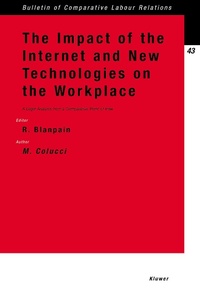
The Impact of the Internet and New Technologies on the Workplace
A Legal Analysis from a Comparative Point of View
Published on 1. July 2002
202 pages
978-90-411-7511-3 (ISBN)
Description

The regulatory architecture available for cyberspace law still seems incapable of conceiving, much less resolving, the new issues of privacy raised by the use of the Internet in the workplace. This penetrating analysis of the thorny problems in this area of the law goes a long way towards clarifying the nature of the conflicts and disputes that arise and that are likely to continue to arise. It is also the first detailed comparative treatment of the subject, analysing the relevant law both at the international level and in six major national jurisdictions.
The author first examines the international jurisdictional problems related to the Internet and new technologies. Starting from an economic analysis of the law of cyberspace, the author demonstrates that the problem of conflicting legal rules may be solved by adopting new laws, regulations and guidelines governing the Internet.
The second part explores the ways in which the Internet and the introduction of new information technologies has dramatically affected the world of work and individual rights. The author analyses the origins, limits and boundaries of these rights, and makes a comparative analysis of the relevant constitutions and statutes in both common law and civil law.
Finally, an examination of the legal systems of the USA, the UK, France, Germany, Italy, and Japan, and of their responses to the new Internet-related issues, enable the author to propose effective ways to achieve a better balance between the employee's right to privacy and the responsibilities of the employer in the new electronic environment.
More than an academic analysis, The Impact of the Internet and New Technologies on the Workplace will provide invaluable guidance to practitioners and policymakers in this burgeoning area of the law. The author's deep understanding of the issues gives his book an immediate relevance that will last for years to come.
The author first examines the international jurisdictional problems related to the Internet and new technologies. Starting from an economic analysis of the law of cyberspace, the author demonstrates that the problem of conflicting legal rules may be solved by adopting new laws, regulations and guidelines governing the Internet.
The second part explores the ways in which the Internet and the introduction of new information technologies has dramatically affected the world of work and individual rights. The author analyses the origins, limits and boundaries of these rights, and makes a comparative analysis of the relevant constitutions and statutes in both common law and civil law.
Finally, an examination of the legal systems of the USA, the UK, France, Germany, Italy, and Japan, and of their responses to the new Internet-related issues, enable the author to propose effective ways to achieve a better balance between the employee's right to privacy and the responsibilities of the employer in the new electronic environment.
More than an academic analysis, The Impact of the Internet and New Technologies on the Workplace will provide invaluable guidance to practitioners and policymakers in this burgeoning area of the law. The author's deep understanding of the issues gives his book an immediate relevance that will last for years to come.
More details
Other editions
Additional editions
Michele Colucci
The Impact of the Internet and New Technologies
A Legal Analysis from a Comparative Point of View
Book
07/2002
1st Edition
Kluwer Law International
€83.46
Shipment within 10-20 days
Content
- Cover
- Half Title Page
- Title Page
- Copyright Page
- Table of Contents
- Note on the Author
- Acknowledgements
- Introduction
- PART I An Economic Analysis of Cyberspace Law
- 1. An Economic Analysis of Cyberspace Law
- 1. INTRODUCTION
- 2. REDUCTION OF TRANSACTION COSTS
- 3. PLURALITY OF RULES WITHIN DIFFERENT DOMAINS
- 4. CUSTOMISATION OF RULES
- 5. INTERNET GOVERNANCE
- 6. TO REGULATE OR NOT TO REGULATE?
- 7. CAREFUL AND WELL-TIMED GOVERNANCE
- 8. JURISDICTION AND CHOICE OF LAW PROBLEMS ON THE INTERNET
- 9. HARMONISATION OF LEGAL RULES
- 10. LEGAL ENFORCEMENT AND SELF-ENFORCEMENT IN CYBERSPACE
- 2. The Impact of the Internet on the Workplace
- 1. A "PRINCIPLE-AGENT" ANALYSIS
- 2. THE EMPLOYER'S PERSPECTIVE
- 3. THE EMPLOYEE'S PERSPECTIVE
- 4. ELECTRONIC PRIVACY IN THEWORKPLACE
- 5. EMPLOYEE'S ARGUMENTS FOR PRIVACY
- 6. EMPLOYER'S ARGUMENTS AGAINST PRIVACY
- 7. GUIDING PRINCIPLES
- 8. E-POLICIES
- PART II Electronic Monitoring and Surveillance in the Workplace
- Introduction
- 3. The ILO and the Code of Practice on Protection of Workers' Personal Data
- 1. DEFINITIONS
- 2. INFORMED AND EXPLICIT CONSENT
- 3. SCOPE OF APPLICATION
- 4. THE FINALITY PRINCIPLE
- 5. COLLECTION OF PERSONAL DATA
- 6. SECURITY AND STORAGE OF PERSONAL DATA
- 4. The Organisation for Economic Cooperation and Development
- 1. OBJECTIVES
- 2. AREA OF APPLICATION
- 3. BASIC PRINCIPLES
- 4. PRINCIPLES OF INTERNATIONAL APPLICATION
- 5. CONFLICTS OF LAWS
- 5. The Council of Europe
- 1. INTRODUCTION
- 2. THE EUROPEAN CONVENTION ON HUMAN RIGHTS AND FUNDAMENTAL FREEDOMS
- 3. CONVENTION FOR THE PROTECTION OF INDIVIDUALSWITH REGARD TO THE AUTOMATIC PROCESSING OF DATA
- 4. RECOMMENDATION NO. R(89) 2 ON THE PROTECTION OF PERSONAL DATA USED FOR EMPLOYMENT PURPOSES
- 5. RECOMMENDATION NO. (99) 5 FOR THE PROTECTION OF PRIVACY ON THE INTERNET
- 6. The European Union: The Data Protection Directive
- 1. THE DATA PROTECTION DIRECTIVE
- 2. DIRECTIVE 97/66/EC ON THE TELECOMMUNICATION SECTOR
- 3. PROPOSED REVISIONS TO EXISTING DIRECTIVES
- PART III The National Scenario
- 7. France
- 1. THE COMPUTER SCIENCE AND FREEDOM ACT
- 2. THE FRENCH CIVIL CODE
- 3. THE FRENCH LABOUR CODE
- 4. RULES OF EMPLOYMENT AND INDIVIDUAL RIGHTS
- 5. ADVANCE NOTICE AND CONSULTATION
- 6. THE FRENCH PENAL CODE
- 7. THE SECRECY OF CORRESPONDENCE WITH REGARD TO E-MAILS IN THEWORKPLACE
- 8. E-MAIL AND THE BURDEN OF PROOF
- 9. THE CNIL
- 10. ON-LINE PRACTICES AND INTERNAL RULES OF GOOD CONDUCT
- 8. Germany
- 1. PRIVACY AS A "PERSONALITY RIGHT"
- 2. THE GERMAN CONSTITUTION
- 3. ACT ON WORKERS' REPRESENTATION IN THE PUBLIC SECTOR
- 4. THEWORKS CONSTITUTION ACT AND "CO-DETERMINATION RIGHTS"
- 5. THE GERMAN DATA PROTECTION ACT
- 6. PERMITTED AND PROHIBITED USE OF THE INTERNET
- 7. A PARALLEL BETWEEN E-MAILS AND PRIVATE PHONE CALLS
- 8. FINAL CONSIDERATIONS
- 9. United Kingdom
- 1. THE HUMAN RIGHTS ACT
- 2. THE REGULATION OF INVESTIGATORY POWERS ACT 2000
- 3. THE TELECOMMUNICATIONS REGULATIONS 2000
- 4. THE DATA PROTECTION ACT 1998
- 5. THE RIGHTS AND REMEDIES OF A DATA SUBJECT
- 6. FINAL CONSIDERATIONS
- 10. Italy
- 1. THE ITALIAN LEGAL FRAMEWORK
- 2. THEWORKERS' STATUTE
- 3. THE ITALIAN DATA PROTECTION ACT NO. 675/96
- 4. THE AUTHORISATIONS FOR PROCESSING OF SENSITIVE DATA FOR EMPLOYMENT PURPOSES
- 5. SURVEILLANCE AND MONITORING IN THE ELECTRONIC ENVIRONMENT
- 6. USE OF ELECTRONIC MAIL FOR PERSONAL REASONS
- 7. CONTROL OF EMPLOYEES' ACTIVITY AND MESSAGES
- 8. CONFINDUSTRIA'S GUIDELINES
- 9. CONCLUSION: MONITORING WITH A HUMAN DIMENSION
- 11. Japan
- 1. THE CONSTITUTION
- 2. THE CIVIL CODE
- 3. THE LABOUR LAW
- 4. WORKERS' PRIVACY PROTECTION
- 5. THE EMPLOYEE'S RIGHT TO USE E-MAIL AND THE INTERNET
- 6. PRIVATE EMPLOYMENT SERVICES AND PRIVACY PROTECTION FOR JOB SEEKERS
- 7. TRADE UNIONS AND "CYBER" TRADE UNIONS
- 8. CONCLUSION
- 12. U.S.A.
- 1. FACTS AND FIGURES
- 2. EMPLOYEE MISUSE OF E-MAIL AND THE INTERNET
- 3. E-MAIL MONITORING IN THEWORKPLACE: THE LEGAL FRAMEWORK
- 4. THE FEDERAL CONSTITUTION
- 5. FEDERAL LEGISLATION
- 6. THE COMMUNICATIONS DECENCY ACT
- 7. THE CHILD ON-LINE PROTECTION ACT
- 8. ANTI-SPAMSTATUTES
- 9. THE CYBERSPACE ELECTRONIC SECURITY ACT OF 1999
- 10. THE NATIONAL LABOUR RELATIONS ACT
- 11. PROPOSED FEDERAL LEGISLATION
- 12. POSITIVE STATE LAW
- 13. THE COMMON LAW OF TORT
- 14. REGULATION BY CONTRACT
- 15. REGULATION BY COLLECTIVE AGREEMENT
- 16. COMMON LAWON INVASION OF PRIVACY ISSUES
- 17. THE U.S. SAFE HARBOR AGREEMENTWITH THE E.U.
- 18. CONCLUSION
- Epilogue
- Selected Bibliography
- Selected Legislation
- Selected Websites
- Back Cover
