

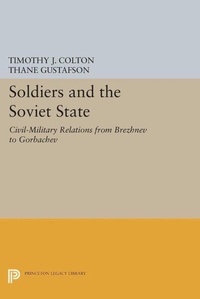
Soldiers and the Soviet State
Civil-Military Relations from Brezhnev to Gorbachev
1st Edition
Published on 14. July 2014
386 pages
978-1-4008-6142-2 (ISBN)
Description

How much power does the Soviet military exert on the politics of the Kremlin? This is one of the most controversial questions in the study of the Soviet Union, here addressed by eight top Western specialists on Soviet politics and security policy. While the authors assert that the civil-military relationship has been less turbulent than often believed, they also point out that Gorbachev's reforms threaten the system of buffers that have until now shielded the military-industrial world from disruption and change.
Introduced by Timothy Colton's essay, "Perspectives on Civil-Military Relations," the volume discusses civil-military relations in relation to political change (Bruce Parrott), the KGB (Amy Knight), resource stringency and civil-military resource allocation (Robert Campbell), the defense industry (Julian Cooper), response to technological challenge (Thane Gustafson), social change (Ellen Jones), and consequences of external expansion (Bruce D. Porter). Gustafson has written a concluding chapter, "Toward a Crisis in Civil-Military Relations?"
Originally published in 1990.
The Princeton Legacy Library uses the latest print-on-demand technology to again make available previously out-of-print books from the distinguished backlist of Princeton University Press. These editions preserve the original texts of these important books while presenting them in durable paperback and hardcover editions. The goal of the Princeton Legacy Library is to vastly increase access to the rich scholarly heritage found in the thousands of books published by Princeton University Press since its founding in 1905.
Introduced by Timothy Colton's essay, "Perspectives on Civil-Military Relations," the volume discusses civil-military relations in relation to political change (Bruce Parrott), the KGB (Amy Knight), resource stringency and civil-military resource allocation (Robert Campbell), the defense industry (Julian Cooper), response to technological challenge (Thane Gustafson), social change (Ellen Jones), and consequences of external expansion (Bruce D. Porter). Gustafson has written a concluding chapter, "Toward a Crisis in Civil-Military Relations?"
Originally published in 1990.
The Princeton Legacy Library uses the latest print-on-demand technology to again make available previously out-of-print books from the distinguished backlist of Princeton University Press. These editions preserve the original texts of these important books while presenting them in durable paperback and hardcover editions. The goal of the Princeton Legacy Library is to vastly increase access to the rich scholarly heritage found in the thousands of books published by Princeton University Press since its founding in 1905.
More details
Other editions
Additional editions
Timothy J. Colton | Thane Gustafson
Soldiers and the Soviet State
Civil-Military Relations from Brezhnev to Gorbachev
Book
04/2016
Princeton University Press
€128.60
Shipment within 10-20 days
Timothy J. Colton | Thane Gustafson
Soldiers and the Soviet State
Civil-Military Relations from Brezhnev to Gorbachev
Book
07/2014
Princeton University Press
€49.00
Shipment within 10-20 days

Timothy J. Colton | Thane Gustafson
Soldiers and the Soviet State
Civil-Military Relations from Brezhnev to Gorbachev
Book
09/1990
Princeton University Press
€15.48
Article exhausted; check different version
Timothy J. Colton | Thane Gustafson
Soldiers and the Soviet State
Civil-Military Relations from Brezhnev to Gorbachev
Book
08/1990
Princeton University Press
€68.09
Article exhausted; check different version
Persons
Edited by Timothy J. Colton & Thane Gustafson
Content
FrontMatter, pg. i
Contents, pg. vii
Tables and Figures, pg. ix
Acknowledgments, pg. xi
One. Perspectives on Civil-Military Relations in the Soviet Union, pg. 3
Two. Political Change and Civil-Military Relations, pg. 44
Three. The KGB and Civil-Military Relations, pg. 93
Four. Resource Stringency and Civil-Military Resource Allocation, pg. 126
Five. The Defense Industry and Civil-Military Relations, pg. 164
Six. The Response to Technological Challenge, pg. 192
Seven. Social Change and Civil-Military Relations, pg. 239
Eight. The Military Abroad: Internal Consequences of External Expansion, pg. 285
Nine. Conclusions: Toward a Crisis in Civil-Military Relations?, pg. 334
Index, pg. 365
Contents, pg. vii
Tables and Figures, pg. ix
Acknowledgments, pg. xi
One. Perspectives on Civil-Military Relations in the Soviet Union, pg. 3
Two. Political Change and Civil-Military Relations, pg. 44
Three. The KGB and Civil-Military Relations, pg. 93
Four. Resource Stringency and Civil-Military Resource Allocation, pg. 126
Five. The Defense Industry and Civil-Military Relations, pg. 164
Six. The Response to Technological Challenge, pg. 192
Seven. Social Change and Civil-Military Relations, pg. 239
Eight. The Military Abroad: Internal Consequences of External Expansion, pg. 285
Nine. Conclusions: Toward a Crisis in Civil-Military Relations?, pg. 334
Index, pg. 365
