

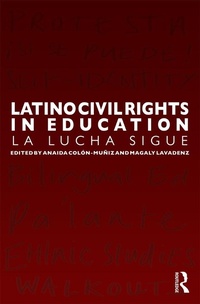
Latino Civil Rights in Education
La Lucha Sigue
Published on 5. October 2015
250 pages
978-1-317-37342-1 (ISBN)
Description

Latino Civil Rights in Education: La Lucha Sigue documents the experiences of historical and contemporary advocates in the movement for civil rights in education of Latinos in the United States. These critical narratives and counternarratives discuss identity, inequality, desegregation, policy, public school, bilingual education, higher education, family engagement, and more, comprising an ongoing effort to improve the conditions of schooling for Latino children. Featuring the perspectives and research of Latino educators, sociologists, historians, attorneys, and academics whose lives were guided by this movement, the book holds broad applications in the study and continuation of social justice and activism today.
Reviews / Votes
"This groundbreaking book gathers the stories of the struggle for social justice through the voices of Latina/o leaders in education. Offering poignant, moving testimonios and well-researched scholarly essays, this collection covers the significant court cases that ultimately ended the racist educational policies under Jim Crow."-Norma E. Cantu, Professor of Latina/Latino Studies and English at the University of Missouri-Kansas City
"Latino Civil Rights in Education is a unique and rich compendium of compelling, wonderfully told reflections on activism, agency, and transformative resistance around improving schooling in the US for Chicanos/Mexicanos, Boricuas, and other Latinos. This book is a must-read for educators and scholars in Chicano or Boricua studies and anyone interested in social activism and organizing, qualitative inquiry, and/or indigenous methodologies."
-Reynaldo F. Macias, Professor of Chicana/o Studies, Education and Applied Linguistics at the University of California, Los Angeles
More details
Series
Language
English
Place of publication
London
United Kingdom
Publishing group
Taylor & Francis Ltd
Target group
College/higher education
Illustrations
1 s/w Abbildung, 6 s/w Tabellen
6 Tables, black and white; 1 Illustrations, black and white
File size
1,07 MB
ISBN-13
978-1-317-37342-1 (9781317373421)
Copyright in bibliographic data and cover images is held by Nielsen Book Services Limited or by the publishers or by their respective licensors: all rights reserved.
Schweitzer Classification
Other editions
Additional editions
Book
10/2015
1st Edition
Routledge
€206.40
Shipment within 10-20 days
Book
10/2015
1st Edition
Routledge
€74.50
Shipment within 10-20 days
Persons
Anaida Colon-Muniz is Associate Professor in the College of Educational Studies at Chapman University, USA. She teaches in the Multiple Subject, Master of Arts and Doctoral programs and is the Director of Community Education for the college's community-based bookstore.
Magaly Lavadenz is Professor in the Department of Educational Leadership and Founding Director of the Center for Equity for English Learners at Loyola Marymount University, USA.
Magaly Lavadenz is Professor in the Department of Educational Leadership and Founding Director of the Center for Equity for English Learners at Loyola Marymount University, USA.
Content
Foreword - Latina(o) Civil Rights Movement: A Deferred Revolution
Donaldo Macedo
Introduction
Chapter 1. Latino Educational Civil Rights: A Critical Sociohistorical Narrative Analysis
Anaida Colon-Muniz and Magaly Lavadenz
Chapter 2. Recognizing Inequality and the Pursuit of Equity: A Legal and Social Equity Framework
Alberto M. Ochoa
Chapter 3. The Lemon Grove Desegregation Case: a Matter of Neglected History
Mike Madrid
Chapter 4. The Meaning of Mendez
Sandra Robbie
Chapter 5. My Recollection of a Failed Attempt to Return the Schools to the Public
Luis Fuentes (narrated by Anaida Colon-Muniz)
Chapter 6. The BC 44, Ethnic Studies, and Transformative Education
Sonia Nieto
Chapter 7. Memoirs of El Centro: The Impact of the Civil Rights Movement in Higher Education
Pedro Pedraza
Chapter 8. The 1968 Los Angeles Chicano Walkout
Herman Sillas
Chapter 9. La Lucha Sigue: An Interview with Dolores Huerta
Magaly Lavadenz and Anaida Colon Muniz
Chapter 10. I am a Chicana, I am Union, I am an Activist: The Struggle for Cultural, Educational and Linguistic Justice
Theresa Montano
Chapter 11. Operation Chicano/a Teacher Program: A School-Based Equity Chicano Teacher Recruitment and Retention Program
Marta E. Sanchez
Chapter 12. I Don't Speak My Mother's Tongue
Evangelina "Gigi" Brignoni
Chapter 13. Becoming Myself in the World
Anaida Colon-Muniz
Chapter 14. Proposition 227 and the Loss of Educational Rights-a personal perspective and quest for equitable educational programs for English Learners
Maria S. Quezada
Chapter 15. Latinos and Social Capitalization-Taking Back Our Schools
Magaly Lavadenz
Chapter 16. Latino Parent Engagement: Struggle, Hope, and Resistance
Pablo C. Ramirez
Chapter 17. A Concise History of the National Latino/a Education Research and Policy Project: Origins, Identity, Accomplishments, and Initiatives
Angela Valenzuela & Patricia Lopez
Afterword
Peter McLaren and Suzanne SooHoo
Appendix: A Chronology of Educational Experiences of Latinos in Latin America and the United States 1538-2011
About the Authors
National Latino/a Education Research and Policy Project: National Advisory Board Members
Donaldo Macedo
Introduction
Chapter 1. Latino Educational Civil Rights: A Critical Sociohistorical Narrative Analysis
Anaida Colon-Muniz and Magaly Lavadenz
Chapter 2. Recognizing Inequality and the Pursuit of Equity: A Legal and Social Equity Framework
Alberto M. Ochoa
Chapter 3. The Lemon Grove Desegregation Case: a Matter of Neglected History
Mike Madrid
Chapter 4. The Meaning of Mendez
Sandra Robbie
Chapter 5. My Recollection of a Failed Attempt to Return the Schools to the Public
Luis Fuentes (narrated by Anaida Colon-Muniz)
Chapter 6. The BC 44, Ethnic Studies, and Transformative Education
Sonia Nieto
Chapter 7. Memoirs of El Centro: The Impact of the Civil Rights Movement in Higher Education
Pedro Pedraza
Chapter 8. The 1968 Los Angeles Chicano Walkout
Herman Sillas
Chapter 9. La Lucha Sigue: An Interview with Dolores Huerta
Magaly Lavadenz and Anaida Colon Muniz
Chapter 10. I am a Chicana, I am Union, I am an Activist: The Struggle for Cultural, Educational and Linguistic Justice
Theresa Montano
Chapter 11. Operation Chicano/a Teacher Program: A School-Based Equity Chicano Teacher Recruitment and Retention Program
Marta E. Sanchez
Chapter 12. I Don't Speak My Mother's Tongue
Evangelina "Gigi" Brignoni
Chapter 13. Becoming Myself in the World
Anaida Colon-Muniz
Chapter 14. Proposition 227 and the Loss of Educational Rights-a personal perspective and quest for equitable educational programs for English Learners
Maria S. Quezada
Chapter 15. Latinos and Social Capitalization-Taking Back Our Schools
Magaly Lavadenz
Chapter 16. Latino Parent Engagement: Struggle, Hope, and Resistance
Pablo C. Ramirez
Chapter 17. A Concise History of the National Latino/a Education Research and Policy Project: Origins, Identity, Accomplishments, and Initiatives
Angela Valenzuela & Patricia Lopez
Afterword
Peter McLaren and Suzanne SooHoo
Appendix: A Chronology of Educational Experiences of Latinos in Latin America and the United States 1538-2011
About the Authors
National Latino/a Education Research and Policy Project: National Advisory Board Members
