

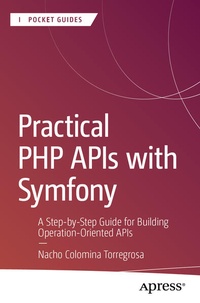
Practical PHP APIs with Symfony
Description

Ever wanted to construct a robust and efficient API architecture that revolves around operations? This focused pocket guide takes you through that process step-by-step, providing you with the knowledge to build an operation-oriented API using the PHP programming with the Symfony framework.
Practical PHP APIs with Symfony is designed to provide you with a comprehensive understanding of how to create a single API endpoint that embraces the concept of operations. We will utilize the robust features of Symfony to build an environment where operations are the focal point of our API design. This focused guide assumes a certain understanding of the Symfony framework and is not intended as an introductory text to the topic.
With this in mind, we will cover essential Symfony topics such as dependency injection features, security authentication and background operations with Symfony Messenger, all with the aim to get you up and running with operation-oriented APIs as quickly and easily as possible.
You Will:
- Learn the principles of constructing an API architecture centered around operations
- Gain insights into the Symfony features that facilitate the development of operation-oriented APIs
- Learn how to create a single API endpoint that manages and executes various operations
- Explore essential Symfony topics, including dependency injection, security authentication, and the use of Symfony Messenger for background operations
- Develop skills to discover, manage, and execute operations within your APIs, using practical examples for better comprehension
This Book is For:
Developers and software engineers with prior knowledge andunderstanding of the Symfony framework who wish to deepen their knowledge in building operation-oriented APIs, as well as those who are looking to know more about API design.
More details
Other editions
Additional editions
Person
Nacho Colomina Torregrosa has been a PHP developer for the last 12 years, which has largely focused on the utilization of the Symfony framework. During this time, he has had the opportunity to observe the growth of PHP and Symfony and feels very fortunate to have participated in very interesting projects with a team made up of wonderful people.
Nacho is passionate about the open source movement and contributes to the open source community and projects as much as possible and is interested the blockchain and Web3 sector and the wider utilization of decentralized applications beyond the finance sector
Content
Chapter 1. Crafting Inputs, Outputs, and Operations.- Chapter 2. Securing Operations.- Chapter 3. Background Execution of API Operations.- Chapter 4. Context-Specific Operations.- Chapter 5. Testing the API.
