

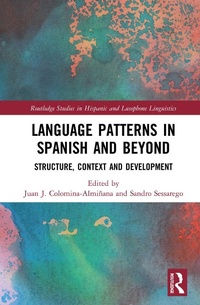
Language Patterns in Spanish and Beyond
Structure, Context and Development
1st Edition
Published on 25. October 2020
368 pages
978-1-000-19314-5 (ISBN)
Description

The scholarly articles included in this volume represent significant contributions to the fields of formal and descriptive syntax, conversational analysis and speech act theory, as well as language development and bilingualism. Taken together, these studies adopt a variety of methodological techniques-ranging from grammaticality judgments to corpus-based analysis to experimental approaches-to offer rich insights into different aspects of Ibero-Romance grammar.
The volume consists of three parts, organized in accordance with the topics treated in the chapters they comprise. Part I focuses on structural patterns, Part II analyzes pragmatic ones, and Part III investigates the acquisition of linguistic aspects found in the speech of L1, L2 and heritage speakers. The authors address these issues by relying on empirically rooted linguistic approaches to data collection, which are coupled with current theoretical assumptions on the nature of sentence structure, discourse dynamics and language acquisition.
The volume will be of interest to anyone researching or studying Hispanic and Ibero-Romance linguistics.
The volume consists of three parts, organized in accordance with the topics treated in the chapters they comprise. Part I focuses on structural patterns, Part II analyzes pragmatic ones, and Part III investigates the acquisition of linguistic aspects found in the speech of L1, L2 and heritage speakers. The authors address these issues by relying on empirically rooted linguistic approaches to data collection, which are coupled with current theoretical assumptions on the nature of sentence structure, discourse dynamics and language acquisition.
The volume will be of interest to anyone researching or studying Hispanic and Ibero-Romance linguistics.
Reviews / Votes
Winner of the silver medal for Best Reference Book, the silver medal for Best eBook, and the Honorable Mention in the Best Academic Themed Book, College Level - Spanish at the 2023 International Latino Book Awards.More details
Series
Edition
1. Auflage
Language
English
Place of publication
London
United Kingdom
Publishing group
Taylor & Francis Ltd
Target group
College/higher education
Product notice
Reflowable
Illustrations
37 Tables, black and white; 43 Line drawings, black and white; 60 Halftones, black and white; 103 Illustrations, black and white
ISBN-13
978-1-000-19314-5 (9781000193145)
Copyright in bibliographic data and cover images is held by Nielsen Book Services Limited or by the publishers or by their respective licensors: all rights reserved.
Schweitzer Classification
Other editions
Additional editions
Juan J. Colomina-Alminana | Sandro Sessarego
Language Patterns in Spanish and Beyond
Structure, Context and Development
Book
08/2022
1st Edition
Routledge
€68.00
Shipment within 15-20 days
Juan J. Colomina-Alminana | Sandro Sessarego
Language Patterns in Spanish and Beyond
Structure, Context and Development
Book
10/2020
1st Edition
Routledge
€207.30
Shipment within 15-20 days
Persons
Juan J. Colomina-Alminana is Instructor of Linguistics and Spanish in the Department of Foreign Languages and Literatures at Louisiana State University, USA.
Sandro Sessarego is Associate Professor in the Department of Spanish and Portuguese at the University of Texas at Austin, USA.
Sandro Sessarego is Associate Professor in the Department of Spanish and Portuguese at the University of Texas at Austin, USA.
Content
Table of Contents
Introduction
Part I - Syntactic patterns
Chapter 1. Argument and adjunct coordination in Spanish
by Michael Wilson and Rong Yin
Chapter 2. The interaction of parasitic gaps and adjunct control in Spanish
by Katie VanDyne
Chapter 3. "?Que traes gueey?": An analysis of Spanish clausal possession
by Christian Ruvalcaba
Chapter 4. Invariable que-questions (IQQs) in Spanish
by Javier Fernandez Sanchez and Alfredo Garcia Pardo
Chapter 5. Verbless DP interrogative constructions and enclisis in Galician
by Brian M. Gravely, Jr. and Timothy M. Gupton
Chapter 6. Leismo: One le or two?
by Adolfo Ausin and Francisco J. Fernandez-Rubiera
Part II - Pragmatic patterns
Chapter 7. What's courteous about leismo?
by Adolfo Ausin
Chapter 8. Verbless exclamatives in Spanish beyond the syntax-semantics interface: a pragmatic account
by Melvin Gonzalez Rivera
Chapter 9. The meaning of y to: conventional implicatures in Puerto Rican Spanish
by Nieves Rivera
Chapter 10. Exploring extended focus and meaning in Chilean Spanish intonational plateau contours
by Brandon M.A. Rogers, Rajiv Rao and Matthew Burner
Chapter 11. The intonation of yes-no questions in Basque Spanish
by Carolina Gonzalez and Lara Reglero
Part III - Acquisition patterns
Chapter 12. How preschoolers acquire the null-overt contrast in Mexican Spanish: evidence from production
by Hannah Forsythe, Dan Greeson and Cristina Schmitt
Chapter 13. Acquisition of null subjects by heritage children and child L2 learners
by Michele Goldin
Chapter 14. Demonstratives in Spanish: children's developing conceptualization of interactive space
by Naomi L. Shin and Jill P. Morford
Chapter 15. The production of ser and estar in Catalan/Spanish bilingual children
by Alejandro Cuza and Pedro Guijarro-Fuentes
Chapter 16. Frequency and semantic prototypicality in L2 Spanish learners' dative constructions
by David Abugaber
Index
Introduction
Part I - Syntactic patterns
Chapter 1. Argument and adjunct coordination in Spanish
by Michael Wilson and Rong Yin
Chapter 2. The interaction of parasitic gaps and adjunct control in Spanish
by Katie VanDyne
Chapter 3. "?Que traes gueey?": An analysis of Spanish clausal possession
by Christian Ruvalcaba
Chapter 4. Invariable que-questions (IQQs) in Spanish
by Javier Fernandez Sanchez and Alfredo Garcia Pardo
Chapter 5. Verbless DP interrogative constructions and enclisis in Galician
by Brian M. Gravely, Jr. and Timothy M. Gupton
Chapter 6. Leismo: One le or two?
by Adolfo Ausin and Francisco J. Fernandez-Rubiera
Part II - Pragmatic patterns
Chapter 7. What's courteous about leismo?
by Adolfo Ausin
Chapter 8. Verbless exclamatives in Spanish beyond the syntax-semantics interface: a pragmatic account
by Melvin Gonzalez Rivera
Chapter 9. The meaning of y to: conventional implicatures in Puerto Rican Spanish
by Nieves Rivera
Chapter 10. Exploring extended focus and meaning in Chilean Spanish intonational plateau contours
by Brandon M.A. Rogers, Rajiv Rao and Matthew Burner
Chapter 11. The intonation of yes-no questions in Basque Spanish
by Carolina Gonzalez and Lara Reglero
Part III - Acquisition patterns
Chapter 12. How preschoolers acquire the null-overt contrast in Mexican Spanish: evidence from production
by Hannah Forsythe, Dan Greeson and Cristina Schmitt
Chapter 13. Acquisition of null subjects by heritage children and child L2 learners
by Michele Goldin
Chapter 14. Demonstratives in Spanish: children's developing conceptualization of interactive space
by Naomi L. Shin and Jill P. Morford
Chapter 15. The production of ser and estar in Catalan/Spanish bilingual children
by Alejandro Cuza and Pedro Guijarro-Fuentes
Chapter 16. Frequency and semantic prototypicality in L2 Spanish learners' dative constructions
by David Abugaber
Index
