

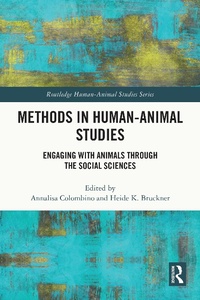
Methods in Human-Animal Studies
Engaging With Animals Through the Social Sciences
1st Edition
Published on 7. June 2023
226 pages
978-1-351-01860-9 (ISBN)
Description

This timely book provides a methodological guide for how to conduct and theorise research in human-animal studies. In response to critiques of the anthropomorphic slant to human-animal research and the increasing political relevance of animals in contemporary environmental debates, this book emphasises methods which bring to light the animal side of multispecies encounters.
Drawing from the interdisciplinary strength of human-animal studies, this book contains contributions from practitioners and scholars working in sociology, anthropology, ethology and geography. Each chapter uses a case-study approach to present a theoretical framework and empirical application of cutting-edge methods in human-animal studies, from creative writing in multispecies ethnographies to visual methods like videography and body mapping. Organized in three parts - theorizing; collaborating; visualizing - the book equips readers with methodological tools to conduct human-animal studies research attentive to animal lives. Furthermore, chapters reflect on the opportunities, limitations and ethical considerations of research that seeks to understand our more-than-human worlds.
The book is aimed towards undergraduate and graduate students in human-animal studies and scholars investigating human-animal relations. It will also be of interest to practitioners and policy-makers who engage with conservation, wildlife management or the human-animal interface of urban and regional planning.
Drawing from the interdisciplinary strength of human-animal studies, this book contains contributions from practitioners and scholars working in sociology, anthropology, ethology and geography. Each chapter uses a case-study approach to present a theoretical framework and empirical application of cutting-edge methods in human-animal studies, from creative writing in multispecies ethnographies to visual methods like videography and body mapping. Organized in three parts - theorizing; collaborating; visualizing - the book equips readers with methodological tools to conduct human-animal studies research attentive to animal lives. Furthermore, chapters reflect on the opportunities, limitations and ethical considerations of research that seeks to understand our more-than-human worlds.
The book is aimed towards undergraduate and graduate students in human-animal studies and scholars investigating human-animal relations. It will also be of interest to practitioners and policy-makers who engage with conservation, wildlife management or the human-animal interface of urban and regional planning.
More details
Series
Edition
1. Auflage
Language
English
Place of publication
London
United Kingdom
Publishing group
Taylor & Francis Ltd
Target group
College/higher education
Product notice
Reflowable
Illustrations
1 Line drawings, black and white; 11 Halftones, black and white; 12 Illustrations, black and white
ISBN-13
978-1-351-01860-9 (9781351018609)
Copyright in bibliographic data and cover images is held by Nielsen Book Services Limited or by the publishers or by their respective licensors: all rights reserved.
Schweitzer Classification
Other editions
Additional editions
Annalisa Colombino | Heide K. Bruckner
Methods in Human-Animal Studies
Engaging With Animals Through the Social Sciences
Book
11/2024
1st Edition
Routledge
€63.20
Shipment within 10-20 days
Annalisa Colombino | Heide K. Bruckner
Methods in Human-Animal Studies
Engaging With Animals Through the Social Sciences
Book
06/2023
1st Edition
Routledge
€205.50
Shipment within 10-20 days
Persons
Annalisa Colombino holds a PhD in human geography from the Open University. She now works at Ca' Foscari, University of Venice, Italy. Her research applies cultural geography to topics such as place-marketing, commodification and branding processes, the geographies of consumption, the bioeconomy and the diverse economy. Most recently, she has been working at the intersection of economic geography, animal geographies and the geographies of food adopting a more-than-human approach inspired by biopolitical thought. Her interdisciplinary research is published in Italian, English and German.
Heide K. Bruckner is a researcher and lecturer currently working in the Department of Geography at the University of Graz, Austria. In her scholarship, she focuses on the promises and challenges of "alternative" food systems in the Global North and South. In particular, she is drawn to embodied, visceral geographies that capture the intersection of personal experience and more-than-human political ecologies. Her diverse research projects span the globe, from the United States and Latin America, to western Europe and the South Pacific.
Heide K. Bruckner is a researcher and lecturer currently working in the Department of Geography at the University of Graz, Austria. In her scholarship, she focuses on the promises and challenges of "alternative" food systems in the Global North and South. In particular, she is drawn to embodied, visceral geographies that capture the intersection of personal experience and more-than-human political ecologies. Her diverse research projects span the globe, from the United States and Latin America, to western Europe and the South Pacific.
Content
Chapter 1: Hidden in plain sight: how (and why) to attend to the animal in human-animal relations
PART I THEORISING
Chapter 2: Decentring humans in research methods: visibilising other animal realities
Chapter 3: Understanding human-animal relations from the perspective of work
Chapter 4: Re-thinking animal and human personhood: towards co-created narratives of affective, embodied, emplaced becomings of human and nonhuman life
PART II: COLLABORATING
Chapter 5: Two species ethnography: honey bees as a case study of an interdisciplinary "more-than-human" method
Chapter 6: Trekking a predator's journey: paths through the Greater Yellowstone Ecosystem
Chapter 7: How to do multispecies-ethnographies when exploring human-(wild) animal interactions: affect, multisensory communication and materiality
PART III: VISUALISING
Chapter 8: Shared sensory signs: mine detection rats and their handlers in Cambodia
Chapter 9: Doing multispecies ethnography with mobile video: exploring human-animal contact zones
Chapter 10: Getting visceral: body mapping the humanimalian
PART I THEORISING
Chapter 2: Decentring humans in research methods: visibilising other animal realities
Chapter 3: Understanding human-animal relations from the perspective of work
Chapter 4: Re-thinking animal and human personhood: towards co-created narratives of affective, embodied, emplaced becomings of human and nonhuman life
PART II: COLLABORATING
Chapter 5: Two species ethnography: honey bees as a case study of an interdisciplinary "more-than-human" method
Chapter 6: Trekking a predator's journey: paths through the Greater Yellowstone Ecosystem
Chapter 7: How to do multispecies-ethnographies when exploring human-(wild) animal interactions: affect, multisensory communication and materiality
PART III: VISUALISING
Chapter 8: Shared sensory signs: mine detection rats and their handlers in Cambodia
Chapter 9: Doing multispecies ethnography with mobile video: exploring human-animal contact zones
Chapter 10: Getting visceral: body mapping the humanimalian
