

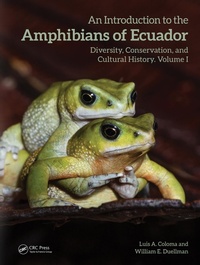
An Introduction to the Amphibians of Ecuador
Diversity, Conservation, and Cultural History
1st Edition
Published on 27. December 2024
354 pages
978-1-040-21634-7 (ISBN)
Description

An Introduction to the Amphibians of Ecuador is the first of four volumes, which are comprehensive, well-illustrated, and authoritative works, making them invaluable to biologists, conservationists, and others. This initial volume delves into the cultural history of amphibians, encompassing ethnobatrachology and folklore, while summarizing the amphibian iconography found in Ecuadorian archaeology. Moreover, it covers topics such as bioprospecting, sustainable management, and biotrade activities. The history and present state of amphibian biology research are also addressed. Furthermore, it explores in comprehensive detail the rich amphibian diversity of Ecuador, providing a thorough review of biogeography, amphibian declines, and conservation.
Subsequent volumes list the characteristics of each species, define each taxon, and compare them to similar other species. Natural history and reproductive behavior, where known, are described, as are data on vocalizations, larvae, and ontogenetic changes. Amphibian distributions are illustrated with physiographic maps with dots. Each volume addresses the declines, extinctions, and conservation status of each species and provides notations of their occurrence in reserves.
KEY FEATURES
Summarizes the ethnozoological aspects of amphibians
Provides a thorough history of research
Introduction to three volumes providing accounts for each of the 3 orders, 19 families, 78 genera, and over 650 species from Ecuador
Subsequent volumes list the characteristics of each species, define each taxon, and compare them to similar other species. Natural history and reproductive behavior, where known, are described, as are data on vocalizations, larvae, and ontogenetic changes. Amphibian distributions are illustrated with physiographic maps with dots. Each volume addresses the declines, extinctions, and conservation status of each species and provides notations of their occurrence in reserves.
KEY FEATURES
Summarizes the ethnozoological aspects of amphibians
Provides a thorough history of research
Introduction to three volumes providing accounts for each of the 3 orders, 19 families, 78 genera, and over 650 species from Ecuador
More details
Edition
1. Auflage
Language
English
Place of publication
London
United Kingdom
Publishing group
Taylor & Francis Ltd
Target group
College/higher education
Professional and scholarly
Illustrations
16 Tables, black and white; 15 Line drawings, color; 24 Line drawings, black and white; 118 Halftones, color; 17 Halftones, black and white; 133 Illustrations, color; 41 Illustrations, black and white
File size
290,94 MB
ISBN-13
978-1-040-21634-7 (9781040216347)
Copyright in bibliographic data and cover images is held by Nielsen Book Services Limited or by the publishers or by their respective licensors: all rights reserved.
Schweitzer Classification
Other editions
Additional editions

Book
01/2025
CRC Press
Unfortunately, price unknown
Available (delivery time upon request)
Luis A. Coloma | William E. Duellman
An Introduction to the Amphibians of Ecuador
Diversity, Conservation, and Cultural History
Book
12/2024
1st Edition
CRC Press
€160.50
Shipment within 15-20 days
Persons
Luis Aurelio Coloma Roman is an amphibian biologist that was born in Guaranda, Provincia Bolivar, Ecuador, in 1962. He received his Licenciatura in Biological Sciences from the Pontificia Universidad Catolica del Ecuador (PUCE) in 1987. In 1991 he was granted an MA in the Department of Systematics and Ecology at the University of Kansas, where he was mentored by William E. Duellman; his thesis was "Ecuadorian Frogs of the Genus Colostethus (Anura: Dendrobatidae)." For his PhD he was under the guidance of Linda Trueb; in 1997 he completed his dissertation, "Morphology, Systematics, and Phylogenetic Relationships Among Frogs of the Genus Atelopus (Anura: Bufonidae)." For 19 years, from 1991 to 2010 he was Professor, Senior Lecturer, in charge of Vertebrates, and in charge of the Herpetology section at the Escuela de Ciencias Biologicas at PUCE. He mentored 23 students of Licenciatura. Since 2011 he has been Director and Researcher at the Centro Jambatu de Investigacion y Conservacion de Anfibios, in Quito, Ecuador. Coloma has published 69 scientific papers, with 56 of these articles focused on amphibians indexed in Scopus (as of 31 May 2023). Additionally, he did 32 outreach publications, among the latter two photo coffe-table books: "Ecuador Megadiverso" and "Sapos, Ecuador Sapodiverso".
He has described or co-described 31 new species of frogs, among which 28 are Ecuadorian frogs of the genera Atelopus (7), Hyloxalus (6), Gastrotheca (4), Hyloscirtus (4), Engystomops (3), Pristimantis (2), Leucostethus (1), and Epipedobates (1). Four species of frogs, one lizard, and one earthworm have been named in his honor by his colleagues. In 2007 he was awarded the Sabin Award for Conservation of Amphibians, awarded by the World Conservation Union and Conservation International. In 2008 he received the Saint Louis Zoo Conservation Award in recognition of his extraordinary lifelong dedication to the conservation of Ecuadorian biodiversity. In 2009 he was appointed member of the Latin American Academy of Sciences. Additional information about Coloma's life appears in Chapter 2 and references therein.
William Edward Duellman (1930-2022) was a herpetologist that was born in Dayton, Ohio, on 06 September 1930. He passed away on 25 February 2022. He earned three degrees from the university -a BA (1951) was in zoology with a minor in geography, MS (1952) in zoology with a minor in botany, and a PhD (1956) in zoology in with a minor in geology. His doctoral dissertation was on snakes of the genus Leptodeira. Since 1959, most of Duellman?s academic life has been at the University of Kansas, where he was professor in the Department of Systematics and Ecology and Curator and Curator Emeritus of Herpetology in the Natural History Museum (now Biodiversity Institute). He published 386 titles (among them twelve books). Among these books are Hylid Frogs of Middle America, An Equatorial Herpetofauna, Biology of Amphibians (With Linda Trueb); Cuzco Amazonico: Lives of Amphibians and Reptiles in a Tropical Rainforest, Terrestrial Breeding Frogs (Strabomantidae) in Peru (with Edgar Lehr), Marsupial Frogs and Allied Genera. Duellman served as major professor for 12 master's and 34 PhD students, and mentored seven post-doctoral scholars. During his time at the University of Kansas Natural History Museum, he built up the collection from 59,000 to more than 300,000 through extensive field work by himself and his students and by acquiring other collections, making it the fourth largest herpetological collection in the United States, and by far the most significant collection of the herpetofauna of Latin America. He has described or co-described 252 species of amphibians from the Neotropics, among which 93 are from Ecuador. Six species of frogs and five species of reptiles has named in his honor. Additional information about Duellman's life is in Chapter 2 and references therein.
He has described or co-described 31 new species of frogs, among which 28 are Ecuadorian frogs of the genera Atelopus (7), Hyloxalus (6), Gastrotheca (4), Hyloscirtus (4), Engystomops (3), Pristimantis (2), Leucostethus (1), and Epipedobates (1). Four species of frogs, one lizard, and one earthworm have been named in his honor by his colleagues. In 2007 he was awarded the Sabin Award for Conservation of Amphibians, awarded by the World Conservation Union and Conservation International. In 2008 he received the Saint Louis Zoo Conservation Award in recognition of his extraordinary lifelong dedication to the conservation of Ecuadorian biodiversity. In 2009 he was appointed member of the Latin American Academy of Sciences. Additional information about Coloma's life appears in Chapter 2 and references therein.
William Edward Duellman (1930-2022) was a herpetologist that was born in Dayton, Ohio, on 06 September 1930. He passed away on 25 February 2022. He earned three degrees from the university -a BA (1951) was in zoology with a minor in geography, MS (1952) in zoology with a minor in botany, and a PhD (1956) in zoology in with a minor in geology. His doctoral dissertation was on snakes of the genus Leptodeira. Since 1959, most of Duellman?s academic life has been at the University of Kansas, where he was professor in the Department of Systematics and Ecology and Curator and Curator Emeritus of Herpetology in the Natural History Museum (now Biodiversity Institute). He published 386 titles (among them twelve books). Among these books are Hylid Frogs of Middle America, An Equatorial Herpetofauna, Biology of Amphibians (With Linda Trueb); Cuzco Amazonico: Lives of Amphibians and Reptiles in a Tropical Rainforest, Terrestrial Breeding Frogs (Strabomantidae) in Peru (with Edgar Lehr), Marsupial Frogs and Allied Genera. Duellman served as major professor for 12 master's and 34 PhD students, and mentored seven post-doctoral scholars. During his time at the University of Kansas Natural History Museum, he built up the collection from 59,000 to more than 300,000 through extensive field work by himself and his students and by acquiring other collections, making it the fourth largest herpetological collection in the United States, and by far the most significant collection of the herpetofauna of Latin America. He has described or co-described 252 species of amphibians from the Neotropics, among which 93 are from Ecuador. Six species of frogs and five species of reptiles has named in his honor. Additional information about Duellman's life is in Chapter 2 and references therein.
Content
Contributors. In Memoriam. Foreword. Preface. Acknowledgments. Chapter 1 Ethnobatrachology. Chapter 2 The History and Present of Amphibian Biology. Chapter 3 Diversity, Extinction, and Conservation. Index.
