

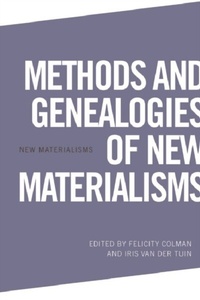
Methods and Genealogies of New Materialisms
Description

Brings together a range of research communities to contextualize and archive over a decade of work in new materialist theorising and knowledge-making practice
- Consolidates new materialisms as a distinguished field of scholarship
- Brings together the key proponents of the field in a multi-voiced conversation
- Provides consonant, dissonant, and feminist genealogies of the state of the field
- Focuses on the methodological nature of the materiality and meaning-making nexus
Combining a reflective genealogical approach along with productive avenues for future research, this volume is an essential collection for the field of new and feminist materialisms.The volume uses the new materialist movements in thought of changing, intersecting, practicing, and transforming. As methods, these movements have engendered the metaphysical questions that different new and feminist materialist practices engage. The volume follows these four movements as method-question-actions in four parts, each of which is preceded by an introductory framing-essay. Rosi Braidotti's preface offers revelatory mappings to bring the book together and curated panels further offer co-authored texts which practice the collective nature of academic thinking advocated by the European feminist new materialisms network.
More details
Other editions
Additional editions
Content
- Intro
- Acknowledgements
- Foreword: A Becoming-world of Collective Knowledge Practices
- Notes on Contributors
- Introduction: New Materialisms: Quantum Ideation across Dissonance
- Part I: Changing Genealogies of New Materialisms
- 1. Introduction: Mapping the New Materialist Terra Incognita
- 2. Bibliography and a Feminist Apparatus of Literary Production
- 3. An Atomist Genealogy of New Materialism
- 4. A Feminist Cartography of Critical New Materialist Philosophies
- 5. Curated Panel: 'Genealogies and Apparatuses of New Materialist Production'
- Part II: Intersecting the Natural and Human Sciences through New Materialisms
- 6. Introduction: Provocations of New Materialisms at the Crossroads of the Natural and Human Sciences
- 7. Reading Science - Caring with Microbes
- 8. Thinking through the Disruptive Effects and Affects of the Coronavirus with Feminist New Materialism
- 9. Un-/Remaking Method: Knowing/Enacting Posthumanist Performative Social Research Methods through 'Diffractive Genealogies' and 'Metaphysical Practices'
- 10. Curated Panel: 'New Materialisms across the Natural Sciences and Humanities: Trajectories, Inspirations and Stirrings'
- Part III: Practising the Creative Arts for New Materialisms
- 11. Introduction: New Materialisms and (the Study of) Art: A Mapping of Co-emergence
- 12. Working Hot: Materialising Practices
- 13. Mapping Sounding Art: Affect, Place, Memory
- 14. Curated Panel: 'Art as Laboratory for Modes of Being-With'
- Part IV: Transforming Economic and Identity-Political Crises and Organisational Experiments through New Materialisms
- 15. Introduction: Reality Check - (Re)calibrating New Materialisms
- 16. The Runaway Weirdness of Money: New Old Materialism for the Anthropocene
- 17. Doing Homework: Encountering Indigenous and New Materialist Onto-Epistemologies in Education Research
- 18. The Politics of Feminist New Materialisms: Insights from Experimenting with Academic Practices
- Index
