

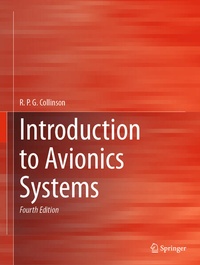
Introduction to Avionics Systems
Description

Now in a revised fourth edition, this course-tested textbook explains the basic principles and underlying theory of the core avionic systems in modern civil and military aircraft. The new edition includes extensive revisions on the latest developments in helmet-mounted displays (HMDs), the use of helmet-mounted rate gyros for helmet tracking, HUD/HMD optical waveguide system technology, and the latest advances on replacing CRTs with solid state displays in HUDs. Updates on controls and fly-by-wire include a section on civil aircraft to cover the Airbus A350 and the advances in its flight control system over the Airbus A380. A new section on automatic flight control of vectored thrust aircraft covers the BAE Systems Harrier and the Lockheed Martin F-35B Lightning 2 Joint Strike Fighter. Detailed coverage is provided for F-35B flight control systems for vertical landing.
Introduction to Avionic Systems, Fourth Edition is an ideal textbook for undergraduate andgraduate courses in avionics and aeronautical engineering, as well as professional development and training courses for post-graduates entering the aerospace industry from a wide range of technical backgrounds and practicing engineers at all levels who require an understanding of avionic systems, aircraft navigation, flight control, and data transmission and systems.
More details
Other editions
Additional editions
Person
R.P.G.Collinson was chief systems engineer and later manager of the Flight Automation Research Laboratory of GEC Avionics Ltd. (now part of BAE Systems), in Rochester, Kent, UK. The Laboratory has been responsible for many innovative systems and techniques which have subsequently been used in the development of avionic equipment for many current European and United States aircraft. During his time with GEC Avionics, he also served as manager of the Flight Instruments Division and the Inertial Navigation Division. He was a Chartered Engineer and Fellow of The Institution of Engineering and Technology (The IET) and the Royal Aeronautical Society. Following service in the Royal Navy, he studied electrical engineering at London University, graduating with a First-Class Honours Degree. He was awarded the Silver Medal of the Royal Aeronautical Society for his contribution to the research and development of advanced avionic equipment. Following his retirement, he gave numeroustalks on avionic and aviation topics to lay and technical audiences and presented specialist lectures at two universities.Sadly, R P G Collinson passed away on 16 th February 2022 just as Edition 4 was nearing completion. With the kind permission of the publisher, Edition 4 has been completed by his sons M R Collinson and S W Collinson and technically reviewed by C Bartlett, former Chief Technologist, BAE Systems, Rochester, Kent.
