

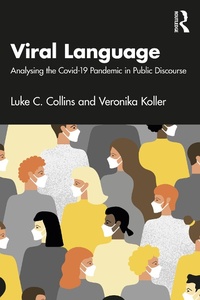
Viral Language
Analysing the Covid-19 Pandemic in Public Discourse
1st Edition
Published on 29. September 2023
210 pages
978-1-000-96186-7 (ISBN)
Description

Viral Language considers a range of different types of public communication and their discussion of the Covid-19 pandemic as a way to investigate health communication. The authors introduce and apply a range of approaches informed by linguistic theory to investigate experiences of the pandemic across a variety of public contexts. In doing so, they demonstrate how experiences of health and illness can be shaped by political messaging, scientific research, news articles and advertising.
Through a series of case studies of Covid-related texts, the authors consider aspects of language instruction, information and innovation, showcasing the breadth of topics that can be studied as part of health communication. Furthermore, each case study provides practical guidance on how to carry out investigations using social media texts, how to analyse metaphor, how to track language innovation and how to work with text and images.
Viral Language is critical reading for postgraduate and upper undergraduate students of applied linguistics and health communication.
Through a series of case studies of Covid-related texts, the authors consider aspects of language instruction, information and innovation, showcasing the breadth of topics that can be studied as part of health communication. Furthermore, each case study provides practical guidance on how to carry out investigations using social media texts, how to analyse metaphor, how to track language innovation and how to work with text and images.
Viral Language is critical reading for postgraduate and upper undergraduate students of applied linguistics and health communication.
Reviews / Votes
A clearly written, must-read piece of work for anybody interested in how a pandemic not only affected our lives but also our own language. An invaluable resource to discover the power of metaphor in unveiling human thinking and creativity in different types of public discourse (health, political, and informational) and contexts (social media, advertising).Iraide Ibarretxe-Antunano, The University of Zaragoza, Spain
With their book, Collins and Koller fill an important gap in the vast literature about Covid-19. They provide readers with an original, critically thorough, and yet accessible, inquiry into the way language has been used in communicating the pandemic, highlighting the impact it generally has in the perception of science in society.
Massimiliano Demata, University of Turin, Italy
COVID-19 has prompted much scholarship in the fields of linguistics and discourse analysis. But Viral Language is unique in that the authors use multiple points of entry to investigate the way the pandemic is represented in various types of public discourses. This book not only provides a thorough appraisal of COVID-19 as discursive construct and social experience, but also initiates the reader into numerous types of linguistic analysis, from speech acts, transitivity and multimodality, to metaphor and lexical innovation. A very valuable book for scholars and students.
Fiona Rossette-Crake, Paris Nanterre University, France
More details
Edition
1. Auflage
Language
English
Place of publication
London
United Kingdom
Publishing group
Taylor & Francis Ltd
Target group
College/higher education
Illustrations
20 Tables, black and white; 3 Line drawings, black and white; 2 Halftones, black and white; 5 Illustrations, black and white
ISBN-13
978-1-000-96186-7 (9781000961867)
Copyright in bibliographic data and cover images is held by Nielsen Book Services Limited or by the publishers or by their respective licensors: all rights reserved.
Schweitzer Classification
Other editions
Additional editions
Book
09/2023
1st Edition
Routledge
€231.50
Shipment within 15-20 days
Book
09/2023
1st Edition
Routledge
€63.40
Shipment within 15-20 days
Persons
Luke C. Collins is a Senior Research Associate with the ESRC Centre for Corpus Approaches to Social Science at Lancaster University, UK.
Veronika Koller is Professor of Discourse Studies at Lancaster University, UK.
Veronika Koller is Professor of Discourse Studies at Lancaster University, UK.
Content
List of Figures; List of Tables; List of abbreviations; Acknowledgements; Chapter 1 Introduction; Chapter 2 Health promotion and public engagement on Twitter; Chapter 3 Politicians' use of metaphor; Chapter 4 Key features of scientific writing on Covid-19; Chapter 5 Investigating 'the science' in news discourse; Chapter 6 Language change in news on the web: lexical innovation in response to Covid-19; Chapter 7 Advertising in the time of coronavirus; Chapter 8 Concluding remarks; Index
