

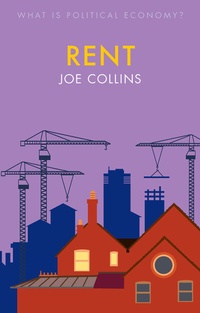
Rent
Description

Examining both concrete contexts and complex concepts, in this book Joe Collins provides a comprehensive but concise survey of the theories and debates over rent and rentier capitalism. He examines global gentrification from São Paolo to Dublin, the tyranny of technology from Taipei to San Francisco, and the excesses of extractivism from Sekondi to Karratha. In doing so, he reveals how rent is fundamental to the current dominant form of capitalist social organization across the globe and how we can prevent the next generation from seeing our societies rent asunder.
An essential resource for students and scholars alike, this groundbreaking book will be of interest to anyone working on capitalism, property, political economy, economic sociology and contemporary politics.
More details
Other editions
Person
Content
Chapter 2 - Rent theory in historical perspective
Chapter 3 - Mainstream rent theory
Chapter 4 - Rent theory in modern political economy
Chapter 5 - Why is rent important today?
Notes
References
2
Rent Theory in Historical Perspective
Changes in rent theory have tended to reflect broader developments in the history of economic thought. This chapter discusses some of these developments, why they occurred and how they inform current debates on rent. The connection emphasized in this chapter is between historically specific theories of rent and the social context in which they emerged and came to change.
Rent before capitalism
In the long and relatively obscure history of Islamic economic thought, at least for audiences in the Anglophone countries, there are important contributions to rent theory worth noting. Abu Yousuf, who lived between 731 and 798, advocated a proportionate rent in kind rather than levying a fixed rent on agricultural land. The rationale was that charging a rent proportionate to the output of the land would incentivize expanded production, whereas a fixed rent might stifle expansion.1 Yousuf's work on principles of taxation is thought to have pre-empted the 'canons of taxation' - equity, certainty, convenience and economy - that emerged in the work of the classical school of political economy from Adam Smith onwards.2 Abu Muhammad bin Hazm, who died in 1064, was a jurist concerned with the collective responsibilities of the state. Ibn Hazm was unique among the four schools of Islamic jurisprudence as an advocate for prohibition of renting out of agricultural land, favouring that owners cultivate the land themselves or enter into sharecropping arrangements. Support for this policy of prohibition of renting has been labelled as socialistic by some, and it is widely considered to be in opposition to the mainstream of Islamic jurisprudence that permits the renting of agricultural land.3
Medieval economic thought of Western Europe offered the following contributions to rent theory. Economies in the later Middle Ages, from the twelfth to fifteenth centuries, in Western Europe were characterized as regional, wherein each town or region was serviced by a surrounding agricultural district. Production and exchange took place primarily within the region, within and between town and country. Peasants represented the majority and they produced mainly for their own subsistence. Anything extra was distributed upwards among the various social groups. Lords presided over the regions and they received what was called a 'quickrent' in the form of surplus food produced on peasant land in return for permitting peasants to live and subsist on the lord's estates.4 This is where the term 'landlord' originates. The lord's own manor, or residence, also had a tillage where produce for the manor was grown and peasants were required to perform compulsory labour on this tillage. This labour that peasants performed for the lord was known as the barshchina or corvée.5
It is tempting to say that these are examples of land rent, or labour rent, in the case of the corvée, but that would remove these examples of rent from their historical context. Deriving ahistorical definitions of rent and then imposing them on any example that fits the abstract definition is the kind of folly that Fine warned against in chapter 1. Doing so would obscure the fact that the society in which this 'rent', the corvée, was being paid had a different form of social organization from society today. This means that our prejudices and views of how the world functions are transported back to the period under observation, effectively reproducing our society in theirs. The level of rent in the late medieval period, for example, is not determined by the degree of market power in markets for factors of production. The idea of a labour market as we understand it today in the context of that society is simply ridiculous. Indeed, the construct of a 'market' itself, with buyers and sellers free to enter apparently mutually beneficial relations of exchange mediated by some form of generally accepted and guaranteed currency, is completely nonsensical in a time when people were effectively enslaved by despots whose social power ostensibly derived from divine providence.
The crucial connection between production and distribution, mediated by agricultural production, was seen clearly by scholars of political economy in the Confucian period in the history of Chinese economic thought. Shi, or food production, was considered the foremost issue for ruling a country by Confucius amidst the need for weapons and the confidence of the people in their ruler.6 The policy of 'light tax' was preferred to stimulate an increase in production by keeping the rental payment for the use of farmland paid by farmers to landowners at a rate that did not disincentivize taking more land under cultivation. The rationale for this approach to rent and taxation was expressed clearly by one of the students of Confucius, You Ruo, who adduced that 'when the people enjoy plenty, the prince necessarily shares in that plenty' but when 'the people have not enough for their needs, the prince cannot expect to have enough for his needs'.7
Theories of rent in pre-capitalist societies were chiefly concerned with how exactly to facilitate the production and distribution of food. Rents conveyed the economic aspect of problems associated with land ownership. The measures of rent or their equivalences were expressed in forms other than the money payment that is taken for granted today because the monetary economy was not yet widespread. Perhaps the division of labour in these societies did not necessitate a universal equivalent form, something that could facilitate exchange throughout a complex economy where the sheer volume of commodities and their types required something other than exchange in kind. It took the explosion in productive capacity in agriculture that emerged in capitalism to displace the rent problem into other spheres of economic activity where ownership and the imperative to benefit from controlling access to productive resources became a source of enrichment.
Physiocracy and landed property in capitalism
Physiocracy means rule of nature. The term was coined by Pierre-Samuel du Pont de Nemours in 1767 to describe the work of François Quesnay and Victor Riqueti, Marquis de Mirabeau.8 Quesnay transformed economics from the study of managing households, cities and states, which was its original designation in ancient Greece as oikonomia, to the science of wealth.9 The physiocrats were responsible for disengaging the 'economic process from its anthropological role as servant of the socio-political order, and established its claim to be the direct manifestation of the natural order', or, in other words, they argued that 'economic process itself embodied natural law and should thus dictate the socio-political order.'10 The stated aim of physiocracy was to 'attain to the greatest degree of prosperity possible for society' in accordance with the 'general laws of the natural order'.11 This initiative led them to inquire as to the origins of value, its distribution and the consequences of these movements. Results of these investigations were important contributions to an evolving social science of political economy. This group of French scholars can be grouped together, for our current purposes, with British scholars such as John Law, William Petty, Richard Cantillon, David Hume, James Steuart, Dudley North and John Locke. French and English traditions of political economy find a degree of unity in the work of Adam Smith, forming the foundation of what is now considered the school of classical political economy.
Smith wove various threads spun by these thinkers to shift the focus from exchange, underpinning the mercantilist writing of people like Thomas Mun and Jean-Baptiste Colbert, to production and to question the primacy of land as the driver of economic activity and as the source of value. Anything before Smith in European economic thought can be taken together in relation to rent theory, so physiocracy will act as a proxy uniting what is a diverse group of thinkers. The physiocratic theory of rent is emphasized to discuss the shift in thinking evident in economic theories of the time attempting to explain the disintegration of feudalism and the emergence of capitalism.
Qesnay, Mirabeau and Anne Robert Jacques Turgot are the key figures associated with physiocracy. Qesnay's skilful use of the systems of patronage saw him elevated to an influential position within the court from which his economic theories came to dominate the French tradition of economics.12 The foundation for the system of thought that would become known as physiocracy was laid with the publication of Qesnay's Tableau Économique (Economic Tables) in 1758. The etymology of the term traces from the Greek physis, nature, and kratein, to rule. Turgot's Réflexions sur la Formation et la Distribution des Riches (Reflections on the Formation and Distribution of Riches), published in 1770, expressed this sentiment clearly with the statement that the earth 'is always the first and only source of wealth; it is that which as the result of cultivation produces all the revenue; it is that also which has provided the first fund of advances prior to all cultivation'.13
The theory of value elaborated by the physiocrats meant that rent was integral to their system of political economy....
