

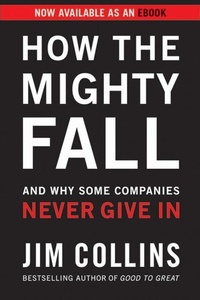
How the Mighty Fall
Description

Decline can be avoided.
Decline can be detected.
Decline can be reversed.
Amidst the desolate landscape of fallen great companies, Jim Collins began to wonder: How do the mighty fall? Can decline be detected early and avoided? How far can a company fall before the path toward doom becomes inevitable and unshakable? How can companies reverse course?
In How the Mighty Fall, Collins confronts these questions, offering leaders the well-founded hope that they can learn how to stave off decline and, if they find themselves falling, reverse their course. Collins' research project?more than four years in duration?uncovered five step-wise stages of decline:
Stage 1: Hubris Born of Success
Stage 2: Undisciplined Pursuit of More
Stage 3: Denial of Risk and Peril
Stage 4: Grasping for Salvation
Stage 5: Capitulation to Irrelevance or Death
By understanding these stages of decline, leaders can substantially reduce their chances of falling all the way to the bottom.
Great companies can stumble, badly, and recover.
Every institution, no matter how great, is vulnerable to decline. There is no law of nature that the most powerful will inevitably remain at the top. Anyone can fall and most eventually do. But, as Collins' research emphasizes, some companies do indeed recover?in some cases, coming back even stronger?even after having crashed into the depths of Stage 4.
Decline, it turns out, is largely self-inflicted, and the path to recovery lies largely within our own hands. We are not imprisoned by our circumstances, our history, or even our staggering defeats along the way. As long as we never get entirely knocked out of the game, hope always remains. The mighty can fall, but they can often rise again.
More details
Other editions
Additional editions
Person
Jim Collins has published multiple international bestsellers that have sold in total more than 11 million copies worldwide, including the perennial favorite Good to Great. His writings and teachings are based on extensive research projects designed to uncover timeless principles of human endeavor and have had a lasting impact across all sectors of society. All of Jim's books share a common thread: the study of people and how they navigate the big questions of leadership and life.
Content
- Intro
- Title Page
- Dedication
- Contents
- Preface
- The Silent Creep of Impending Doom
- Five Stages of Decline
- Stage 1: Hubris Born of Success
- Stage 2: Undisciplined Pursuit of More
- Stage 3: Denial of Risk and Peril
- Stage 4: Grasping for Salvation
- Stage 5: Capitulation to Irrelevance or Death
- Well-Founded Hope
- Appendices
- Appendix 1: Fallen-Company Selection Criteria
- Appendix 2: Success-Contrast Selection Criteria
- Appendix 3: Fannie Mae and the Financial Crisis of 2008
- Appendix 4.A: Evidence Table-Subverting the Complacency Hypothesis
- Appendix 4.B: Evidence Table-Grasping for Salvation
- Appendix 5: What Makes for the "Right People" in Key Seats?
- Appendix 6.A: Decline and Recovery Case IBM
- Appendix 6.B: Decline and Recovery Case Nucor
- Appendix 6.C: Decline and Recovery Case Nordstrom
- Appendix 7: Good-To-Great Framework-Concept Summary
- Notes
- Index
- Acknowledgments
- About the Author
- Books by Jim Collins
- Back Ad
- Copyright
- About the Publisher
