


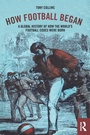
How Football Began
A Global History of How the World's Football Codes Were Born
1st Edition
Published on 6. August 2018
218 pages
978-1-351-70968-2 (ISBN)
Description

This ambitious and fascinating history considers why, in the space of sixty years between 1850 and 1910, football grew from a marginal and unorganised activity to become the dominant winter entertainment for millions of people around the world.
The book explores how the world's football codes - soccer, rugby league, rugby union, American, Australian, Canadian and Gaelic - developed as part of the commercialised leisure industry in the nineteenth century. Football, however and wherever it was played, was a product of the second industrial revolution, the rise of the mass media, and the spirit of the age of the masses.
Important reading for students of sports studies, history, sociology, development and management, this book is also a valuable resource for scholars and academics involved in the study of football in all its forms, as well as an engrossing read for anyone interested in the early history of football.
The book explores how the world's football codes - soccer, rugby league, rugby union, American, Australian, Canadian and Gaelic - developed as part of the commercialised leisure industry in the nineteenth century. Football, however and wherever it was played, was a product of the second industrial revolution, the rise of the mass media, and the spirit of the age of the masses.
Important reading for students of sports studies, history, sociology, development and management, this book is also a valuable resource for scholars and academics involved in the study of football in all its forms, as well as an engrossing read for anyone interested in the early history of football.
Reviews / Votes
"The origins of football's many codes and their complex relationship to each other has been one of sporting history's great grey areas, dominated by hearsay and invention. No longer. Tony Collins' cool and illuminating How Football Began brings range, precision and sources to bear on the matter. As is often the case, the truths that emerge are infinitely more interesting than the myths they dispel." - David Goldblatt, Author of The Ball is Round: A Global History of Football and The Game of Our Lives"Collins takes a fascinating look at the history, development, branching, and codification of football in all of its forms around the world, particularly in the late 19th century ... Because the connections between these sports has long been forgotten, Collins weaves a meticulous history of them devoid of myth and speculation. How Football Began charts today's remarkable global reach and the spectacle of football in all of its forms. Summing Up: Highly recommended." - B. D. Singleton, California State University San Bernardino, CHOICE May 2019
"Collins cleverly untangles the spatial and temporal web of football's socioeconomic history into a linear medium while also weaving together the perspectives of administrators and the press from archival records with secondary literature to build a map representing the "primordial soup" nature of early football." - Katrina Cohen-Palacios, York University
"The book is also well-written and comprehensible and gives new insights both for people with practical experiences from football and for researchers, students and others without own experience from the sport itself. I therefore recommend this book to scholars and students of the beautiful game in sport history, sociology of sport, sport development, sport management, as well as for practitioners involved in football in all its forms. It is especially of great interest for readers interested in the early history of football. The book is not about football only, but about the society that created it, and I especially appreciate that women's involvement in the various football codes is included, which seldom is found in football research." - Bente Ovedie Skogvang, Inland Norway University of Applied Sciences, idrottsforum.org
More details
Edition
1. Auflage
Language
English
Place of publication
London
United Kingdom
Publishing group
Taylor & Francis Ltd
Target group
College/higher education
Illustrations
3 Line drawings, black and white; 9 Halftones, black and white; 12 Illustrations, black and white
File size
6,68 MB
ISBN-13
978-1-351-70968-2 (9781351709682)
Copyright in bibliographic data and cover images is held by Nielsen Book Services Limited or by the publishers or by their respective licensors: all rights reserved.
Schweitzer Classification
Other editions
Additional editions

Book
08/2018
1st Edition
Routledge
€207.50
Shipment within 10-20 days
Book
08/2018
1st Edition
Routledge
€63.50
Shipment within 10-20 days
Person
Tony Collins is Emeritus Professor of History in the International Centre for Sports History and Culture at De Montfort University, UK. His previous books include Rugby's Great Split, Rugby League in Twentieth Century Britain, A Social History of English Rugby Union and The Oval World - each of which won the Lord Aberdare prize for sports history book of the year - as well as his global history Sport in Capitalist Society.
Content
1. The Failure of the Football Association 2. Before the Beginning: Folk Football 3. The Gentleman's Game 4. Sheffield: Football Beyond the Metropolis 5. The End of the Universal Game 6. From the Classes to the Masses 7. Glasgow: Football Capital of the 19th Century 8. The Coming of Professionalism 9. Women and Football: Kicking against the Pricks 10. Rugby Football: A House Divided 11. Melbourne: A City and Its Football 12. Australian Rules and the Invention of Football Traditions 13. Ireland: Creating Gaelic Football 14. Football and Nationalism in Ireland and Beyond 15. American Football: The Old Game in the New World 16. Canadian Football: Between Scrum and Snapback 17. Rugby League Football: From People's Game to Proletarian Sport 18. The 1905-06 Football Crisis: North America 19. The 1905-06 Football Crisis: Rugby 20. Soccer: The Modern Game for the Modern World 21. The Global Game
