

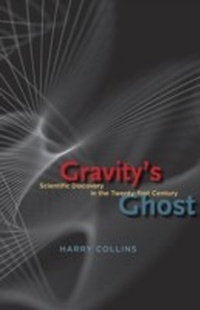
Gravity's Ghost
Description

A gripping look at gravitational wave research and what it says about scientific discovery and the future of the scientific community.
"This fine book pairs exploratory analysis with the pulse of a detective story. Giving a portrait of the way a community chose to test itself on the threshold of new knowledge, Collins offers the rich sociological insight that can only be won from uncommon experience, from a long-standing dialogue with the community he studies, and from a moral engagement in the future of science." - Richard Staley, author of Einstein's Generation: The Origins of the Relativity Revolution
In theory, at least, gravitational waves do exist. We are constantly bathed in gravitational radiation, which is generated when stars explode or collide and a portion of their mass becomes energy that ripples out like a disturbance on the surface of a serene pond. But unfortunately no gravitational wave has ever been directly detected even though the search has lasted more than forty years.
As the leading chronicler of the search for gravitational waves, Harry Collins has been right there with the scientists since the start. The result of his unprecedented access to the front lines of physical science is Gravity's Ghost,a thrilling chronicle of high-stakes research and cutting-edge discovery. Here, Collins reveals that scientific discovery and nondiscovery can turn on scientific traditions and rivalries, that ideal statistical analysis rests on impossible procedures and unattainable knowledge, and that fact in one place is baseless assumption in another.He also argues that sciences like gravitational wave detection, in exemplifying how the intractable is to be handled, can offer scientific leadership a moral beacon for the twenty-first century. In the end, Gravity's Ghostshows that discoveries are the denouements of dramatic scientific mysteries.
"A sociologist embedded (with full access!) in the LIGO Scientific Collaboration chronicles the search for gravitational waves. Though physicists, with very few exceptions, are in no doubt that gravitational waves exist, evidence for their passage through the new kilometer-length interferometers would nevertheless represent the scientific event of the twenty-first century. Harry Collins has turned the initial joined search exploiting the LIGO and Virgo instruments into a detective novel that exquisitely describes the social processes associated with discovery (and statistical analysis) in a large collaborative effort."-Francis Halzen, University of Wisconsin-Madison and Director of Icecube Neutrino Detector Project
All prices
More details
Other editions
Additional editions
Person
Harry Collins is distinguished research professor of sociology at Cardiff University; director of the Centre for the Study of Knowledge, Expertise, and Science; and author of many books, including Gravity's Shadow: The Search for Gravitational Waves, also published by the University of Chicago Press.
Content
- Intro
- Contents
- Introduction
- 1. Gravitational Wave Detection
- 2. The Equinox Event: Early Days
- 3. Resistance to Discovery
- 4. The Equinox Event: The Middle Period
- 5. The Hidden Histories of Statistical Tests
- 6. The Equinox Event: The Denouement
- 7. Gravity's Ghost
- Envoi: Science in the Twenty-First Century
- Postscript: Thinking after Arcadia
- Appendix 1: The Burst Group Checklist as of October 2007
- Appendix 2: The Burst Group Abstract Prepared for the Arcadia Meeting
- Acknowledgments
- References
- Index

