

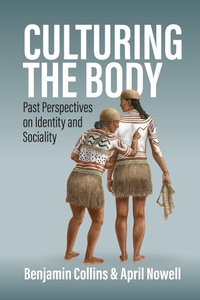
Culturing the Body
Description

The human body is both the site of lived experiences and a means of communicating those experiences to a diverse audience. Hominins have been culturing their bodies, that is adding social and cultural meaning through the use pigments and objects, for over 100,000 years. There is archaeological evidence for practices of adornment of the body by late Pleistocene and early Holocene hominins, including personal ornaments, clothing, hairstyles, body painting, and tattoos. These practices have been variously interpreted to reflect differences such as gender, status, and ethnicity, to attract or intimidate others, and as indices of a symbolically mediated self and personal identity. These studies contribute to a novel and growing body of evidence for diversity of cultural expression in the past, something that is a hallmark of human cultures today.
More details
Other editions
Additional editions
Persons
Benjamin Collins is affiliated with the Department of Anthropology, University of Manitoba, and the Department of Archaeology, University of Cape Town. His research explores social networks and connections among past forager societies.
Content
List of Illustrations
Foreword: Culturing Emergent Bodies
Rosemary Joyce
Acknowledgments
Introduction: Towards a Culturing of the Paleolithic Body
April Nowell and Benjamin Collins
Chapter 1. Enveloping Oneself in Others: Semiotic, Spatial, and Temporal Dimensions of Ostrich Eggshell Bead Use in Southern Africa
Peter J. Mitchell and Brian A. Stewart
Chapter 2. Manufacturing Social Landscapes: Bead Production, Exchange, and Social Connections at Grassridge Rockshelter, South Africa
Benjamin Collins, Amy Hatton, April Nowell, and Christopher J. H. Ames
Chapter 3. Perspectives on Stone Age Sociality: A New Role for Ostrich Eggshell Beads
Jennifer M. Miller
Chapter 4. A Shell Bead from a Faraway Ocean: Significance Assessment of a Single Indigenous Ornament from Southern Australia
Keryn Walshe
Chapter 5. Building identities and social organization throughout the Early Holocene: Interpreting the personal adornments of the last hunter-gatherers in Portugal
Lino André
Chapter 6. Beads on the edge of the world: Atlantic identity and sociality during the Upper Paleolithic of western Iberia
Nuno Bicho and Lino André
Chapter 7. Constructing Identity: Body decoration and modification in the Swabian Aurignacian
Ewa Dutkiewicz, Sibylle Wolf, Elizabeth C. Velliky, and Nicholas J. Conard
Chapter 8. What's in a color? Ochre use in the Middle Stone Age of Southern Africa
Tammy Hodgskiss
Chapter 9. The Best Dressed Hominin: Clothing, tanning and textile production in the Paleolithic
April Nowell and Aurora Skala
Conclusion: Culturing Bodies in the Past: Similarities Across Diversity
Benjamin Collins and April Nowell
Index
