

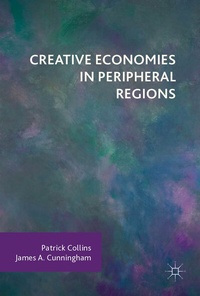
Creative Economies in Peripheral Regions
Description

Economies are dynamic entities and subject to constant flux. Driven by changing tastes, new ways to make and disruptive innovations, new routes of economic development present themselves at ever increasing rates. This study is concerned with the rise of the creative economy. UNCTAD has marked the emergence of the creative economy across the globe and noted its resilience in the face of recent economic turmoil. Here, the authors intend to bring the level of analysis down to the regional and firm level by uncovering the extent of the creative economy in some of Europe's most peripheral regions.
This is the first study to draw on international research carried out across four EU member states to add to the neglected area of the creative economy of peripheral regions. The work contributes to expanding theory in the areas of economic geography, business studies and regional development.
More details
Other editions
Additional editions
Persons
Patrick Collins is an economic geographer who has published in the areas of regional development, the information society, and the impact of telecommunications provision. Recently, Patrick has investigated the economic contribution of creative and cultural industries to Galway and the west of Ireland more generally. Patrick is currently Lecturer at the School of Geography and Archaeology NUI Galway.
James A. Cunningham is Professor of Strategic Management at Newcastle Business School at Northumbria University. His research interests intersect innovation, entrepreneurship and strategic management. His current research interests include strategy issues with respect to principal investigators as scientific entrepreneurs and market shapers; university technology transfer and commercialisation; academic and technology entrepreneurship and entrepreneurial universities.
Content
