

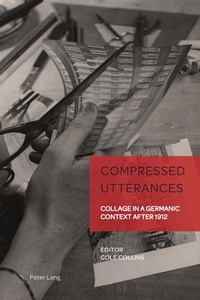
Compressed Utterances
Description

«Compressed Utterances brings focused attention to collage in a Germanic context, whose contours and impact are still so little appreciated. As this stunning volume shows, collage serves as a key medium not only for understanding art historical developments but social and political transformations as well, often embodying the dynamic forces of avant-garde criticality.»
(Thomas O. Haakenson, Associate Professor, History of Art and
Visual Culture, California College of the Arts)
«A deep dive into the paradigmatic medium of the twentieth century, Compressed Utterances is the foundational text of the growing field of collage studies. The book's established and emerging authors investigate an astonishing range of previously unknown collage work to explore German artists' and writers' deployment of this medium as appropriative, intertextual, alienating, and temporally slippery.»
(Elizabeth Otto, Professor of Modern and Contemporary Art,
The University at Buffalo, State University of New York)
Composite pictures create narratives and images from many fragments. They turn often disparate and juxtaposing images and text into a singular image or message. Collage makes from the broken and, arguably, no other country has reflected the fractious nature of its history more than Germany.
The collage form is one of the best expressive forms to be taken up and experimented with by German artists since 1912. Compressed Utterances: Collage in a Germanic Context after 1912 brings together essays by scholars, students and curators to examine the use of collage by German-speaking artists, making in their homeland and abroad, whose works are closely connected to the tumultuous histories of Germany and neighbouring German-speaking nations since 1912 to the late 2000s.
More details
Other editions
Additional editions
Person
Cole Collins is a researcher and lecturer at the Technische Universität München at the Chair of History and Theory of Architecture, Art and Design. He has written and researched on Kurt Schwitters, collage and gender. He is Assistant Editor for the Kurt Schwitters Society and co-convenor of the Collage Research Network. He has taught on collage, gender and queer studies in modern and contemporary art and architecture, Bauhaus, Dada, artistic manifestos, as well as on performance art, installation and dance. He has held guest lectureships at Akademie der Bildenden Künste München, Leuphana University Lüneburg, Passau University and California College of the Arts.
Content
Contents: Collage's Interrelations: Text, Geography and Materiality - David Ragnar Nelson: City of Paper: The Materiality of Montage in Alfred Döblin's Berlin Alexanderplatz (1929) - Astrid von Asten: «I Was Haunted by the Idea of Doing Something Absolute»: Hans Arp, Pioneer of Non-Objective Collage - Collage and Appropriation - Brett M. Van Hoesen: Colonial Botany and the Collages of Max Ernst - Ana María Gómez López: Fossils and Clippings as Odds and Ends: Johannes Weigelt's Elusive Photomontages in Nazi Germany - Defining and Re-Defining Collage in a Postwar Context - Adrian Sudhalter: Collage as Symbolic Form: Margaret Miller, Collage and the «Dislocations of War» - Michael White: Montage Reassembled: Dada in the Postwar Archive - Collage and Corporeality - Oona Lochner: Cutting Across Lines: Lil Picard and the Reorienting Effects of Collage - Lisa Lee: Thomas Hirschhorn and the Incommensurable Gesture.
