

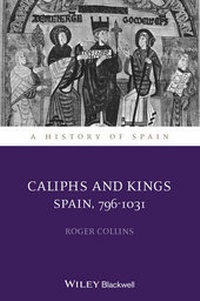
Caliphs and Kings
Description

Reviews / Votes
"A blessing for faculty, but also a very usefulintroduction for students." (H-Soz-u-Kult, March2014) "Caliphs and Kings: Spain, 796-1031is a book forreaders who seek interesting stories culled from Christianhistorical sources from the period from 796-1031, rather thanfor those who seek a book on the caliphal aspects of the sameperiod." (Project Muse, 1 June 2014) "Supported by useful royal genealogies and a vastbibliography. Summing Up: Highly recommended. Alllevels/libraries." (Choice, 1 November 2012)'Dr Collins has provided a commendably clear, insightful and scholarly guide to the Umayyad period in Iberia. This latest volume maintains the high standard of Wiley-Blackwell's distinguished History of Spain series.' --Simon Barton, University of ExeterMore details
Other editions
Additional editions
Person
Content
1
Al-Andalus
War and Society, 796–888
The Annalists
The problems we face in using the Arabic sources for the history of al-Andalus in the ninth to eleventh centuries are both fewer and simpler than those met with in trying to make sense of the preceding period of the conquest, the rule of the governors, and of the first two Umayyads (711–796).1 But we need to understand the purposes for which they were written and the relationships between them. Some of the earliest historical writings in al-Andalus were composed to resolve legal questions rather than provide factual narratives of events for their own sake. By the early part of the tenth century, however, Andalusi historians were motivated by rather different concerns and began using the relatively copious records of the Umayyad court to produce substantial narrative works containing detailed information on a number of specific topics. These included the appointments made by the ruler each year to military commands and to judicial and administrative posts; the deaths of distinguished individuals; and the aim, course, and outcome of any military expeditions, including the numbers of “infidels” killed and captured.2 The practice of compiling such lists goes back to the earliest phases of Islamic historiography in the mid-eighth century.3
Based on such yearly records kept by the Umayyad administration, these narrative histories generally took an annalistic form and structured their content into annual units. Only when a ruler died would this pattern be modified, when reports of his life, his wives, his children, his age and appearance, and the chief ministers who had served him would be included in a round-up section added to the appropriate annal. This pattern of historical writing was definitely not unique to al-Andalus, having first emerged around the middle of the eighth century in Syria, quite possibly influenced by the Syriac tradition of annal writing. It developed gradually into its full-grown form in the work of writers such as al-abar (d. 923) in the ‘Abbsid caliphate from the early ninth century onwards, and its Western equivalents generally followed a generation or more later.4 Indeed, some of the Andalusi historians wrote with the deliberate aim of providing information on Western events largely overlooked by their ‘Abbsid predecessors. Such a genesis in the official records of the Umayyad court makes the work of these historians extremely valuable, though it has to be accepted that the details given in government reports can be exaggerated, especially when it is a matter of publicizing the dynasty's achievements.
A more serious problem than allowing for propagandistic distortion of the details of military and other achievements is the fact that many of these works have been lost or survive only as fragments preserved in the larger-scale compilations of later generations of historians. Inevitably this raises the question of how such excerpts were made. Were they verbatim or did a later writer edit or condense the text he was borrowing, possibly interpolating other material? In some cases the survival of fragments of a work permits comparisons with the way it was used by later writers and thus reveals how faithful they were to the texts they were copying or excerpting.
For example, only some sections of the work of the most important Andalusi historian for this period, Ibn ayyn (d. 1076), have survived intact, but the whole of it was used as a source by a North African annalist, Ibn ‘Idhr, who was writing in 1313/4.5 Where direct comparison can be made, it is clear that sometimes Ibn ‘Idhr lightly condensed his predecessor's work but did not otherwise change or distort the information he took from it. However, it would seem that Ibn ayyn was not Ibn ‘Idhr's only source, as the latter's work includes information not found in the earlier author. As he did not name his informants, we can only guess at whom these others may have been. So, we cannot simply use Ibn ‘Idhr's text as a means of reconstructing the lost sections of that of Ibn ayyn.
A general problem with the narrative sources for the history of al-Andalus that may surprise Western medievalists is their limited manuscript survival. Most equivalent Latin historical texts, from any period and almost any part of medieval Christian Europe, normally survive in more than one manuscript copy, and most of them are preserved in many. In most cases, too, at least some of these copies were written close to the lifetime of the author, and in a few instances include authorial originals. The rate of survival of not only Arabic but also Latin works written in al-Andalus in these centuries is generally rather low. In many cases such texts are now only found in a single manuscript, which is usually several centuries later in date than the period of original composition.
A good but not untypical example is that of what is probably the only surviving section of the seventh book of the Muqtabis of Ibn ayyn, which covers the history of the Umayyad court in the years 971 to 975 in remarkable detail. This came to light during a visit by the foremost Spanish Arabist of the day, Don Francisco Codera (1836–1917), to Algeria and Tunisia in 1886. His journey was sponsored by the Real Academia de la Historia in Madrid and aimed at the discovery of manuscripts containing Arabic historical texts relating to al-Andalus. Alerted to the existence of two such codices in the Algerian town of Constantine (Qusan⃛nah), he tried to purchase them via the local Spanish vice-consul, who made the necessary enquiries. The owners, the “heirs of Sd ammda,” would not sell but allowed the vice-consul to keep the two manuscripts for a fortnight. By the time Codera was informed and made his way to Constantine, only four of those days remained. He recognized the importance of the finds, especially of the section of the Muqtabis that formed part of the contents of one of them, and commissioned a local scribe named al-Fakkn to make a copy, to be sent on to him in Madrid in due course.6
More leisurely study of that copy, completed in 1887, revealed, from a dated colophon, that the manuscript in Constantine was itself a copy of an original made in Ceuta in 1249. But when the manuscript in Constantine owned by the heirs of Sd ammda had been written could not be established. It itself vanished sometime after the 1887 copy was made. Codera was pleased with al-Fakkn's calligraphy, but when it was examined more closely with an eye to an edition of the text, the intending editor, Don Emilio García Gómez (1905–1995), said that al-Fakkn had “copied mechanically, without understanding much of what he was writing; he took no account of the disordered state of the original” – many of the folios being in the wrong order. Another distinguished scholar characterized it as “a bad copy” and “almost useless.”7 Yet this is all we have, as far as this text is concerned: a poor copy made in 1887 by a semi-literate scribe, which requires substantial editorial alteration of its text to make sense of the contents. The undated manuscript from Constantine, the manuscript from Ceuta of 1249 that it copied, and Ibn ayyn's authorial original from the eleventh century are all lost.8
As the study of better preserved texts shows, the process of copying results in the introduction of new errors each time it occurs, and a modern edition would normally rely on many or all of the extant manuscripts in attempting to reconstruct the author's original version. Where a work only survives in a single, late manuscript, it can be assumed that its text will have been corrupted by several generations of scribal errors, affecting names of persons and places in particular, as these are the most prone to such corruption. In addition, when a work is only to be found in a single and relatively late manuscript, as for example with the earliest surviving section of that of Ibn ayyn referred to above, we cannot be confident that we possess the most authoritative version of it. Thus, it could be that the material in the comparable parts of Ibn Idhr not found in Ibn ayyn, and which we therefore deduce must have come from another source or sources, actually derives from a fuller or less corrupt version of Ibn ayyn's text than the one contained in our sole manuscript of it.
Where the scholar working on Arabic texts can have a hypothetical advantage over one studying medieval Latin ones is that there is a much greater chance of new manuscripts being discovered. In particular, the recent revelation that large libraries of Arabic manuscripts have survived in mosques and madrassas in parts of West Africa, particularly in Timbuktu in Mali, is of particular significance for those interested in al-Andalus, in the light of the close political and trading links between these two areas in the Almoravid (1090–1147) and Almohad (1147–c.1220) periods, and the fact that Andalusi refugees certainly took manuscript books with them into exile in northern Africa in the centuries that followed.9
The earliest phase of historical writing in al-Andalus was prompted primarily by legal debates, such as whether a particular territory had been conquered forcefully or had submitted willingly following an initial Arab victory. On the answer to this depended many practical issues, such as the nature and extent of tribute to be levied and its distribution amongst the...
