
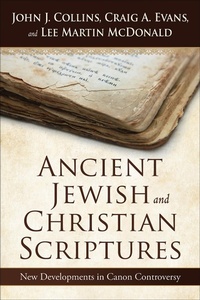
Ancient Jewish and Christian Scriptures
Description
Alles über E-Books | Antworten auf Fragen rund um E-Books, Kopierschutz und Dateiformate finden Sie in unserem Info- & Hilfebereich.
Ancient Jewish and Christian Scriptures examines the writings included in and excluded from the Jewish and Christian canons of Scripture and explores the social settings in which some of this literature was viewed as authoritative and some was viewed either as uninspired or as heretical. John J. Collins, Craig A. Evans, and Lee Martin McDonald examine how those noncanonical writings demonstrate the historical, literary, and religious aspects of the culture that gave rise to the writings. They also show how literature excluded from the Jewish and Christian canons of Scripture remains valuable today for understanding the questions and conflicts that early Jewish and Christian faith communities faced. Through this discussion, contemporary readers acquire a broader understanding of biblical Scripture and of Jewish and Christian faith inspired by Scripture.
All prices
More details
Other editions
Additional editions
Persons
John J. Collinsis Holmes Professor of Old Testament Criticism and Interpretation at Yale Divinity School. His books includeJewish Wisdom in the Hellenistic Age;Apocalypse, Prophecy, and Pseudepigraphy: On Jewish Apocalyptic Literature; The Invention of Judaism: Torah and Jewish Identity from Deuteronomy to Paul; and, most recently, What Are Biblical Values? What the Bible Says on Key Ethical Issues.Collins serves as general editor of the Anchor Yale Bible and Anchor Yale Bible Reference Library. He is on the editorial board of theJournal for the Study of JudaismandDead Sea Discoveries.Previously, he has served as President of the Society of Biblical Literature and the Catholic Biblical Association.
Content
- Intro
- Endorsements
- Half Title
- Title Page
- Copyright
- Contents
- Acknowledgments
- Abbreviations
- Introduction (Collins, Evans, McDonald)
- 1. The Penumbra of the Canon: What Do the Deuterocanonical Books Represent? (Collins)
- 2. Beyond the Canon: The Recovery of the Pseudepigrapha (Collins)
- 3. Nonbiblical Literature in the Dead Sea Scrolls (Collins)
- 4. Recognizing Jewish Religious Texts as Scripture (McDonald)
- 5. Forming Jewish Scriptures as a Biblical Canon (McDonald)
- 6. Recognizing Christian Religious Texts as Scripture (McDonald)
- 7. Forming Christian Scriptures as a Biblical Canon (McDonald)
- 8. The Christian Apocrypha (Evans)
- 9. The Gospels of Peter and Thomas (Evans)
- Conclusion (Collins, Evans, McDonald)
- Bibliography
- Index of Ancient Writings
- Index of Modern Authors
- Index of Subjects
- Excerpt from Forgotten Scriptures: The Selection and Rejection of Early Religious Writings, by Lee Martin McDonald

System requirements
File format: ePUB
Copy protection: Adobe-DRM (Digital Rights Management)
System requirements:
- Computer (Windows; MacOS X; Linux): Install the free reader Adobe Digital Editions prior to download (see eBook Help).
- Tablet/smartphone (Android; iOS): Install the free app Adobe Digital Editions or the app PocketBook before downloading (see eBook Help).
- E-reader: Bookeen, Kobo, Pocketbook, Sony, Tolino and many more (not Kindle).
The file format ePub works well for novels and non-fiction books – i.e., „flowing” text without complex layout. On an e-reader or smartphone, line and page breaks automatically adjust to fit the small displays.
This eBook uses Adobe-DRM, a „hard” copy protection. If the necessary requirements are not met, unfortunately you will not be able to open the eBook. You will therefore need to prepare your reading hardware before downloading.
Please note: We strongly recommend that you authorise using your personal Adobe ID after installation of any reading software.
For more information, see our ebook Help page.
File format: PDF
Copy-Protection: Adobe-DRM (Digital Rights Management)
System requirements:
- Computer (Windows; MacOS X; Linux): Install the free reader Adobe Digital Editions prior to download (see eBook Help).
- Tablet/smartphone (Android; iOS): Install the free app Adobe Digital Editions or the app PocketBook before downloading (see eBook Help).
- E-reader: Bookeen, Kobo, Pocketbook, Sony, Tolino and many more (only limited: Kindle).
The file format PDF always displays a book page identically on any hardware. This makes PDF suitable for complex layouts such as those used in textbooks and reference books (images, tables, columns, footnotes). Unfortunately, on the small screens of e-readers or smartphones, PDFs are rather annoying, requiring too much scrolling.
This eBook uses Adobe-DRM, a „hard” copy protection. If the necessary requirements are not met, unfortunately you will not be able to open the eBook. You will therefore need to prepare your reading hardware before downloading.
Please note: We strongly recommend that you authorise using your personal Adobe ID after installation of any reading software.
For more information, see our eBook Help page.
File format: ePUB
Copy protection: Watermark-DRM (Digital Rights Management)
System requirements:
- Computer (Windows; MacOS X; Linux): Use a reading software that can process the file format ePUB: e.g., Adobe Digital Editions or FBReader – both free (see eBook Help).
- Tablet/Smartphone (Android; iOS): Before downloading, install the free app Adobe Digital Editions (see eBook Help).
- E-reader: Bookeen, Kobo, Pocketbook, Sony, Tolino and many more (not Kindle).
The file format ePUB works well for novels and non-fiction books – i.e., „flowing” text without complex layout. On an e-reader or smartphone, line and page breaks automatically adjust to fit the small displays.
This eBook uses Watermark-DRM, a „soft” copy protection. This means that there are no technical restrictions to prevent illegal distribution. However, there is a personalised watermark embedded in the eBook that can be used to identify the purchaser of the eBook in the event of misuse and to provide evidence for legal purposes.
For more information, see our eBook Help page.
