

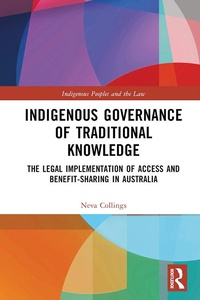
Indigenous Governance of Traditional Knowledge
The Legal Implementation of Access and Benefit-Sharing in Australia
1st Edition
Published on 17. August 2023
296 pages
978-1-000-92763-4 (ISBN)
Description

This book addresses the issue of Indigenous peoples' participation in genetic resource access and benefit-sharing and associated traditional knowledge for self-determination.
Genetic resources from nature are increasingly used in global biodiscovery research and development, but they often use Indigenous peoples' traditional knowledge without their consent and without sharing the benefit. The Nagoya Protocol is an instrument of the Convention on Biological Diversity intended to ensure Indigenous peoples' traditional knowledge is used with their prior and informed consent or approval and entails benefit-sharing on mutually agreed terms. Many countries with significant Indigenous populations have signed the Nagoya Protocol and are currently grappling with implementation of its provisions. This book takes up a case study of Australia to demonstrate how Indigenous community governance in settler states can serve as a path to implementing the Nagoya Protocol. Australia's access and benefitsharing framework is globally hailed as best practice, offering lessons for other countries implementing the Nagoya Protocol. Focusing on two Indigenous community organisations in Australia, the book establishes a unique evaluative framework for analysing and differentiating the governance arrangements used by Indigenous communities for facilitating decision-making related to traditional knowledge.
This book will appeal to scholars working in the areas of international environmental law, human rights, biotechnology law, and Indigenous legal issues; as well as those directly engaged in implementing access and benefit-sharing measures and developing law reform strategies.
Genetic resources from nature are increasingly used in global biodiscovery research and development, but they often use Indigenous peoples' traditional knowledge without their consent and without sharing the benefit. The Nagoya Protocol is an instrument of the Convention on Biological Diversity intended to ensure Indigenous peoples' traditional knowledge is used with their prior and informed consent or approval and entails benefit-sharing on mutually agreed terms. Many countries with significant Indigenous populations have signed the Nagoya Protocol and are currently grappling with implementation of its provisions. This book takes up a case study of Australia to demonstrate how Indigenous community governance in settler states can serve as a path to implementing the Nagoya Protocol. Australia's access and benefitsharing framework is globally hailed as best practice, offering lessons for other countries implementing the Nagoya Protocol. Focusing on two Indigenous community organisations in Australia, the book establishes a unique evaluative framework for analysing and differentiating the governance arrangements used by Indigenous communities for facilitating decision-making related to traditional knowledge.
This book will appeal to scholars working in the areas of international environmental law, human rights, biotechnology law, and Indigenous legal issues; as well as those directly engaged in implementing access and benefit-sharing measures and developing law reform strategies.
More details
Series
Edition
1. Auflage
Language
English
Place of publication
London
United Kingdom
Publishing group
Taylor & Francis Ltd
Target group
College/higher education
Illustrations
2 Tables, black and white; 3 Line drawings, black and white; 3 Halftones, black and white; 6 Illustrations, black and white
ISBN-13
978-1-000-92763-4 (9781000927634)
Copyright in bibliographic data and cover images is held by Nielsen Book Services Limited or by the publishers or by their respective licensors: all rights reserved.
Schweitzer Classification
Other editions
Additional editions
Neva Collings
Indigenous Governance of Traditional Knowledge
The Legal Implementation of Access and Benefit-Sharing in Australia
Book
04/2025
1st Edition
Routledge
€61.70
Shipment within 10-20 days
Neva Collings
Indigenous Governance of Traditional Knowledge
The Legal Implementation of Access and Benefit-Sharing in Australia
Book
08/2023
1st Edition
Routledge
€206.80
Shipment within 10-20 days
Person
Neva Collings is an Aboriginal lawyer currently practising in New South Wales, Australia.
Content
1. Introduction 2. International Legal Framework: Respecting Traditional Knowledge and Fair and Equitable Benefit-Sharing 3. Australia's Implementation of the Convention on Biological Diversity and Supplementary Bonn Guidelines and Nagoya Protocol 4. Aboriginal and Torres Strait Islander Peoples' Governance and the Role of Incorporated Organisations in Domestic Measures Under the Framework of the Nagoya Protocol 5. Case Study of the Gawler Ranges Aboriginal Corporation 6. Case Study of the North Australian Indigenous Land and Sea Management Alliance Ltd (NAILSMA) 7. Comparing the Legal Governance of GRAC and NAILSMA for Sharing and Protecting Traditional Knowledge 8. Main Conclusions and Steps for the Future
