

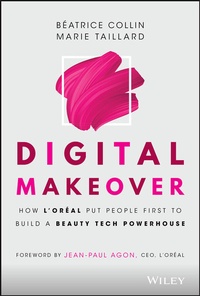
Digital Makeover
Description

Digital Makeover: How L'Oréal Put People First to Build a Beauty Tech Powerhouse examines L'Oréal's successful people-driven digital transformation. Professors and authors Beatrice Collin and Marie Taillard set out exactly how L'Oréal turned itself into a digital and tech powerhouse by building on its legacy to reimagine relationships inside the company, and with its customers and partners.
Digital Makeover comprehensively describes L'Oréal's strategy, including:
* Maintaining market leadership in the face of disruption
* Believing in the transformative power of the organization, its legacy and its people
* A social-centric approach to beauty tech, ecommerce and digital services
* The company's successful play for market dominance in China
* Case studies that showcase best practices for digital transformation across sectors
Digital Makeover is perfect for anyone interested in business strategy, marketing, or digital transformation, as well as businesspeople and leaders from inside and outside the beauty industry and belongs on the shelves of anyone with an interest in organizational transformation, management, leadership, and digital strategies.
More details
Other editions
Additional editions
Persons
MARIE TAILLARD is Professor of Marketing at ESCP Business School. She has over thirty years of experience supporting small and large companies worldwide and teaches across continents in graduate and executive learning programs. Her research focuses on digital transformation and customer centricity.
Content
Introduction: Building a Beauty Powerhouse xiii
Part I Four Foundational Pillars 1
1 Orchestrate Creativity 3
The Importance of an Evangelist 4
Time to Improvise 6
From Creative Chaos to Orchestrated Rigor 13
Enabling Resonance 16
2 Cultivate Healthy Doubt 21
Productive Anxiety 22
Challenging the Status Quo 23
Permanent Questioning 24
The Dual Innovation Channel 25
Balancing Passion with Science 26
Tensions and Achievements 27
Market Leader and Challenger 28
3 Learn and Innovate with Rigor 37
Innovators Are Most Valuable Players 39
Do, Undo, and Redo 42
Incubators as Promoters of Change 47
4 Listen with Curiosity 51
Politeness of the Heart 54
Seizing What's Emerging 59
L'Oréalization 60
Full Color Palette 61
Ban the Boring 64
An Open Innovation Ecosystem 65
Part II A Human-Centered Transformation 71
5 Centering Customers 73
A Focus Shift 75
Precision Marketing 80
Seamless Customer Journeys 81
The Strategic Use of Data 84
6 Becoming Social 89
Social Centricity 92
Friends Find Solutions 94
Friends Give Advice 95
Friends Take You Places 96
Friends Share Their Looks 97
Friends Shop with You 98
Friends Stick Together 100
7 Transforming Relationships with Partners 105
From a Chain to an Ecosystem 106
Ecosystems' Key Attributes 108
Ecosystems Perform in Times of Crisis 114
8 Putting People First 119
Teams Are the New Heroes 122
Customer Satisfaction Is the New Product Performance 124
Eat What You Cook Is the New Leave Before It Burns 125
Frame and Trust Is the New Control 128
Problem-Solving Together Is the New Meeting Behavior 130
Empowerment Is the New Management 132
Test and Learn Is the New Perfection 133
Cooperation Is the New Confrontation 135
Conclusion 139
Acknowledgments 143
About the Authors 147
Appendix 1: L'Oréal's History: A Timeline of Significant Dates 151
Appendix 2: Timeline of L'Oréal's Acquisitions and Strategies 153
Appendix 3: A Selection of L'Oréal Brands by Category 2020 159
Appendix 4: Global Beauty Industry Data 161
Notes 167
References 175
Index 183
1
ORCHESTRATE CREATIVITY
Mention digital transformation and you conjure up ideas about e-commerce, social networks, and big data. Too often, we overlook the fact that it is also about the strategic and organizational processes within the company itself. Digital transformation brings with it profound organizational change, a change that relies on and impacts individuals deep in the ranks of the company yet requires coordination by a strong leader.
At L'Oréal, CEO Jean-Paul Agon initiated and orchestrated the transformation by preaching relentlessly for change and by drawing from the company's legacy and culture to activate the transformation. L'Oréal has a long tradition of balancing creativity and inspiration with discipline and scientific rigor, whether it be in its dual-channel approach to research or its distinctive market-entry strategies. When encouraged to emanate from deep within the organization, creativity delivers innovative solutions that are truly relevant and responsive to the market. Scientific discipline and rigor can boost the impact of disparate solutions from across the organization by turning them into explicit knowledge to be shared throughout the organization.
For Agon-faced with a double objective of bringing the entire organization on board and transforming it through and through-the tried-and-true blend of creativity and rigor offered a natural path forward. Although the need for a profound transformation seems obvious in retrospect, the 2010 context in which Agon declared a digital emergency was very different from our current understanding of the business landscape. Having had the vision and confidence to declare a digital emergency, Agon not only needed to get buy-in throughout, he also had to think ahead to how he would operationalize the transformation more broadly. In resolving this dilemma, Agon's priority course of action combined a strong and urgent message from the top with an invitation to the entire organization to innovate and improvise.
Enabling improvisation is an important way for a leader to blend creativity and discipline. Jazz music is legendary for its reliance on improvisation, as illustrated by the story of trumpet player and bandleader Miles Davis's recording session for his 1959 album, Kind of Blue. Davis showed up at the recording studio with two new musical modes that had never been played before. With no time to reflect on how to use these modes, band members had to improvise by integrating them into the performance at the same time they discovered the modes: they combined the creativity of adapting the forms to their own style and mood with the rigor of sticking to the required forms. Kind of Blue turned out to be one of the greatest jazz recordings of all time. No time to ask questions-just discover, dive in, and improvise. Agon's digital emergency declaration was nothing short of the proclamation of a new type of musical harmony for L'Oréal. While the score was being written, he demanded that the entire organization face up to this new beat and let it guide and inspire future initiatives. These improvised responses, tentative and disparate at first, would eventually be harmonized and made to rise into a full-blown collective achievement: creativity integrated with discipline.
Having inspired improvisation, Agon launched the second phase of L'Oréal's digital transformation by appointing a CDO. There was still plenty of room for improvisation but, little by little, improvised practices were formalized and shared across units and supported by the new leader as cohesion, harmony, and systematicity traveled from the parts to the whole. Throughout the process, Agon held on to his evangelist role by consistently delivering the same urgent and reassuring message: digital is our collective imperative; it starts with you, but it belongs to all of us.
The Importance of an Evangelist
Digital transformation is first and foremost a change process. And, as with any significant change, it requires strong leadership and determination if it is to succeed. This simple statement does not, however, capture the true complexity of transformation. And this is particularly true for a digital makeover, where everything ranging from new products to new partnerships, new manufacturing processes to new supply chains, new practices to new functions and business units has to be rethought from scratch. It must all be reimagined and reinvented, often in real time, and in a context of great uncertainty, volatility, and, very often, anxiety throughout the company.
From the start of his digital mission, Agon was driven by his profound belief that the moment for transformation had come and that any delay would severely jeopardize the future of the company. Having decreed 2010 "the digital year," he embarked on a crusade to convince L'Oréal's employees that digital transformation was no longer optional, a message he reinforced consistently and vehemently over time. In true L'Oréal fashion, much of Agon's conviction came from his observations and discussions with leaders across sectors and his thorough understanding of the sector and the market. He notes, "Some friends in the digital world were explaining what was going on, and I realized a tsunami was coming. I could see it from far away."1 Throughout the history of L'Oréal, the CEO's personal conviction provided the impetus for major changes; that conviction has often developed organically through personal experience, sometimes serendipitously, other times more systematically.
Among L'Oréal's direct competitors, French cosmetics house Clarins had already begun to make significant strides in digital transformation. On the retail side, Sephora was developing innovative approaches, particularly in the United States, built on data collection using its loyalty programs and e-commerce platforms. While L'Oréal's direct big competitors were increasingly investing in digital media and distribution, none of them had undergone a wholesale digital transformation. Similarly, digital had yet to accelerate the beauty sector's massive shift toward the ascent of indie brands, often led by highly influential celebrities. Agon's crusade was motivated by his faith in the power of digital, but it also reflected his recognition that there were no simple rules of the game for how to go about orchestrating a digital transformation. There was no roadmap and Agon wasn't about to pretend to have one.
One thing Agon understood from the very beginning is that digital transformation, more than any previous type of change initiative, must involve the entire organization and, beyond that, the whole system around it, including its customers and partners such as distributors, retailers, and others. Not only does digital transformation foster greater participation within the entire system, but it can only happen through a participative process, a lesson that brands learned the hard way early on when they tried to censor customer reviews or critics. In 2010, having been accused by Greenpeace of using unsustainable palm oil in its KitKat bars, Nestlé tried to silence the critics by claiming their video, which had gone viral, broke copyright laws. The social media uproar was such that the company had to reverse course. It learned that the power of consumers could not simply be ignored and instead had to be used as an opportunity to better understand and respond to their needs. Nestlé eventually learned to engage with its critics and the wider market, and used the opportunity to overhaul its product sourcing and policies.2 The very nature of digital technology is that it allows information to circulate freely and to be shareable. Once let loose, information is there to be used by anyone who has access to it and is able to, or chooses to, participate. This is true for customers who share product reviews and how-to tips, as well as for employees whose success stories through trial and error are extolled as best practices.
Agon recognized the value of sharing information to promote participation, as well as the value of participation in the transformation process. He wanted digital transformation to touch all areas of the company and to involve everyone. The process, in his view, demanded an open mind and a relentless desire to experiment. This is the message he repeated every time he spoke, both within and outside the company-he never visited a division or country without addressing the issue of digital transformation and encouraging participation and experimentation. In 2011, for the first time, L'Oréal devoted a chapter of its annual report to digital projects, a move that symbolized the tenacity of Agon and his board of directors in pursuing the digital endeavor as participative.
Across the company, executives began to embark on a series of digital initiatives, many of which were true improvisations. Agon heartily encouraged and supported all of the experiments, even the most imaginative, from taking a chance with up-and-coming influencers to querying search data for creative product development to inventing new ways for hair colorists to better serve their clients.
Time to Improvise
As in many other companies, the early days of digital transformation caused confusion and anxiety. Markets such as the United States took an early lead in integrating digital initiatives around customers' path to purchase.3 In a 2011...
