

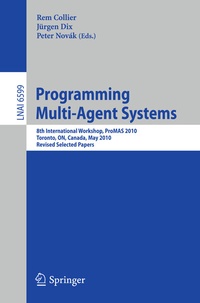
Programming Multi-Agent Systems
8th International Workshop, ProMAS 2010, Toronto, ON, Canada, May 11, 2010. Revised Selected Papers
Published on 28. March 2012
XI, 159 pages
978-3-642-28939-2 (ISBN)
Description

This book constitutes the proceedings of the 8th International Workshop on Programming Multi-Agent Systems held in Toronto, Canada, in May 2010 in conjunction with AAMAS 2010, the 9th International Joint Conference on Autonomous Agents and Multiagent Systems. The 7 revised full papers presented together with 1 invited paper were carefully reviewed and selected for inclusion in the book. The papers cover a broad range of mostly practical topics like decision component of agent systems; practical examples of programming languages; interaction with the environment, and are thus organized in topical sections on reasoning, programming languages, and environments.
More details
Other editions
Additional editions
Rem Collier | Jürgen Dix | Peter Novák
Programming Multi-Agent Systems
8th International Workshop, ProMAS 2010, Toronto, ON, Canada, May 11, 2010. Revised Selected Papers
Book
04/2012
Springer
€53.49
Shipment within 7-9 days
Content
- Title
- Preface
- Organization
- Table of Contents
- Part I: Invited Paper
- Towards Simulation-Aided Design of Multi-Agent Systems
- Introduction
- Running Case Study: Free-Flight-Oriented Air Traffic Control
- Simulation-Aided Design of Multi-Agent Systems
- Core Concepts
- Development Process
- Scope of Applicability
- Design Considerations of the SADMAS Approach
- Bottom-Up System Evolution
- Elaboration Tolerance
- Cross-Platform Portability and Deployment Issues
- Requirements on a SADMAS Platform
- Adjustable Simulation Fidelity
- Rich Environmental Modelling
- Simulation Scalability
- Mixed-Mode Support
- Evaluation Modes
- Discussion and Related Work
- Conclusions and Outlook
- References
- Part II: Reasoning
- Reinforcement Learning as Heuristic for Action-Rule Preferences
- Introduction
- Related Work
- The Agent Language GOAL
- Learning to Solve the Rule Selection Problem
- Reinforcement Learning
- GOAL-RL
- Experiments
- Setup
- Blocks World Experiments
- Logistics Domain Experiments
- Conclusion
- References
- Towards Reasoning with Partial Goal Satisfaction in Intelligent Agents
- Introduction and Motivation
- Background and Related Work
- Example Scenario
- Abstract Framework for Partial Goal Satisfaction
- Goal Template and Goal Instance
- Achievement and Unachievability
- Binary Goal Achievement
- Goal Adaptation
- Reasons for and Uses of Adaptation
- Cost/Benefit Analysis
- Towards an Embedding within a Goal Framework
- Reasoning in the Example Scenario
- Conclusion and Next Steps
- References
- Part III: Programming Languages
- Evaluating Agent-Oriented Programs: Towards Multi-paradigm Metrics
- Introduction
- Why Metrics?
- Measures of Product Quality
- Tools for Software Research
- Related Work
- Motivating Example
- Solution Architecture
- Preliminary Evaluation
- Paradigm-Independent Metrics
- Software as Aggregation Hierarchies
- Discovering Dependencies by Refactoring
- Coupling Between Elements (CBE)
- Lack of Cohesion of Elements (LCE)
- Results
- Conclusions
- References
- Atomic Intentions in Jason
- Introduction
- Jason
- Atomic Intentions
- Atomic Plans in Jason
- Failure of Atomic Plans
- A New Approach to Atomic Intentions
- Delta State
- Delta Belief Base
- Delta Plan Base
- Delta Event List
- Conclusion
- References
- Software Support for Organised Adaptation
- Introduction
- Background Work
- Dynamic Protocol Specification
- System Support for Adaptive Specifications
- PreSage-MS
- PreSage-MS Architecture
- Agents and Environment
- Event Calculus Manager
- Metric Space Plugin
- Environmental State Plugin
- PreSage Experimental Design
- Agent Design
- Protocol Design
- Metric Space Design
- Experimental Design and Example
- Discussion and Related Research
- Further Work
- Summary and Conclusions
- References
- Part IV: Environments
- Action and Perception in Agent Programming Languages: From Exogenous to Endogenous Environments
- Introduction
- Action and Perception in Agent Programming Languages
- The Action Model
- The Perception Model
- An Effective Interaction Model for Endogenous Environments
- Action Side
- Perception Side
- Evaluation Using CArtAgO
- The Action Model at Work
- Exploiting the Perception Model
- Related Works
- Conclusion
- References
- An Interface for Agent-Environment Interaction
- Introduction
- Principles and Meta-model
- Principles
- Meta-model
- A Generic Environment Interface
- Motivating Example: Multi-Agent Contest
- Interface Intermediate Language
- Functional Point-of-View
- Implementation Details
- Related Work
- Conclusion
- References
- Author Index
