

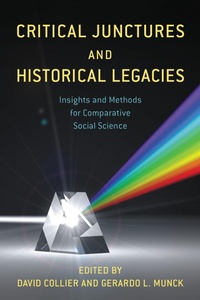
Critical Junctures and Historical Legacies
Insights and Methods for Comparative Social Science
1st Edition
Published on 28. February 2022
520 pages
979-8-8818-7548-0 (ISBN)
Description

Over the past 50 years, scholars across the social sciences have employed critical juncture analysis to understand how social orders are created, become entrenched, and change. In this book, leading scholars from several disciplines offer the first coordinated effort to define this field of research, assess its theoretical and methodological foundations, and use a critical assessment of current practices as a basis for guiding its future. Contributors include stars in this field who have written some of the classic works on critical junctures, as well as the rising stars of the next generation who will continue to shape historical comparative analysis for years to come. Critical Junctures and Historical Legacies will be an indispensable resource for social science research methods scholars and students.
More details
Edition
1. Auflage
Language
English
Place of publication
United States
Publishing group
Bloomsbury Publishing Plc
Illustrations
31 b/w illustrations; 16 tables
ISBN-13
979-8-8818-7548-0 (9798881875480)
Copyright in bibliographic data and cover images is held by Nielsen Book Services Limited or by the publishers or by their respective licensors: all rights reserved.
Schweitzer Classification
Other editions
Additional editions
David Collier | Gerardo L. Munck
Critical Junctures and Historical Legacies
Insights and Methods for Comparative Social Science
Book
03/2022
Rowman & Littlefield Publishers
€132.00
Shipment within 3-4 weeks
Persons
David Collier is Chancellor's Professor Emeritus at the University of California, Berkeley. His scholarly contributions were recognized in 2014, when he received the Johann Skytte Prize, the preeminent international award in the discipline of political science. At Berkeley, he served as Department Chair and Chair of the Center for Latin American Studies. His research focuses on democracy and authoritarianism, Latin American politics, comparative-historical analysis, and methodology. Collier's books include Shaping the Political Arena: Critical Junctures, the Labor Movement, and the Regime Dynamics in Latin America (with Ruth Berins Collier; Princeton University Press, 1991, reissued in 2002), which won the Best Book Prize of the APSA Comparative Politics Section and is a seminal work in the field of critical junctures and comparative historical analysis. His co-authored and co-edited methodological work includes Rethinking Social Inquiry: Diverse Tools, Shared Standards, 2nd expanded edition (Rowman & Littlefield, 2010); Statistical Models and Causal Inference: A Dialogue with the Social Sciences (Cambridge University Press, 2009); Concepts and Method in Social Science (Routledge, 2009), and The Oxford Handbook of Political Methodology (Oxford University Press, 2008). Within the American Political Science Association, he has served as President of the Organized Section for Comparative Politics, Vice President of the Association, and founding President of the Organized Section for Qualitative and Multi-Method Research. Collier is an elected Fellow of the American Academy of Arts and Sciences and of the American Association for the Advancement of Science. His more recent awards, along with the Skytte Prize, include the 2014 Frank J. Goodnow Award for Distinguished Service to Political Science and the American Political Science Association.
Gerardo L. Munck is Professor in the Department of Political Science and International Relations at the University of Southern California (USC). His books include Authoritarianism and Democratization. Soldiers and Workers in Argentina, 1976-83 (Penn State University Press, 1998); Regimes and Democracy in Latin America (Oxford University Press, 2007); Passion, Craft, and Method in Comparative Politics (with Richard Snyder; Johns Hopkins University Press, 2007); Measuring Democracy: A Bridge Between Scholarship and Politics (Johns Hopkins University, 2009); A Middle-quality Institutional Trap: Democracy and State Capacity in Latin America (with Sebastián Mazzuca; Cambridge University Press, 2020); and Contemporary Latin American Politics: The Quest for Democracy and Citizenship Rights (with Juan Pablo Luna; Cambridge University Press, forthcoming, 2022). He is currently completing a book manuscript on the evolution of knowledge about the social world, entitled How Advances in the Social Sciences Have Been Made: The Study of Democracy and Democratization Since 1789. His articles have been published in the Annual Review of Political Science, World Politics, Comparative Politics, and Comparative Political Studies. The awards he has received include the 2003 Award for Conceptual Innovation in Democratic Studies, of the International Political Science Association (IPSA) Committee on Concepts and Methods (C&M) and the Facultad Latinoamericana de Ciencias Sociales (FLACSO), Mexico; and the Frank Cass Prize for Best Overall Article in Democratization in 2016.
Gerardo L. Munck is Professor in the Department of Political Science and International Relations at the University of Southern California (USC). His books include Authoritarianism and Democratization. Soldiers and Workers in Argentina, 1976-83 (Penn State University Press, 1998); Regimes and Democracy in Latin America (Oxford University Press, 2007); Passion, Craft, and Method in Comparative Politics (with Richard Snyder; Johns Hopkins University Press, 2007); Measuring Democracy: A Bridge Between Scholarship and Politics (Johns Hopkins University, 2009); A Middle-quality Institutional Trap: Democracy and State Capacity in Latin America (with Sebastián Mazzuca; Cambridge University Press, 2020); and Contemporary Latin American Politics: The Quest for Democracy and Citizenship Rights (with Juan Pablo Luna; Cambridge University Press, forthcoming, 2022). He is currently completing a book manuscript on the evolution of knowledge about the social world, entitled How Advances in the Social Sciences Have Been Made: The Study of Democracy and Democratization Since 1789. His articles have been published in the Annual Review of Political Science, World Politics, Comparative Politics, and Comparative Political Studies. The awards he has received include the 2003 Award for Conceptual Innovation in Democratic Studies, of the International Political Science Association (IPSA) Committee on Concepts and Methods (C&M) and the Facultad Latinoamericana de Ciencias Sociales (FLACSO), Mexico; and the Frank Cass Prize for Best Overall Article in Democratization in 2016.
Content
Contents
List of Figures and Tables
Preface
Introduction: Tradition and Innovation in Critical Juncture Research
David Collier and Gerardo L. Munck
I. Basics: Core Concepts and Big Substantive Questions
1. Critical Juncture Framework and the Five-Step Template
David Collier
2. Critical Junctures and Developmental Paths: Colonialism and Long-Term Economic Prosperity
James A. Robinson
3. Postwar Settlements and International Order: A Critical Juncture Perspective
G. John Ikenberry
4. Mobilization, Protest, and Conflicts of the 1960s: What Is the Legacy, and How Did It Unfold?
Sidney Tarrow
II. Framework and Methods: Historical Causation and Causal Inference
5. The Theoretical Foundations of Critical Juncture Research: Critique and Reconstruction
Gerardo L. Munck
6. Critical Junctures, Contingency, and Models of Institutional Change
Rachel Beatty Riedl and Kenneth M. Roberts
7. Qualitative Causal Inference and Critical Junctures: The Problem of Backdoor Paths
David Waldner
8. Quantitative Methods and Critical Junctures: The Strengths and Limits of Quantitative History
Gerardo L. Munck
III. Substantive Applications I: States and Political Regimes
9. Nineteenth-Century State Formation and Long-Term Economic Performance in Latin America
Sebastián L. Mazzuca
10. Religion and Critical Junctures: Divergent Trajectories of Liberalism in Modern Europe
Andrew C. Gould
11. Evaluating Critical Junctures in Latin America: Historical vs. Proximate Causes in the 1940s
Ruth Berins Collier
12. Regime Transitions as Critical Junctures: Cultural Legacies of Democratization in Spain and Portugal
Robert M. Fishman
13. Leninist Extinction? Critical Junctures, Legacies, and the Study of Post-Communism
Danielle N. Lussier and Jody LaPorte
IV. Substantive Applications II: Neoliberalism and Political Parties
14. Temporal Distance, Reactive Sequences, and Institutional Legacies: Reflections on Latin America's Neoliberal Critical Junctures
Kenneth M. Roberts
15. A New Critical Juncture? Analyzing Party System Transformation in South American Politics
Samuel Handlin
16. A Fourth Critical Juncture? Party Politics in Contemporary Chile
Timothy R. Scully
17. Potential Mistakes, Plausible Options: Establishing the Legacy of Hypothesized Critical Junctures
Taylor C. Boas
18. Critical Junctures and Contemporary Latin America: A Note of Caution
Robert R. Kaufman
V Conclusion
19. The Power and Promise of Critical Juncture Research
Gerardo L. Munck
Appendix I Conceptions of a Critical Juncture and Cognate Terms
Appendix II Glossary of Terms Used in Critical Juncture Research
Appendix III Bibliography of Substantive Research on Critical Junctures
Appendix IV Examples of Critical Juncture Research
Index
About the Contributors
List of Figures and Tables
Preface
Introduction: Tradition and Innovation in Critical Juncture Research
David Collier and Gerardo L. Munck
I. Basics: Core Concepts and Big Substantive Questions
1. Critical Juncture Framework and the Five-Step Template
David Collier
2. Critical Junctures and Developmental Paths: Colonialism and Long-Term Economic Prosperity
James A. Robinson
3. Postwar Settlements and International Order: A Critical Juncture Perspective
G. John Ikenberry
4. Mobilization, Protest, and Conflicts of the 1960s: What Is the Legacy, and How Did It Unfold?
Sidney Tarrow
II. Framework and Methods: Historical Causation and Causal Inference
5. The Theoretical Foundations of Critical Juncture Research: Critique and Reconstruction
Gerardo L. Munck
6. Critical Junctures, Contingency, and Models of Institutional Change
Rachel Beatty Riedl and Kenneth M. Roberts
7. Qualitative Causal Inference and Critical Junctures: The Problem of Backdoor Paths
David Waldner
8. Quantitative Methods and Critical Junctures: The Strengths and Limits of Quantitative History
Gerardo L. Munck
III. Substantive Applications I: States and Political Regimes
9. Nineteenth-Century State Formation and Long-Term Economic Performance in Latin America
Sebastián L. Mazzuca
10. Religion and Critical Junctures: Divergent Trajectories of Liberalism in Modern Europe
Andrew C. Gould
11. Evaluating Critical Junctures in Latin America: Historical vs. Proximate Causes in the 1940s
Ruth Berins Collier
12. Regime Transitions as Critical Junctures: Cultural Legacies of Democratization in Spain and Portugal
Robert M. Fishman
13. Leninist Extinction? Critical Junctures, Legacies, and the Study of Post-Communism
Danielle N. Lussier and Jody LaPorte
IV. Substantive Applications II: Neoliberalism and Political Parties
14. Temporal Distance, Reactive Sequences, and Institutional Legacies: Reflections on Latin America's Neoliberal Critical Junctures
Kenneth M. Roberts
15. A New Critical Juncture? Analyzing Party System Transformation in South American Politics
Samuel Handlin
16. A Fourth Critical Juncture? Party Politics in Contemporary Chile
Timothy R. Scully
17. Potential Mistakes, Plausible Options: Establishing the Legacy of Hypothesized Critical Junctures
Taylor C. Boas
18. Critical Junctures and Contemporary Latin America: A Note of Caution
Robert R. Kaufman
V Conclusion
19. The Power and Promise of Critical Juncture Research
Gerardo L. Munck
Appendix I Conceptions of a Critical Juncture and Cognate Terms
Appendix II Glossary of Terms Used in Critical Juncture Research
Appendix III Bibliography of Substantive Research on Critical Junctures
Appendix IV Examples of Critical Juncture Research
Index
About the Contributors
