

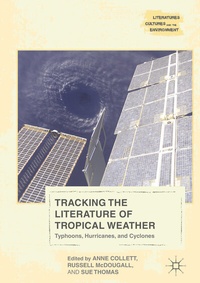
Tracking the Literature of Tropical Weather
Description

This book tracks across history and cultures the ways in which writers have imagined cyclones, hurricanes, and typhoons, collectively understood as "tropical weather." Historically, literature has drawn upon the natural world for its store of symbolic language and technical device, making use of violent storms in the form of plot, drama, trope, and image in order to highlight their relationship to the political, social, and psychological realms of human affairs. Charting this relationship through writers such as Joseph Conrad, Herman Melville, Gisèle Pineau, and other writers from places like Australia, Japan, Mauritius, the Caribbean, and the Philippines, this ground-breaking collection of essays illuminates the specificities of the ways local, national, and regional communities have made sense and even relied upon the literary to endure the devastation caused by deadly tropical weather.
Reviews / Votes
"A landmark compilation elegantly articulating what literature holds about the often devastating-yet rarely adequately reported-impacts of tropical weather extremes on the human condition." (Patrick D. Nunn, Professor of Geography, University of the Sunshine Coast, Australia)
"This engaging collection of essays on Pacific, Indian Ocean, and Caribbean storm-texts reveals how writing about and in response to tropical storms provides insight into cultures of survival and salvage. Unfolding a distinctive discourse of 'tropicality', the authors show how storms and literary culture spin themselves into each other." (Steve Mentz, Professor of English, St. John's University, New York City, USA)
"While tropical storms are often associated with the inevitability of natural disasters, the contributors to this comparative, transnational volume convincingly demonstrate the ways in which they are complex social and climatological events. Here, the turbulence of the tropics is a source of knowledge production, memory, aesthetics, empire, risk, vulnerability, representation, and an illuminator, as well as a catalyst for social relations. This is a welcome 'counter wind' to prevailing representations of the tropics and will certainly transform our understanding of how disastrous events are both historical and representational." (Elizabeth DeLoughrey, Associate Professor of English, UCLA Institute for the Environment and Sustainability, USA)
More details
Other editions
Additional editions
Persons
Anne Collett is Associate Professor of English at the University of Wollongong, Australia.
Russell McDougall is Professor of English at the University of New England, Australia.
Sue Thomas is Professor of English at La Trobe University, Melbourne, Australia.
