

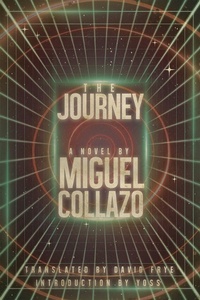
The Journey
Description

Introduced by beloved Cuban science fiction author Yoss as one of the foundational novels of the genre, Miguel Collazo's 1960s classic The Journey is a mind-opening parable of social progress, prophets and reluctant masses, and humanity's metaphysical voyage inward.
On planet Ambar, long ago colonized by scientists who arrived by spaceship, inhabitants no longer live in cities. Generation after generation, Ambarians wander through the desert, the valley, and the ruins as the mysterious "symbols" loom in the sky. Once a new generation develops the ability to broadcast images, feelings and memories to others, they start to hope and wait for a life-changing transformation: The Journey.
Filled with intricate family trees, huge desert flowers, and intelligent automatons, Miguel Collazo's evocative world traces the makings of a civilization that has lost its way and gradually rebuilds itself in a desolate landscape. This multi-generational saga highlights what binds us together as a community and the roles that memory, affection, and hope play in our history.
One of what Cuban science fiction great Daína Chaviano calls the "hexagon of top-notch, almost inimitable Cuban books of the genre," The Journey is essential reading for anyone interested in the roots of Cuban literature and science fiction.
More details
Persons
About the Author:
Miguel Collazo Toledo was born in Havana, Cuba in 1936. A plastic artist and writer, he formed the group Los Cinco, and along with other artists exhibited at the Lex Gallery (1956) and the Biennial of Mexico. He worked as a textile artist at the Textilera Ariguanabo (1960-1962) and as an author of television scripts at CMQ and CMBF (1963). He was a contributor to Diario Libre, Cultura '64, Unión, and La Gaceta de Cuba. He was in charge of national galleries at the General Directorate of the National Council of Culture, where he also worked as a literary adviser in the National Directorate of Literature. In 1999, he took his own life, leaving a scant but important literary legacy, today followed by many.
About the Translator:
When he isn't translating, David Frye teaches Latin American culture and society at the University of Michigan. Translations include First New Chronicle and Good Government by Guaman Poma de Ayala (Peru, 1615); The Mangy Parrot by José Joaquín Fernandez de Lizardi (Mexico, 1816), for which he received a National Endowment for the Arts Fellowship; Writing across Cultures: Narrative Transculturation in Latin America by Ángel Rama (Uruguay, 1982), and several Cuban and Spanish novels and poems.
About the Introducer:
Born José Miguel Sánchez Gómez in Havana, Cuba, in 1969, Yoss assumed his pen name in 1988, when he won the Premio David in the science-fiction category for Timshel. Since then, he has gone on to become one of Cuba's most iconic literary figures-as the author of more than twenty acclaimed books, as a champion of science fiction through his workshops in Cuba and around the world, and as the lead singer of the heavy metal band Tenaz. His four novels translated into English are A Planet for Rent, Super Extra Grande, Condomnauts, and Red Dust.
Content
- Intro
- Introduction
- The Journey
- Part One The Machines
- Part Two Cásel
- Part Three Arnes
- Part Four Cadars
- Part Five The Men of the Projects
