

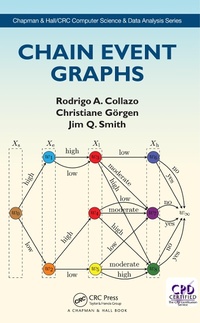
Chain Event Graphs
1st Edition
Published on 29. January 2018
254 pages
978-1-351-64683-3 (ISBN)
Description

Written by some major contributors to the development of this class of graphical models, Chain Event Graphs introduces a viable and straightforward new tool for statistical inference, model selection and learning techniques. The book extends established technologies used in the study of discrete Bayesian Networks so that they apply in a much more general setting
As the first book on Chain Event Graphs, this monograph is expected to become a landmark work on the use of event trees and coloured probability trees in statistics, and to lead to the increased use of such tree models to describe hypotheses about how events might unfold.
Features:
introduces a new and exciting discrete graphical model based on an event tree
focusses on illustrating inferential techniques, making its methodology accessible to a very broad audience and, most importantly, to practitioners
illustrated by a wide range of examples, encompassing important present and future applications
includes exercises to test comprehension and can easily be used as a course book
introduces relevant software packages
Rodrigo A. Collazo is a methodological and computational statistician based at the Naval Systems Analysis Centre (CASNAV) in Rio de Janeiro, Brazil. Christiane Goergen is a mathematical statistician at the Max Planck Institute for Mathematics in the Sciences, Leipzig, Germany. Jim Q. Smith is a professor of statistics at the University of Warwick, UK. He has published widely in the field of statistics, AI, and decision analysis and has written two other books, most recently Bayesian Decision Analysis: Principles and Practice (Cambridge University Press 2010).
As the first book on Chain Event Graphs, this monograph is expected to become a landmark work on the use of event trees and coloured probability trees in statistics, and to lead to the increased use of such tree models to describe hypotheses about how events might unfold.
Features:
introduces a new and exciting discrete graphical model based on an event tree
focusses on illustrating inferential techniques, making its methodology accessible to a very broad audience and, most importantly, to practitioners
illustrated by a wide range of examples, encompassing important present and future applications
includes exercises to test comprehension and can easily be used as a course book
introduces relevant software packages
Rodrigo A. Collazo is a methodological and computational statistician based at the Naval Systems Analysis Centre (CASNAV) in Rio de Janeiro, Brazil. Christiane Goergen is a mathematical statistician at the Max Planck Institute for Mathematics in the Sciences, Leipzig, Germany. Jim Q. Smith is a professor of statistics at the University of Warwick, UK. He has published widely in the field of statistics, AI, and decision analysis and has written two other books, most recently Bayesian Decision Analysis: Principles and Practice (Cambridge University Press 2010).
Reviews / Votes
"Statisticians Collazo, Goergen, and Smith provide a thorough introduction to the methodology of chain event graphs. The authors present background on discrete statistical modeling and the use of Bayesian inference. The chain event graph method is shown to be less restrictive than that of Bayesian networks, though it represents something of a generalization of that method. Beginning with an event tree, the chain event graph is a graphical representation that can represent a process of developing events. The authors present an array of examples to illustrate the concepts, and exercises are scattered throughout the text. Included with the book's purchase is access to software to create these models. Readers interested in this subject may also wish to consult the works of Judea Pearl, who developed Bayesian Networks and promoted the use of a probabilistic approach to the field of artificial intelligence (see, for example, Causality: Models, Reasoning, and Inference, CH, Mar'10, 47-3771)."~CHOICE, R. L. Pour, emeritus, Emory and Henry College
Summing Up: Recommended. Upper-division undergraduates through faculty and professionals. "Statisticians Collazo, Goergen, and Smith provide a thorough introduction to the methodology of chain event graphs. The authors present background on discrete statistical modeling and the use of Bayesian inference. The chain event graph method is shown to be less restrictive than that of Bayesian networks, though it represents something of a generalization of that method. Beginning with an event tree, the chain event graph is a graphical representation that can represent a process of developing events. The authors present an array of examples to illustrate the concepts, and exercises are scattered throughout the text. Included with the book's purchase is access to software to create these models. Readers interested in this subject may also wish to consult the works of Judea Pearl, who developed Bayesian Networks and promoted the use of a probabilistic approach to the field of artificial intelligence (see, for example, Causality: Models, Reasoning, and Inference, CH, Mar'10, 47-3771)."
~CHOICE, R. L. Pour, emeritus, Emory and Henry College
Summing Up: Recommended. Upper-division undergraduates through faculty and professionals.
More details
Series
Edition
1. Auflage
Language
English
Place of publication
London
United Kingdom
Publishing group
Taylor & Francis Ltd
Target group
College/higher education
Product notice
Reflowable
File size
5,67 MB
ISBN-13
978-1-351-64683-3 (9781351646833)
Copyright in bibliographic data and cover images is held by Nielsen Book Services Limited or by the publishers or by their respective licensors: all rights reserved.
Schweitzer Classification
Other editions
Additional editions
Rodrigo A. Collazo | Christiane Goergen | Jim Q. Smith
Chain Event Graphs
Chapman & Hall/CRC Computer Science and Data Analysis Series
Book
06/2020
1st Edition
CRC Press
€60.65
Shipment within 15-20 days
Rodrigo A. Collazo | Christiane Goergen | Jim Q. Smith
Chain Event Graphs
Chapman & Hall/CRC Computer Science and Data Analysis Series
Book
01/2018
1st Edition
CRC Press
€144.08
Shipment within 15-20 days
Persons
Rodrigo A. Collazo, Christiane Goergen, Jim Q. Smith
Content
1.Introduction 2.Bayesian inference using graphs 3.The Chain Event Graph 4.Reasoning with a CEG 5.Estimation and propagation on a given CEG 6.Model selection for CEGs 7.How to model with a CEG: a real-world application 8.Causal inference using CEGs Bibliography
