

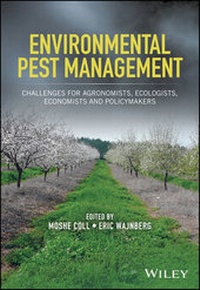
Environmental Pest Management
Description

More details
Other editions
Additional editions
Persons
Content
List of Contributors xi
Preface xv
Moshe Coll and Eric Wajnberg
1 Environmental Pest Management: A Call to Shift from a Pest-Centric to a System-Centric Approach 1
Moshe Coll and Eric Wajnberg
1.1 Introduction 1
1.2 Modern Developments in Pest Control 1
1.3 The Disillusionment with Integrated Pest Management 3
1.4 A Call for Environmental Pest Management 11
Acknowledgements 13
References 13
Part I General Background 19
2 Approaches in Plant Protection: Science, Technology, Environment and Society 21
Deborah K. Letourneau, Margaret I. FitzSimmons and Diego J. Nieto
2.1 Introduction 21
2.2 History of Plant Protection Approaches 22
2.3 Integrated Pest Management: What Does it Take? 31
2.4 Transforming Agriculture Systems for IPM 41
Acknowledgments 43
References 43
3 The Economics of Alternative Pest Management Strategies: Basic Assessment 55
Clement A. Tisdell, David Adamson and Bruce Auld
3.1 Introduction 55
3.2 Economic Decisions at Farm Level Based on Threshold Models Assuming Use of a Given Pest Control Technique and Certainty 56
3.3 Uncertainties and Economic Decisions at Farm Level About Pest Control: Assumes a Given Pest Control Technique and Applies the Threshold Approach 60
3.4 Choice of Alternative Pest Control Techniques at Farm Level Assuming Certainty 64
3.5 The Economics of the Timing of Pest Control and the Optimal Choice of Techniques Given Uncertainty 66
3.6 A Note on Biological Pest Control 70
3.7 Discussion of the Modelling of the Economics of Pest Management at the Farm Level 71
3.8 Concluding Comments 73
References 73
Part II Impact of Pest Management Practices on the Environment 77
4 Effects of Chemical Control on the Environment 79
Francisco Sánchez-Bayo
4.1 Introduction 79
4.2 Pesticides in Agriculture 79
4.3 Impacts of Pesticides on the Environment 83
4.4 Concluding Remarks 94
References 95
5 Environmental Impacts of Arthropod Biological Control: An Ecological Perspective 105
David E. Jennings, Jian J. Duan and Peter A. Follett
5.1 Introduction 105
5.2 The 'Invasion' Process of Establishing Non-native Biocontrol Agents 106
5.3 Ecological Processes Underlying the Environmental Impact of Biocontrol 107
5.4 Ecological Impact Assessment and Cost-benefit Analysis 111
5.5 Case Study I: Biocontrol of Emerald Ash Borer (Agrilus planipennis) 112
5.6 Case Study II: Biocontrol of Tamarisk (Tamarix spp.) 115
5.7 Concluding Remarks 119
Acknowledgements 120
References 120
6 Effects of Transgenic Crops on the Environment 131
Peter B. Woodbury, Antonio DiTommaso, Janice Thies, Matthew Ryan and John Losey
6.1 Range and Scope of Transgenic Crops 131
6.2 Conceptual Framework 132
6.3 Primary Effects 132
6.4 Secondary Effects 134
6.5 Tertiary Effects: Broader Spatial and Temporal Scales 137
6.6 Quantifying Risks and Benefits of Transgenic Traits 140
6.7 Variation Among Countries in Risk Assessment and Management 143
6.8 Conclusions 143
References 144
Part III Influence of Unmanaged Habitats on Pest Management 151
7 Ecosystem Services Provided by Unmanaged Habitats in Agricultural Landscapes 153
Stefano Colazza, Morgan W. Shields, Ezio Peri and Antonino Cusumano
7.1 Introduction 153
7.2 Global Importance of Arthropod Natural Enemies in Pest Management 155
7.3 Importance of Multitrophic Interactions to Biological Pest Control 156
7.4 Importance of Unmanaged Vegetation for Biological Control 158
7.5 Landscape Use to Maximize Biological Control 163
7.6 Conclusions 164
References 165
8 The Role of Ecosystem Disservices in Pest Management 175
Mark A.K. Gillespie and Steve D. Wratten
8.1 Introduction 175
8.2 EDS and Unmanaged Habitats 178
8.3 Landscape Context and the EDS from Unmanaged Habitats 186
8.4 Managing for EDS from Unmanaged Habitats 188
8.5 Conclusions and Future Research 189
References 190
Part IV Effects of Global Changes on Pest Management 195
9 Effect of Climate Change on Insect Pest Management 197
Nigel R. Andrew and Sarah J. Hill
9.1 Introduction 197
9.2 Observed Climate Changes Influencing Agro-Ecosystems 198
9.3 Insect Responses to Climate Change 198
9.4 Overview of Insect Pests in Agro-Ecosystems and Climate Change 202
9.5 How Climate Change and Insect Responses May Affect Various Ecological Processes Important for Plant Protection 207
9.6 Climate Change and IPM Approaches 210
9.7 Directions for Future Research 214
Acknowledgements 214
References 215
10 Effects of Biological Invasions on Pest Management 225
George K. Roderick and Maria Navajas
10.1 Invasion Science 225
10.2 Invasions - A Natural Process? 233
10.3 Perception and Value of Introduced and Invasive Alien Species 234
10.4 When to Act, and Why? 235
10.5 How Best to Control Invasive Species? 235
10.6 Case Studies 236
10.7 Conclusions 238
Acknowledgements 240
References 240
Part V Pest Control and Public Health 249
11 Pesticides and Human Health 251
Jane A. Hoppin and Catherine E. LePrevost
11.1 Introduction 251
11.2 Human Exposure to Pesticides 251
11.3 Acute Toxicity 254
11.4 Chronic Human Health Effects 257
11.5 Conclusions 265
References 266
12 Human Health Concerns Related to the Consumption of Foods from Genetically Modified Crops 275
Javier Magaña-Gómez and Ana Maria Calderón de la Barca
12.1 History of GM Foods and Associated Food Safety Concerns 275
12.2 Status and Commercial Traits Regarding Genetically Modified Organisms 277
12.3 The Bases for Unintended Health Risks 281
12.4 Guidelines and Approaches Used for Risk Assessment of GM Foods 282
12.5 Recent Research on in vivo Evaluation of GM Foods Consumption 283
12.6 Shortcomings and Research Needs in the Risk Assessment of Genetically Modified Foods 286
12.7 Conclusion 290
References 290
Part VI Policies Related to Environmental Pest Management 297
13 Effectiveness of Pesticide Policies: Experiences from Danish Pesticide Regulation 1986-2015 299
Anders Branth Pedersen and Helle Ørsted Nielsen
13.1 Introduction 299
13.2 Denmark - a Pioneer in Pesticide Policies 300
13.3 Effects 306
13.4 Comparing Denmark to the EU and Internationally 315
13.5 Conclusion 319
References 319
14 Impacts of Exotic Biological Control Agents on Non-target Species and Biodiversity: Evidence, Policy and Implications 325
Barbara I.P. Barratt and Clark A.C. Ehlers
14.1 Environmental Safety of Biological Control 325
14.2 Legislation and Regulation of Biological Control 327
14.3 Risk Assessment 329
14.4 Postrelease Validation of Predicted Outcomes 337
14.5 Implications of Biological Control Regulation Policy: What has it Meant for Biological Control Practice? 339
14.6 The Future for Biological Control Regulation 340
Acknowledgements 341
References 341
15 Pesticides in Food Safety versus Food Security 347
Pieter Spanoghe
15.1 Introduction 347
15.2 Use of Plant Protection Products in Farming Systems 348
15.3 Food Security in a Changing World 353
15.4 Food Safety and Pesticides in a Global Market 356
15.5 Towards Sustainability 362
15.6 Conclusion 364
References 364
16 External Costs of Food Production: Environmental and Human Health Costs of Pest Management 369
Nir Becker
16.1 Introduction: Pesticide Externalities 369
16.2 Background: The Impact of Pesticide Use 370
16.3 The Challenge in Estimating Externalities from Pesticide Use 373
16.4 Externality Estimation Methods 375
16.5 Overview of Existing Studies on Externalities of Pesticides 376
16.6 Integrated Pest Management 378
16.7 The Role of Information 379
16.8 Conclusion 380
References 381
17 The Role of Pest Management in Driving Agri-environment Schemes in Switzerland 385
Felix Herzog, Katja Jacot, Matthias Tschumi and Thomas Walter
17.1 Introduction 385
17.2 Policy Context of the Swiss Agricultural Sector 386
17.3 Ecological Focus Areas for Biodiversity Protection 388
17.4 Ecosystem Service Provision as a New Paradigm 394
17.5 Conclusion 398
References 399
Part VII Concluding Remarks, Take-Home Messages and a Call for Action 405
18 Environmental Pest Management: The Need for Long-term Governmental Commitment 407
Moshe Coll and Eric Wajnberg
18.1 The Prevalence of a Pest-centric, Bottom-up Approach to Pest Control 407
18.2 The Main Messages Presented in this Volume 408
18.3 The Role of Governments in Pest Management 412
18.4 Characteristics of Top-down, Environmental Pest Management 414
Acknowledgements 416
References 416
Index 419
1
Environmental Pest Management: A Call to Shift from a Pest-Centric to a System-Centric Approach
Moshe Coll and Eric Wajnberg
1.1 Introduction
According to a United Nations Food and Agriculture Organization estimate, about 795 million people suffered from chronic undernourishment in 2015 (FAO, IFAD and WFP 2015), indicating that one in nine people is deficient in calories, protein, iron, iodine or vitamin A, B, C or D, or any combination thereof (Sommer and West 1996). Such high levels of global food insecurity make many human societies vulnerable to health problems, reduced productivity and geopolitical unrest. A crop loss due to pest activity is a major contributor to food insecurity: 30-40% of potential world crop production is destroyed by pests (Natural Resources Institute 1992; Oerke et al. 1994). Of all pests, insects cause an estimated 14% of crop losses, plant pathogens 13% and weeds 13% (Pimentel 2007). An additional 30% of the crop is destroyed by postharvest insect pests and diseases, particularly in the developing world (Kumar 1984).
Humans have probably struggled with pestiferous insects, mites, nematodes, plant pathogens, weeds and vertebrates since the dawn of agriculture some 10 000 years ago (Figure 1.1). The earliest approaches employed were probably hand removal of pests and weeds, scaring away seed-consuming birds and trapping of granivorous rodents. Crop rotation, intercropping and selection of pest-resistant cultivars soon followed. The earliest recorded use of chemical pesticides dates back to 2500 BC, when the Sumerians used sulphur compounds as insecticides (see Figure 1.1). The use of botanical compounds, such as nicotine and pyrethrum, was later reported. However, pesticide application became common practice only in the 19th century, with increased agricultural mechanization.
Figure 1.1 The history of pest management and changes in agro-ecosystem sustainability. Historic data are based on Abrol and Shankar (2012) and https://courses.cit.cornell.edu/ipm444/lec-notes/extra/ipm-history.html.
1.2 Modern Developments in Pest Control
In the 20th century, the discovery of synthetic compounds with insecticidal and herbicidal properties, such as DDT and 2,4-D in 1939 and 1940, respectively, quickly made chemical control the predominant method of pest control. In most cropping systems, this has remained the case to this day, in spite of growing awareness of the negative impacts of pesticides on human health and the environment. In fact, many of our current serious pest problems have been brought about by intensification of cropping systems, mechanization, selection for high yielding but pest-susceptible crop genotypes, fertilization and irrigation inputs, and frequent application of pesticides (Thomas 1999; Waage 1993). Therefore, since the middle of the 20th century, most pest control measures have targeted specific pests on particular crops within single fields. Although reliance on a single tactic, usually the application of chemical pesticides, provides only a short-term solution (Thomas 1999), such a bottom-up approach has remained dominant is spite of widespread promotion of Integrated Pest Management (IPM) (Ehler 2006).
Integrated Pest Management has been accepted worldwide as the strategy of choice for pest population management. Since the United Nations Conference on the Environment in 1992 in Rio de Janeiro, Brazil, it has been the global policy in agriculture, natural resource management and trade. As a result, most of the world's population now lives in countries with IPM-guided policies for the production of most of the world's staple foods (Vreysen et al. 2007). Nonetheless, the definition of IPM has remained vague and highly inconsistent for more than 55 years (Table 1.1) (Bajwa and Kogan 2002). Van den Bosch and Stern (1962) stated that 'it is the entire ecosystem and its components that are of primary concern and not a particular pest'. Yet only 24% (16 of 67) of IPM definitions surveyed by Bajwa and Kogan (2002) included the term 'system' as the implementable programme or ecological unit. Furthermore, none of the surveyed definitions presented the term 'integrated' (in IPM) to indicate the integration of different measures employed simultaneously against several taxa across pest types (plant pathogens, insects, mites, nematodes, weeds, etc.). Since IPM is not legislatively defined, its definitions seem to reflect the respective interests and points of view of different individuals and organizations. Therefore, IPM is not a distinct, well-defined crop production strategy.
Table 1.1 Selected definitions of Integrated Pest Management proposed or used by prominent authorities, arranged in chronological order (based in part on Bajwa and Kogan 2002).
Year Definition Source 1959 Applied pest control which combines and integrates biological and chemical control. Chemical control is used as necessary and in a manner which is least disruptive to biological control. Integrated control may make use of naturally occurring biological control as well as biological control affected by manipulated or induced biotic agents. Stern et al. (1959) 1966 A pest population management system that utilizes all suitable techniques in a compatible manner to reduce pest populations and maintain them at levels below those causing economic injury. Smith and Reynolds (1966) 1967 A pest management system that, in the context of the associated environment and the population dynamics of the pest species, utilizes all suitable techniques and methods in as compatible a manner as possible and maintains the pest populations at levels below those causing economic injury. FAO (1967) 1969 Utilization of all suitable techniques to reduce and maintain pest populations at levels below those causing injury of economic importance to agriculture and forestry, or bringing two or more methods of control into a harmonized system designed to maintain pest levels below those at which they cause harm - a system that must rest on firm ecological principles and approaches. National Academy of Science (1969) 1972 An approach that employs a combination of techniques to control the wide variety of potential pests that may threaten crops. It involves maximum reliance on natural pest population controls, along with a combination of techniques that may contribute to suppression - cultural methods, pest-specific diseases, resistant crop varieties, sterile insects, attractants, augmentation of parasites or predators, or chemical pesticides as needed. Council on Environmental Quality (1972) 1978 A multidisciplinary, ecological approach to the management of pest populations, which utilizes a variety of control tactics compatibly in a single co-ordinated pest management system. Smith (1978) 1979 The selection, integration and implementation of pest control based on predicted economic, ecological and sociological consequences. Bottrell (1979) 1979 The optimization of pest control in an economically and ecologically sound manner, accomplished by the co-ordinated use of multiple tactics to assure stable crop production and to maintain pest damage below the economic injury level while minimizing hazards to humans, animals, plants and the environment. Office of Technology Assessment (1979) 1980 An interdisciplinary approach incorporating the judicious application of the most efficient methods of maintaining pest populations at tolerable levels. Recognition of the problems associated with widespread pesticide application has encouraged the development and utilization of alternative pest control techniques. Rather than employing a single control tactic, attention is being directed to the co-ordinated use of multiple tactics, an approach known as integrated pest management. FAO (1980) 1981 An ecologically based pest control strategy that relies heavily on natural mortality factors, such as natural enemies and weather, and seeks out control tactics that disrupt these factors as little as possible. IPM uses pesticides, but only after systematic monitoring of pest populations and natural control factors indicate a need. Ideally, an integrated pest management programme considers all available pest control actions, including no action, and evaluates the potential interaction among various control tactics, cultural practices, weather, other pests, and the crop to be protected. Flint and van den Bosch (1981) 1982 The use of two or more tactics in a compatible manner to maintain the population of one or more pests at acceptable levels in the production of food and fiber while providing protection against hazards to humans, domestic animals, plants and the environment. Council for Agricultural Science and Technology (1982) 1984 A strategy for...