

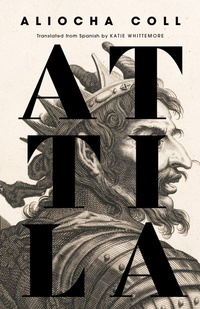
Attila
Description

"My life will not make any sense when Attila is finished," declared Aliocha Coll about his mesmerizing final novel. In this groundbreaking "untranslatable" work, he channels Joycean experimentalism to explore the fragility of empires, the future of the city, and the weight of legacy.
Attila the Hun, reimagined as a visionary leader, contemplates the fate of his people at the gates of Rome. His son, Quijote, is caught between empires and ideals, forced to choose between his father's vision of a Hunnic utopia and the decaying allure of Roman civilization. As Rome burns, Quijote journeys through both real and surreal landscapes, encountering psychedelic visions, mystical revelations, and existential dilemmas.
Quijote's journey blurs the lines between past and future, uniting Biblical, Classical, and Buddhist traditions while moving between planes of existence. Attila is an intricate and elusive masterpiece from the explosive and disorienting imagination of Aliocha Coll, where characters from myth and history intermingle in a stunning labyrinth of allegory and metaphor.
More details
Other editions
Additional editions
Persons
The pseudonym of Javier Coll Mata (Madrid, May 6, 1948?Paris, November 15, 1990), Aliocha Coll was a Spanish writer and translator raised in Barcelona who spent several years of his adult life in Paris, where he committed suicide after completing Attila. He is the subject of "Everything Bad Comes Back" by Javier Marías, and believed in Finnegans Wake as the "starting point" for contemporary literature. In addition to Attila, he wrote a couple novels, a play, and several essays, but the majority his work was either published posthumously or remains unpublished, despite Spanish super agent Carmen Balcells backing him throughout her life as the future of Spanish literature.
Katie Whittemore translates from the Spanish. Her translations include novels by Sara Mesa, Javier Serena, Aroa Moreno Durán, Lara Moreno, Nuria Labari, Katixa Agirre, Jon Bilbao, Juan Gómez Bárcena, Almudena Sánchez, Aliocha Coll, and Pilar Adón. She received an NEA Translation Fellowship in 2022 for Lara Moreno's In Case We Lose Power, and has been a finalist for the Spain-USA Foundation Translation Prize and the Queen Sofía Spanish Institute Translation Prize, and longlisted for the National Translation Award.
