

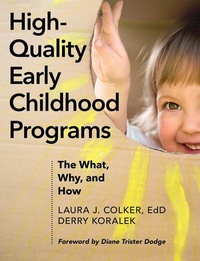
High-Quality Early Childhood Programs
Description

An invaluable tool for the director/supervisor striving to identify what aspects of an early childhood program need improvement. The detailed descriptions of what one should see in high quality programs (and why) gives readers a strong foundation of child development knowledge and of principles translated into practice.
Laura Colker is the author of over 100 publications and instructional guides, including co-authorship of The Creative Curriculum for Preschool, The Creative Curriculum for Family Child Care, and The Creative Curriculum for Infants and Toddlers. The Creative Curriculum for Preschool, now in its fifth edition, is the most widely used preschool curriculum in the United States. She also served as content specialist or scriptwriter on over forty educational videos for PBS and Reading Is Fundamental, and developed online training for early childhood caregivers and family child care providers for NACCRRA (National Association of Child Care Resource and Referral Agencies).
Diane Trister Dodge, founder and president of Teaching Strategies, Inc., is the author of numerous books, articles, and training materials on early childhood education. She is the lead author on all of Teaching Strategies books, including the popular The Creative Curriculum series.
Derry Koralek is the President of DGK & Company, an independent consultant in early childhood education and developer of training materials and guidebooks. Past clients include Reading Is Fundamental, the Head Start Bureau, Military Child Development Programs, and the Devereux Foundation. Koralek is a past Editor-in-Chief of Teaching Young Children, National Association for the Education of Young Children, and winner of the Association for Educational Publishing Golden Lamp Award, 2014.
More details
Other editions
Additional editions
Persons
DERRY KORALEK spent more than 14 years writing and editing publications for NAEYC. She was the Editor in Chief of Young Children, NAEYC's peer-reviewed professional journal and creator and Editor-in-Chief of Teaching Young Children, a magazine for preschool educators. While at NAEYC, she served as Chief Publications Officer, overseeing the publication of periodicals, books, and digital content. As the President of DGK & Company, she develops early childhood training materials and guidebooks for private groups and for state and federal clients.
Content
- Intro
- Title Page
- Copyright
- Contents
- Foreword
- Acknowledgments
- Introduction
- Chapter 1: Foundations for Quality
- Standards of Quality
- Characteristics of High-Quality Early Childhood Programs
- Chapter 2: Ensuring the Effectiveness of Infant Programs
- Environment
- Foundations Underlying Quality
- What the Environment Should Look Like
- When the Environment Needs Further Adjusting
- Toys, Materials, and Equipment
- Foundations Underlying Quality
- What Toys, Materials, and Equipment Should Look Like
- When the Toys, Materials, and Equipment Need Further Adjusting
- Program Structure
- Foundations Underlying Quality
- What Program Structure Should Look Like
- When the Program Structure Needs Further Adjusting
- Curriculum: Activities and Experiences
- Foundations Underlying Quality
- What the Curriculum Should Look Like
- When the Curriculum Needs Further Adjusting
- Supportive Interactions
- Foundations Underlying Quality
- What Supportive Interactions Should Look Like
- When Interactions Need Further Adjusting
- Positive Guidance
- Foundations Underlying Quality
- What Positive Guidance Should Look Like
- When Guidance Strategies Need Further Adjusting
- Chapter 3: Ensuring the Effectiveness of Toddler Programs
- Environment
- Foundations Underlying Quality
- What the Environment Should Look Like
- When the Environment Needs Further Adjusting
- Toys, Materials, and Equipment
- Foundations Underlying Quality
- What Toys, Materials, and Equipment Should Look Like
- When the Toys, Materials, and Equipment Need Further Adjusting
- Program Structure
- Foundations Underlying Quality
- What Program Structure Should Look Like
- When the Program Structure Needs Further Adjusting
- Curriculum: Activities and Experiences
- Foundations Underlying Quality
- What the Curriculum Should Look Like
- When the Curriculum Needs Further Adjusting
- Supportive Interactions
- Foundations Underlying Quality
- What Supportive Interactions Should Look Like
- When Interactions Need Further Adjusting
- Positive Guidance
- Foundations Underlying Quality
- What Positive Guidance Should Look Like
- When Guidance Strategies Need Further Adjusting
- Chapter 4: Ensuring the Effectiveness of Preschool Programs
- Environment
- Foundations Underlying Quality
- What the Environment Should Look Like
- When the Environment Needs Further Adjusting
- Toys, Materials, and Equipment
- Foundations Underlying Quality
- What Toys, Materials, and Equipment Should Look Like
- When the Toys, Materials, and Equipment Need Further Adjusting
- Program Structure
- Foundations Underlying Quality
- What Program Structure Should Look Like
- When the Program Structure Needs Further Adjusting
- Curriculum: Activities and Experiences
- Foundations Underlying Quality
- What the Curriculum Should Look Like
- When the Curriculum Needs Further Adjusting
- Supportive Interactions
- Foundations Underlying Quality
- What Supportive Interactions Should Look Like
- When Interactions Need Further Adjusting
- Positive Guidance
- Foundations Underlying Quality
- What Positive Guidance Should Look Like
- When Guidance Strategies Need Further Adjusting
- Chapter 5: Engaging Families
- Foundations Underlying Quality
- What Family Engagement Should Look Like
- When Family Engagement Strategies Need Further Adjusting
- Appendix A: Checklist for Maintaining Healthy and Safe Environments for Young Children
- Appendix B: Observation Checklists for Ensuring Quality in Infant Programs
- Appendix C: Observation Checklists for Ensuring Quality in Toddler Programs
- Appendix D: Observation Checklists for Ensuring Quality in Preschool Programs
- Appendix E: Observation Checklist for Engaging Families in Early Childhood Programs
- Appendix F: Resources for Supporting Quality in Early Childhood Programs
- References
- Index
