

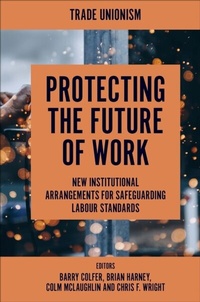
Protecting the Future of Work
New Institutional Arrangements for Safeguarding Labour Standards
1st Edition
Published on 20. January 2023
192 pages
978-1-80071-248-5 (ISBN)
Description

Institutions such as trade unions that were once relied upon to protect workers' wages, conditions and job security are eroding. In response, new forms of worker protections are emerging.
Protecting the Future of Work examines new forms of regulation that have emerged in response to increasing social concern about poor labour practices, growing inequality, and detrimental working conditions. It looks at how trade unions, community organisations and other actors have mobilised to raise public awareness and pressure businesses and governments to improve working conditions.
Featuring a balance of texts on the changing nature of and the history of trade union change and transformation, the series Trade Unionism gives space for in-depth, detailed analysis and captures key themes on the nature of internationalism and trade unionism.
Protecting the Future of Work examines new forms of regulation that have emerged in response to increasing social concern about poor labour practices, growing inequality, and detrimental working conditions. It looks at how trade unions, community organisations and other actors have mobilised to raise public awareness and pressure businesses and governments to improve working conditions.
Featuring a balance of texts on the changing nature of and the history of trade union change and transformation, the series Trade Unionism gives space for in-depth, detailed analysis and captures key themes on the nature of internationalism and trade unionism.
Reviews / Votes
This volume contributes to innovation in theory and policy debate in industrial relations and entails a stimulating and topical analysis of the role and practices of trade unions, new forms of regulation, and labour standards in times of challenge and transformation. -- Mia Roennmar, Professor, Faculty of Law, Lund University, Sweden, and Past-President of the International Labour and Employment Relations Association. This edited volume is a thought-provoking, conceptually rigorous and urgent analysis of changes in labour market regulation and employment relations over recent times. The shift the authors identify towards a 'patchwork of rules' is illustrated through the impressive line of chapters covering unfamiliar areas like the 'gig economy' in China. A must-read for understanding contemporary developments in employment relations and a fitting tribute to Professor Willy Brown. -- Heather Connolly, Associate Professor, Department People, Organizations and Society, Grenoble Ecole de Management, France This volume brings together some of the best thinkers about how the regulation of work and employment is changing around the world to mark the legacy of Professor Willy Brown. The chapters explore how the regulation of our working lives is changing; sometimes optimistically, sometimes pessimistically. But always with an attention to detail that defines Willy's intellectual legacy. The authors make important contributions to our understanding of the changes and what they mean to workers, managers, capital, states, and supra-state institutions. -- Melanie Simms, Professor of Work and Employment, Adam Smith Business School, University of Glasgow, UK Ongoing upheavals in the world of work, including the rise of platform work, outsourcing and global supply chains, have disrupted and corroded the capacity of established regulatory arrangements, notably collective bargaining, to protect workers and improve working conditions. This stimulating and timely volume examines the new forms of statutory and employer-led, voluntarist regulation that have emerged in response, highlights the institutional experimentation involved, and assesses their interface with traditional arrangements in an evolving regulatory 'patchwork'. The contributors draw insightfully from developments across a range of countries. -- Paul Marginson, Emeritus Professor of Industrial Relations, University of Warwick, UK A truly insightful analysis of the world of work in contemporary societies, offering many practical solutions to key problems. Very much in the spirit of Willy Brown's contributions, and a strong testament to how much he has given and continues to give to our subject-area -- Keith Whitfield, Professor of Human Resource Management, Cardiff Business School, Cardiff University, UKMore details
Series
Language
English
Place of publication
Bingley
United Kingdom
Target group
Professional and scholarly
File size
2,97 MB
ISBN-13
978-1-80071-248-5 (9781800712485)
Copyright in bibliographic data and cover images is held by Nielsen Book Services Limited or by the publishers or by their respective licensors: all rights reserved.
Schweitzer Classification
Other editions
Additional editions
Barry Colfer
Protecting the Future of Work
New Institutional Arrangements for Safeguarding Labour Standards
Book
01/2023
Emerald Publishing Limited
€114.50
Shipment within 3-4 weeks
Persons
Barry Colfer is Research Fellow at St Edmund's College and the Department of Politics and International Studies (POLIS) and a Max Weber Fellow at the European University Institute (EUI) in Florence, Italy. As of January 2022, he is the Director of Research at the Institute of International and European Affairs (IIEA) think tank in Dublin, Ireland.
Brian Harney is Professor of Strategy and HRM at Dublin City University Business School. His research explores the intersection of strategy and employment relations with a particular focus on small, growing and knowledge intensive firms.
Colm McLaughlin is Professor of Employment Relations at the UCD College of Business, University College Dublin, and Co-Director of the UCD Centre for Business and Society (UCD CeBaS). His research focuses on comparative and institutional employment, comparing the effectiveness of employment regulation in achieving public policy outcomes around decent work and equality.
Chris F. Wright is an Associate Professor in the Discipline of Work and Organisational Studies at the University of Sydney Business School. His research focuses primarily on migrant labour, comparative employment relations and sustainable supply chains.
Brian Harney is Professor of Strategy and HRM at Dublin City University Business School. His research explores the intersection of strategy and employment relations with a particular focus on small, growing and knowledge intensive firms.
Colm McLaughlin is Professor of Employment Relations at the UCD College of Business, University College Dublin, and Co-Director of the UCD Centre for Business and Society (UCD CeBaS). His research focuses on comparative and institutional employment, comparing the effectiveness of employment regulation in achieving public policy outcomes around decent work and equality.
Chris F. Wright is an Associate Professor in the Discipline of Work and Organisational Studies at the University of Sydney Business School. His research focuses primarily on migrant labour, comparative employment relations and sustainable supply chains.
Content
Introduction. New Institutional Arrangements for Safeguarding Labour Standards; Barry Colfer, Brian Harney, Colm Mclaughlin, and Chris F Wright
Chapter 1. Neoliberalism or Augmented Pluralism? Defending the Web of Rules in New Zealand, Australia and Ireland; Colm Mclaughlin and Chris F Wright
Chapter 2. The European Social Model and the Patchwork of Rules; Barry Colfer
Chapter 3. Regulatory Experimentation and Gender Inequality; Colm Mclaughlin
Chapter 4. The Limits of HRM in a New Era of Work: Bezonomics and the Amazon Effect; Brian Harney
Chapter 5. Beyond Mobilisation at Mcdonald's: Towards Networked Organising; Alex J. Wood
Chapter 6. The Rising Gig Economy in China: Implications for the Protection of Migrant Workers; Cheng Chang and Wei Huang
Chapter 7. Collaborative Institutional Experimentation to Address the Exploitation and Marginalisation of Migrant Workers; Chris F Wright, Kyoung-Hee Yu, and Stephen Clibborn
Chapter 8. Global Supply Chains and Labour Standards: From a Patchwork of Rules to a Web of Rules?; Aristea Koukiadaki
Conclusion. Towards a New Web of Rules; Barry Colfer, Brian Harney, Colm Mclaughlin, and Chris F Wright
Chapter 1. Neoliberalism or Augmented Pluralism? Defending the Web of Rules in New Zealand, Australia and Ireland; Colm Mclaughlin and Chris F Wright
Chapter 2. The European Social Model and the Patchwork of Rules; Barry Colfer
Chapter 3. Regulatory Experimentation and Gender Inequality; Colm Mclaughlin
Chapter 4. The Limits of HRM in a New Era of Work: Bezonomics and the Amazon Effect; Brian Harney
Chapter 5. Beyond Mobilisation at Mcdonald's: Towards Networked Organising; Alex J. Wood
Chapter 6. The Rising Gig Economy in China: Implications for the Protection of Migrant Workers; Cheng Chang and Wei Huang
Chapter 7. Collaborative Institutional Experimentation to Address the Exploitation and Marginalisation of Migrant Workers; Chris F Wright, Kyoung-Hee Yu, and Stephen Clibborn
Chapter 8. Global Supply Chains and Labour Standards: From a Patchwork of Rules to a Web of Rules?; Aristea Koukiadaki
Conclusion. Towards a New Web of Rules; Barry Colfer, Brian Harney, Colm Mclaughlin, and Chris F Wright
