

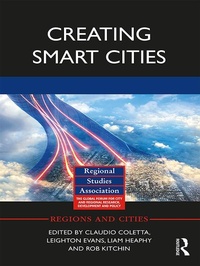
Creating Smart Cities
1st Edition
Published on 26. October 2018
254 pages
978-1-351-18239-3 (ISBN)
Description

In cities around the world, digital technologies are utilized to manage city services and infrastructures, to govern urban life, to solve urban issues and to drive local and regional economies. While "smart city" advocates are keen to promote the benefits of smart urbanism - increased efficiency, sustainability, resilience, competitiveness, safety and security - critics point to the negative effects, such as the production of technocratic governance, the corporatization of urban services, technological lock-ins, privacy harms and vulnerability to cyberattack.
This book, through a range of international case studies, suggests social, political and practical interventions that would enable more equitable and just smart cities, reaping the benefits of smart city initiatives while minimizing some of their perils.
Included are case studies from Ireland, the United States of America, Colombia, the Netherlands, Singapore, India and the United Kingdom. These chapters discuss a range of issues including political economy, citizenship, standards, testbedding, urban regeneration, ethics, surveillance, privacy and cybersecurity. This book will be of interest to urban policymakers, as well as researchers in Regional Studies and Urban Planning.
This book, through a range of international case studies, suggests social, political and practical interventions that would enable more equitable and just smart cities, reaping the benefits of smart city initiatives while minimizing some of their perils.
Included are case studies from Ireland, the United States of America, Colombia, the Netherlands, Singapore, India and the United Kingdom. These chapters discuss a range of issues including political economy, citizenship, standards, testbedding, urban regeneration, ethics, surveillance, privacy and cybersecurity. This book will be of interest to urban policymakers, as well as researchers in Regional Studies and Urban Planning.
More details
Series
Edition
1. Auflage
Language
English
Place of publication
London
United Kingdom
Publishing group
Taylor & Francis Ltd
Target group
College/higher education
Illustrations
6 Tables, black and white; 7 Line drawings, black and white; 6 Halftones, black and white; 13 Illustrations, black and white
File size
7,62 MB
ISBN-13
978-1-351-18239-3 (9781351182393)
Copyright in bibliographic data and cover images is held by Nielsen Book Services Limited or by the publishers or by their respective licensors: all rights reserved.
Schweitzer Classification
Other editions
Additional editions
Claudio Coletta | Leighton Evans | Liam Heaphy
Creating Smart Cities
Book
11/2018
1st Edition
Routledge
€63.40
Shipment within 15-20 days
Claudio Coletta | Leighton Evans | Liam Heaphy
Creating Smart Cities
Book
11/2018
1st Edition
Routledge
€206.50
Shipment within 15-20 days
Persons
Claudio Coletta is research manager in the Urban Studies Institute at the University of Antwerp. His research focuses on urban phenomena at the intersection between technology, narratives and practices. His current interests address algorithms and automated urban management, the temporal dimension of smart cities development, and experimental urbanism.
Leighton Evans is a Senior Lecturer in Media Theory at Swansea University. His research focus is on phenomenology and digital media, with interests in locative media, virtual and augmented reality, the experience of labour in data intensive environments and the subjective experience of technological implementation.
Liam Heaphy is a postdoctoral research fellow in the School of Architecture, Planning & Environmental Policy at University College Dublin. His research draws on science and technology studies, planning, architecture and history to examine the relationship between urban science and urban form, with a particular focus on sustainability and spatial planning.
Rob Kitchin is a professor and ERC Advanced Investigator at the National University of Ireland Maynooth. He is principal investigator of the Programmable City project and the co-PI of the Building City Dashboards project. He has published widely across the social sciences, including 26 authored/edited books and over 180 articles and book chapters.
Leighton Evans is a Senior Lecturer in Media Theory at Swansea University. His research focus is on phenomenology and digital media, with interests in locative media, virtual and augmented reality, the experience of labour in data intensive environments and the subjective experience of technological implementation.
Liam Heaphy is a postdoctoral research fellow in the School of Architecture, Planning & Environmental Policy at University College Dublin. His research draws on science and technology studies, planning, architecture and history to examine the relationship between urban science and urban form, with a particular focus on sustainability and spatial planning.
Rob Kitchin is a professor and ERC Advanced Investigator at the National University of Ireland Maynooth. He is principal investigator of the Programmable City project and the co-PI of the Building City Dashboards project. He has published widely across the social sciences, including 26 authored/edited books and over 180 articles and book chapters.
Content
1 Creating smart cities Rob Kitchin, Claudio Coletta, Leighton Evans and Liam Heaphy PART I The political economy of smart cities 2 A Digital Deal for the smart city: Participation, protection, progress Jathan Sadowski 3 Politicising smart city standards James Merricks White 4 Urban revitalization through automated policing and "smart" surveillance in Camden, New Jersey Alan Wiig 5 Can urban "miracles" be engineered in laboratories? Turning Medellin into a model city for the Global South Felix Talvard 6 Building smart city partnerships in the "Silicon Docks" Liam Heaphy and Reka Petercsak 7 Towards a study of city experiments Brice Laurent and David Pontille 8 University campuses as testbeds of smart urban innovation Andrew Karvonen, Chris Martin and James Evans PART II Smart cities, citizenship and ethics 9 Who are the end-use(r)s of smart cities? A synthesis of conversations in Amsterdam Christine Richter, Linnet Taylor, Shazade Jameson and Carmen Perez del Pulgar 10 'Cityzens become netizens': Hashtag citizenships in the making of India's 100 smart cities Ayona Datta 11 From smart cities to smart citizens? Searching for the 'actually existing smart citizen' in Atlanta, Georgia Taylor Shelton and Thomas Lodato 12 Promises, practices and problems of collaborative infrastructuring: The case of Dublin City Council (DCC) Beta and Code for Ireland Sung-Yueh Perng 13 Smart for a reason: Sustainability and social inclusion in the sharing city Duncan McLaren and Julian Agyeman 14 Pseudonymisation and the smart city: Considering the General Data Protection Regulation Maria Helen Murphy 15 The privacy parenthesis: Private and public spheres, smart cities and big data Leighton Evans 16 The challenges of cybersecurity for smart cities Martin Dodge and Rob Kitchin PART III Conclusion 17 Reframing, reimagining and remaking smart cities Rob Kitchin
