

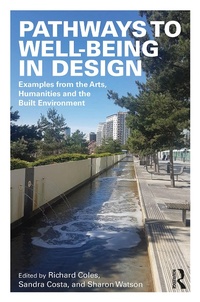
Pathways to Well-Being in Design
Examples from the Arts, Humanities and the Built Environment
1st Edition
Published on 11. October 2018
264 pages
978-1-351-17003-1 (ISBN)
Description

How can we achieve and promote well-being? Drawing on examples from the arts, humanities and design, this book brings together work from a wide range of areas to reveal the unique ways in which different disciplines approach the universal goal of supporting well-being.
Pathways to Well-Being in Design recognises that the distinction between academics and practitioners often becomes blurred, where, when working together, a fusion of thoughts and ideas takes place and provides a powerful platform for dialogue.
Providing new insights into the approaches and issues associated with promoting well-being, the book's multi-disciplinary coverage invites readers to consider these ideas within the framework of their own work.
The book's 12 chapters are authored by academics who are involved in practice or are working with practitioners and features real world case studies which cover a range of situations, circumstances, environments, and social groups.
Pathways to Well-Being in Design responds to those wishing to enquire further about well-being, taking the reader through different circumstances to consider approaches, discussing practice and theory, real world and virtual world considerations.
This book is essential reading for anyone seeking to understand well-being, including students and professionals in architecture, landscape architecture, urban planning, design and health sciences.
Pathways to Well-Being in Design recognises that the distinction between academics and practitioners often becomes blurred, where, when working together, a fusion of thoughts and ideas takes place and provides a powerful platform for dialogue.
Providing new insights into the approaches and issues associated with promoting well-being, the book's multi-disciplinary coverage invites readers to consider these ideas within the framework of their own work.
The book's 12 chapters are authored by academics who are involved in practice or are working with practitioners and features real world case studies which cover a range of situations, circumstances, environments, and social groups.
Pathways to Well-Being in Design responds to those wishing to enquire further about well-being, taking the reader through different circumstances to consider approaches, discussing practice and theory, real world and virtual world considerations.
This book is essential reading for anyone seeking to understand well-being, including students and professionals in architecture, landscape architecture, urban planning, design and health sciences.
More details
Edition
1. Auflage
Language
English
Place of publication
London
United Kingdom
Publishing group
Taylor & Francis Ltd
Target group
College/higher education
Professional and scholarly
Illustrations
14 Tables, black and white; 34 Line drawings, black and white; 44 Halftones, black and white
File size
12,12 MB
ISBN-13
978-1-351-17003-1 (9781351170031)
Copyright in bibliographic data and cover images is held by Nielsen Book Services Limited or by the publishers or by their respective licensors: all rights reserved.
Schweitzer Classification
Other editions
Additional editions
Richard Coles | Sandra Costa | Sharon Watson
Pathways to Well-Being in Design
Examples from the Arts, Humanities and the Built Environment
Book
10/2018
1st Edition
Routledge
€78.23
Shipment within 15-20 days
Richard Coles | Sandra Costa | Sharon Watson
Pathways to Well-Being in Design
Examples from the Arts, Humanities and the Built Environment
Book
10/2018
1st Edition
Routledge
€230.48
Shipment within 15-20 days
Persons
Richard Coles is Emeritus Professor of Landscape in the Birmingham School of Architecture and Design, based in the Faculty of the Arts, Design and Media, Birmingham City University, UK. His research involves understanding the nature of environmental interaction and the development of environments that are supportive of the needs of users.
Sandra Costa is a Researcher and Lecturer in Landscape Architecture at the Birmingham School of Architecture and Design, Birmingham City University. Her research examines the nature of person-place interactions, exploring the choreographies of the experience and how individuals negotiate wellbeing. She received her PhD from Birmingham City University researching immersive walking techniques involving self-narrated walking.
Sharon Watson is a Landscape Architect focusing on aspects of community engagement and research involving children. She has extensive experience of working with schools and the educational sector, where she has developed sophisticated child-centric methodologies involving the use of digital media. Her current research involves working with children in investigating their responses to the natural world and the different agencies offered by current technology, focusing on the wild places that exist in urban situations. She holds a PhD from Birmingham City University.
Sandra Costa is a Researcher and Lecturer in Landscape Architecture at the Birmingham School of Architecture and Design, Birmingham City University. Her research examines the nature of person-place interactions, exploring the choreographies of the experience and how individuals negotiate wellbeing. She received her PhD from Birmingham City University researching immersive walking techniques involving self-narrated walking.
Sharon Watson is a Landscape Architect focusing on aspects of community engagement and research involving children. She has extensive experience of working with schools and the educational sector, where she has developed sophisticated child-centric methodologies involving the use of digital media. Her current research involves working with children in investigating their responses to the natural world and the different agencies offered by current technology, focusing on the wild places that exist in urban situations. She holds a PhD from Birmingham City University.
Content
Introduction 1. Ways to Well-being for Children Larissa Pople, Saamah Abdallah, Gwyther Rees and Gill Main 2. Co-Creating Well-being Experiences with Assisted Living Technologies Nikki Holliday, Darren Awang, Gillian Ward 3. Green Space and Urban Greening Benefits for Health and Well-being Across the Life-Course: A Pathway for the Operationalisation of the Green Infrastructure Approach Owen Douglas, Mark Scott, Mick Lennon 4. Growing Pathways to Well-being through Community Gardens and Greenspace; Case studies from Birmingham and the West Midlands, UK Veronica Barry and Chris Blythe 5. Biophilia and the Practice of Biophilic Design Elizabeth Freeman Calabrese and Alice Dommert 6. 'On Empathy' and Well-Being: Orientations and Conversations for the Aspiring Architect Amrit Phull 7. Emotional Transition and the Internet World: Implications for Well-being John Sparrow 8. The Legal Protection of the Well-being of Future Generations Haydn Davies 9. Well-Being Restoration in the Workspace Sukanlaya Sawang and Mirko Guaralda 10. Designing for Well-being in Late Stage Dementia Cathy Treadaway, Jac Fennell, David Prytherch, Gail Kenning, Andy Walters 11. Alone Together - Documentary Filmmaking and Stories of Well-being in Outdoor Spaces Esther Johnson 12. Pathways to Well-being Richard Coles, Sandra Costa, Sharon Watson Index
