

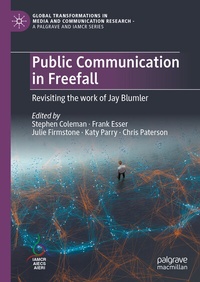
Public Communication in Freefall
Description

This book addresses key challenges facing global political communication at a time in which transformations in political practice, media ecology and cultural expectations both threaten traditional democratic norms and point to potential new ways of enacting political democracy. Drawing upon the outstanding theoretical insights of Jay Blumler to our understanding of the norms and practices of political communication, but also critically interrogating and updating them where appropriate, the volume asks timely questions about what publicness and democracy mean in the 2020s.
Many people are talking and writing about the crisis of political democracy, fewer are talking about the role of the media in relation to that crisis. While many scholars have responded in an ad hoc way to the various crises of populism, polarisation, mis and disinformation, this book shows how Jay Blumler's scholarship provides us with the tools and framework to research and understand the changing communication environment systemically and rigorously. The book demonstrates the applicability and relevance of Blumler's work in explicating the current crisis of communication and the need for fresh and radical thinking in tackling it. The book's breadth and depth of chapters from a broad range of scholars from the East and West, ranging from long-standing contributors to the field to those in the early stages of their career, combine to produce a thoughtful and provocative invitation to reflect upon the concept of a 'crisis of public communication'. We expect this book to become a major source for political communication students and scholars.
More details
Other editions
Additional editions
Persons
Stephen Coleman is Professor of Political Communication at the University of Leeds, UK.
Frank Esser is Professor of International & Comparative Media Research in the Department of Communication and Media Research at the University of Zurich, Switzerland.
Julie Firmstone is Professor of Journalism and Political Communication at the School of Media and Communication, University of Leeds, UK.
Katy Parry is Professor of Media and Politics at the University of Leeds, UK.
Chris Paterson is Professor of Global Communication at the School of Media and Communication, University of Leeds, UK.
Content
1. Introduction.- Section One: The 'crisis of public communication' in historical perspective .- 2. Reprint of the following journal article which we will obtain permission to publish: Blumler, J.G. and Coleman, S., 2015. Democracy and the media-revisited. Javnost-The Public, 22(2), pp.111-128.- 3. Prof. W. Russell Neuman, NYU Steinhardt: Cycles of Crisis: The Current Condition of the Democratic Public Sphere.- 4. Prof. Barbara Pfetsch, Freie Universität Berlin: Fluid Public Spheres, Noisy Networks and Political Polarization - Safeguards against the threats of democratic public communication.- Section Two: Challenges in the 'fourth age' of political communication .- 5. Prof. Paul D'Angelo and Prof. Erik P. Bucy, Texas Tech University: The Crisis of a Denigrated Press in a Post-Compromise U.S. Political Culture.- 6. Dr. Curd Knüpfer, Freie Universität Berlin: The Challenge by Far-right Counter-publics as the Next Crisis of Public Communication.- 7. Dr Márton Bene, Centre for Social Sciences (TK PTI): The effect of the viralization of political communication on the crisis of public communication.- Section Three: The public sphere and citizen engagement .- 8. Dr. Tom Chivers and Prof. Stuart Allan, Cardiff University: Rethinking the public value of Public Service Broadcasting in the political communications freefall.- 9. Prof. William H. Dutton and Dr. Grant Blank (Oxford Internet Institute): Diversity of Sources in Democratic Communication: Speaking Comparatively.- 10. Prof. Zrinjka Perusko, University of Zagreb: The Crisis of Public Communication in Hybrid Public Spheres and the Aspiration to Deliberative Democracy.- 11. Sang Jung Kim,, Yibing Sun, Zening Duan, Yooji Suh, Ruochong Fan, Mengyu Li, Erik Bucy, Porismita Borah, Josephine Lukito, Zhongkai Sun, Dhavan Shah: The Increasingly Contentious Spaces of Mediated Interaction: Aggressive Partisanship and Weakening Citizenship.-12. Author TBC: Afterword: The continuing legacy of Jay Blumler's work
