

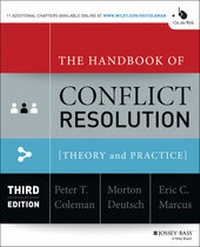
The Handbook of Conflict Resolution
Description

More details
Other editions
Additional editions
Persons
Peter Coleman is Associate Professor of Psychology and Education at Teachers College, Associate Professor of Psychology at The Earth Institute at Columbia University, current Director of Int'l Center for Cooperation and Conflict Resolution at Teacher's College, Faculty Sponsor of the MS Program in Negotiation and Conflict Resolution in Dept of Continuing Ed at Columbia, and?an active mediator.
Morton Deutsch is the E.L. Thorndike Professor and director emeritus of the International Center for Cooperation and Conflict Resolution (ICCCR) at Columbia University. He is considered to be one of the leading pioneers in the study of intergroup relations and conflict resolution.
Eric Marcus is Founder and Principal of The Marcus Group, a consulting firm that specializes in enhancing organizational effectiveness and individual and group development, whose clients include: JPMorgan Chase, United Nations, Neighborhood Housing Services of NYC and Say Yes to Education. He also teaches in the Master's program in Negotiation & Conflict Resolution at Columbia University.
Content
Preface xi
Introduction xvii
Morton Deutsch
Part one: Interpersonal and Intergroup Processes 1
1 Cooperation, Competition, and Conflict 3
Morton Deutsch
2 Justice and Conflict 29
Morton Deutsch
3 A Delicate and Deliberate Journey toward Justice: Challenging Privilege: Building Structures of Solidarity 56
Michelle Fine, Alexis Halkovic
4 Constructive Controversy: The Value of Intellectual Opposition 76
David W. Johnson, Roger T. Johnson, Dean Tjosvold
5 Trust, Trust Development, and Trust Repair 104
Roy J. Lewicki, Edward C. Tomlinson
6 Power and Conflict 137
Peter T. Coleman
7 Communication and Conflict 168
Robert M. Krauss, Ezequiel Morsella
8 Language, Peace, and Conflict Resolution 182
Francisco Gomes de Matos
9 The PSDM Model: Integrating Problem Solving and Decision Making in Conflict Resolution 203
Eben A. Weitzman, Patricia Flynn Weitzman
10 Intergroup Conflict 230
Ronald J. Fisher
Part two: Intrapsychic and Intragroup Processes 253
11 Judgmental Biases in Conflict Resolution and How to Overcome Them 255
Leigh L. Thompson, Brian J. Lucas
12 Emotion and Conflict: Why It Is Important to Understand How Emotions Affect Conflict and How Conflict Affects Emotions 283
Evelin G. Lindner
13 Self-Regulation in the Service of Conflict Resolution 310
Walter Mischel, Aaron L. DeSmet, Ethan Kross
14 Group Decision Making in Conflict: From Groupthink to Polythink in the War in Iraq 331
Alex Mintz, Carly Wayne
Part three: Personal Differences 353
15 Natural-Born Peacemakers? Gender and the Resolution of Conflict 355
Mara Olekalns
16 Resolving Intractable Intergroup Conflicts: The Role of Implicit Theories about Groups 384
Eran Halperin, James J. Gross, Carol S. Dweck
17 Personality and Conflict 400
Sandra V. Sandy, Susan K. Boardman, Morton Deutsch
18 The Development of Conflict Resolution Skills: Preschool to Adulthood 430
Sandra V. Sandy
Part four: Creativity and Change 465
19 Creativity and Conflict Resolution: The Role of Point of View 467
Howard E. Gruber
20 Some Guidelines for Developing a Creative Approach to Conflict 478
Peter T. Coleman, Morton Deutsch
21 Creativity in the Outcomes of Conflict 490
Peter J. Carnevale
22 Change and Conflict: Motivation, Resistance, and Commitment 513
Eric C. Marcus
23 Changing Minds: Persuasion in Negotiation and Conflict Resolution 533
Alison Ledgerwood, Shannon P. Callahan, Shelly Chaiken
24 Learning through Reflection on Experience: An Adult Learning Framework for How to Handle Conflict 558
Victoria J. Marsick, Dorothy E. Weaver, Lyle Yorks
Part five: Culture and Conflict 579
25 The Alchemy of Change: Cultural Fluency in Conflict Resolution 581
Michelle LeBaron
26 Indigenous Lessons for Conflict Resolution 604
Geneviève Souillac, Douglas P. Fry
27 Multiculturalism and Conflict 623
Mekayla K. Castro, Peter T. Coleman
28 Cooperative and Competitive Conflict in China 654
Dean Tjosvold, Kwok Leung, David W. Johnson
Part six: Difficult Conflicts 679
29 Aggression and Violence: Causes and Correctives 681
Wen Liu, Susan Opotow
30 Intractable Conflict 708
Peter T. Coleman
31 The Pragmatics of Peace with Justice: The Challenge of Integrating Mediation and Human Rights 745
Eileen F. Babbitt
32 Terrorism: Negotiating at the Edge of the Abyss 764
Guy Olivier Faure
Part seven: Models of Practice 793
33 Negotiation 795
Roy J. Lewicki, Edward C. Tomlinson
34 The Mediation of Conflict: Context, Cognition, and Practice 817
Kenneth Kressel
35 Teaching Conflict Resolution Skills in a Workshop 849
Susan W. Coleman, Yaron Prywes
36 Creating Constructive Communication through Dialogue 877
Beth Fisher-Yoshida
37 An Empirically Based Approach to Couples' Conflict 898
John Gottman, Julie S. Gottman, Andy Greendorfer, Mirabai Wahbe
38 Managing Conflict through Large Group Methods 921
Barbara Benedict Bunker, Susan W. Coleman
39 Group Relations and Conflict Resolution 947
Sarah J. Brazaitis
40 Reconciliation between Groups: Preventing (New) Violence and Improving Lives 971
Ervin Staub
41 Social Networks, Social Media, and Conflict Resolution 998
James D. Westaby, Nicholas Redding
42 Using Research Findings in Practice: From Knowledge Acquisition to Application 1023
Daniel Druckman
43 Nonviolent Struggle: An Overview 1043
Gene Sharp
Part eight: Looking to the Future 1059
44 A Framework for Thinking about Research on Conflict Resolution Initiatives 1061
Morton Deutsch, Jennifer Goldman-Wetzler, Christine T. Chung
45 Some Research Frontiers in the Study of Conflict and Its Resolution 1087
Dean G. Pruitt, Katharina G. Kugler
Concluding Overview 1111
Peter T. Coleman, Eric C. Marcus
About the Editors 1125
About the Contributors 1129
Name Index 1163
Subject Index 1191
Part nine: Domain Specific
Chapters 46 through 56 are available exclusively as online downloads. Visit www.wiley.com/go/coleman for more information.
46 Gender Conflict in Marriage
Janice M. Steil, Beth Turetsky
47 Conflict Resolution in Schools
David W. Johnson, Roger T. Johnson
48 Conflict in Organizations
W. Warner Burke
49 Labor Relations and Conflict Christopher
Honeyman
50 Alternative and Appropriate Dispute Resolution in Context: Formal, Informal, and Semiformal Legal Processes
Carrie Menkel-Meadow
51 Police and Conflict Resolution: Some Observations
Maria R. Volpe
52 Participatory Action Research, Conflict Resolution, and Communities
Claudia E. Cohen, Rebecca Neshkes, Michelle Pryce-Screen, Elizabeth Hernandez, Micaela Linder, Megan Doherty-Baker
53 Faith Matters: Religion as a Third Side for Peace
Bridget Moix
54 Nongovernmental Organizations as a Vehicle for Collective Action
Andrea Bartoli, Borislava Manojlovic, Mark Magellan
55 Managing Environmental Conflict
Joshua Fisher
56 International Conflict Resolution: From Practice to Knowledge and Back Again
Anthony Wanis-St. John, Suzanne Ghais
PREFACE
The field of conflict resolution continues to develop rapidly. As a consequence, we have updated and revised the second edition of this Handbook. Almost all of the chapters in the second edition have been updated; in some, the revisions have been extensive, and in others, only minor changes seemed necessary. Also, we have added new chapters on topics that were not covered or needed more coverage than they received in the first two editions. Given the scope of growth in the field, we have expanded the book considerably. And in order to make this expansion more cost effective for the readership, we have developed a new online section of the book.
The new chapters for this edition have an asterisk next to them in the Contents. They are important, original contributions to the field of conflict resolution by outstanding scholars and practitioners, as are the updated chapters from the first two editions.
In the Preface to the first edition, we characterized the purpose of the Handbook, its organization, professional value, and orientation. This book is meant for those who wish to deepen their understanding of the processes involved in conflicts and their knowledge of how to manage them constructively. It provides the theoretical underpinnings that shed light on the fundamental social psychological processes involved in understanding and managing conflicts at all levels: interpersonal, intergroup, organizational, and international.
As an area of scholarship and professional practice, conflict resolution is relatively young, having emerged as a discipline after World War II. Practice and theory have been only loosely linked. This book aims to foster closer connection between the two by demonstrating the relevance of theoretical ideas and empirical research to practice. Although the link between theory and practice is inherently bidirectional, this book primarily emphasizes the path from theory to practice.
The theoretical ideas presented in this book were for the most part not developed specifically in relation to understanding conflict or to facilitate professional practice in this area. They have relevance to any area in which it is important to understand the basic processes in social interactions of all sorts and in various contexts—at work; in politics, schools, families, clinics, courts, and bedrooms; on highways; and elsewhere. For the purposes of this book, the authors have developed their chapters to bring out the relevance of the theories and research being discussed to understanding conflict specifically.
When appropriate, chapters are organized to address three general topics. The first deals with the theoretical ideas in the substantive area being discussed. The second draws out the implications of these ideas for understanding conflict, and the third is concerned with the implications of these ideas for educating or training people to manage their conflicts more constructively.
The Handbook of Conflict Resolution is divided into parts somewhat arbitrarily, and inevitably there is overlap among them. The introductory chapter gives examples of real conflicts and indicates the kinds of questions one might pose to understand what is going on in the conflicts—questions that are addressed in many of the chapters. The Introduction also has a brief discussion of the orientations of practitioners on the one hand and researcher-theorists on the other, to offer some insight into the misunderstandings that often occur between these two groups. It also contains an abbreviated history of the study of conflict from a social psychological perspective and indicates the sorts of questions that have been and are being addressed.
Parts 1 through 4 comprise the major portion of the book and present the theoretical ideas that have been developed (mainly in areas of social psychology) that are useful in understanding conflict processes as well as in helping people learn to manage their conflicts constructively. The authors of the chapters in these parts discuss the practical implications of their ideas for conflict, as well as the theoretical foundations underlying the implications they draw.
Even apart from their usefulness for conflict, the theoretical ideas should be of value to anyone interested in understanding the nature of basic social psychological processes and involved in social interactions of any kind. The Contents pages for parts 1 through 4 indicate the broad range of theoretical ideas and their implications for conflict. They are grouped, arbitrarily, into interpersonal and intergroup processes, intrapsychic and intragroup processes, personal differences, and creativity and change. Almost all of the chapters discuss matters that cross such arbitrary boundaries. New chapters (chapters 3, 14, and 15) respectively deal with privilege and justice, group decision making, and gender, as they relate to conflict.
Part 5 contains four chapters that consider the relation between culture and conflict, each from a somewhat different perspective. Chapters 25 through 27 (all new chapters) examine some of the common sorts of misunderstanding that can arise when people from varying cultural backgrounds interact and what can be done to help them learn to understand one another’s cultural background. Then chapter 28 examines an influential theoretical approach to conflict resolution developed in the United States to see how it is (or is not) applicable to conflict in the entirely different context of China.
Part 6 is concerned with difficult conflicts. Two revised chapters (29 and 30) examine aggression and violence and intractable conflict, respectively. Two new chapters have been added: chapter 31 is focused on the connections between human rights and conflicts and chapter 32 on terrorism.
Part 7 is most directly concerned with practice. Its eleven chapters are all authored by leaders in the field and focus on theory and research behind common models of practice such as negotiation (33), mediation (34), the Coleman Raider model for training in constructive conflict resolution (35), dialogue processes (36), and John Gottman’s model of conflict management with couples (37). These chapters then go on to strategies for working with larger groups (38), employing group relations theory (39), reconciliation between groups (40), and employing social network theory to conflict analysis and resolution (41). Chapter 42 focuses on using research findings in practice and chapter 43 on nonviolence and conflict.
In part 8, we look to the future. Chapter 44 presents a framework for thinking about research on conflict resolution training. As of this writing, there has been little good and systematic research in this area. If the field is to develop and have a bright future, it needs more research. Chapter 45 presents the authors’ views of the future directions that basic research on conflict and its resolution might well take.
The concluding chapter is an overview and commentary on the current state of the field; it considers issues such as what substantive questions need to be addressed that have not received the attention they warrant—that is, the practice as well as theoretical issues.
The final (online) section contains what we have labeled our domain-specific chapters. The expert authors of these chapters were asked to familiarize themselves with the basic processes chapters of this Handbook and then to speak to these models and practices in their chapters, making links to existing chapters explicit. They include chapters in the following domains: gender conflict in marriage (chapter 46), conflict resolution in schools (47), conflict in organizations (48), labor relations and conflict (49), law and dispute resolution (50), police and conflict resolution (51), participatory action research, conflict resolution, and communities (52), religion as a third side for peace (53), nongovernmental organizations as a vehicle for collective action (54), managing environmental conflict (55), and international conflict resolution (56).
The contributors to this edition of The Handbook of Conflict Resolution are an illustrious group of experts in the areas with which their chapters are concerned. We have asked them to write chapters that can be easily understood by readers who are not social scientists but are also credible to other experts in their areas. Furthermore, we suggested to them that they limit considerably the number of technical references in their chapter. Given the opaqueness of much writing in the social sciences, it is surprising how well the contributors have succeeded in writing clear, informative, interesting, useful, and authoritative chapters.
We believe The Handbook of Conflict Resolution is accessible and valuable to a wide variety of groups with an interest in constructive conflict management: to undergraduate and graduate students, as well as their professors, in a number of academic fields such as psychology, education, sociology, political science, business, international relations, law, social work, and health care. It is also of value to practitioners such as conflict resolution trainers and consultants, negotiators, mediators, and those who manage or supervise others. In editing this Handbook, we have learned a great deal, so we believe that even those considered experts can find much of value in it.
One final word about the orientation of this Handbook: it is concerned with finding cooperative, win-win solutions to conflict, no matter how difficult. The “black arts” of conflict (such as violence, coercion, intimidation, deceit, blackmail, and seduction) are not discussed except, if at all, in the context of how to respond to or prevent the use of such tactics by oneself or others....
