

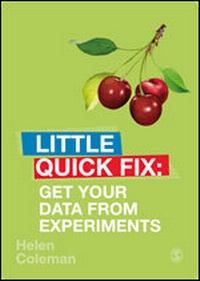
Get Your Data From Experiments
Little Quick Fix
1st Edition
Published on 25. November 2020
128 pages
978-1-5297-4207-7 (ISBN)
Description

Offering guidance on doing experiments, this Little Quick Fix helps you select the most appropriate experiment for your research, collect and record data, minimise error, and ensure your experiment is ethical and reproducible.
More details
Series
Language
English
Place of publication
London
United Kingdom
Publishing group
Sage Publications Ltd (Digital)
Target group
Adult education
ISBN-13
978-1-5297-4207-7 (9781529742077)
Copyright in bibliographic data and cover images is held by Nielsen Book Services Limited or by the publishers or by their respective licensors: all rights reserved.
Schweitzer Classification
Other editions
Additional editions
Book
12/2020
1st Edition
SAGE Publications Ltd
€14.00
Shipment within 15-20 days
Person
Helen Coleman is an award-winning senior lecturer in education; research design; methods and statistics; and childhood law, policy, and practice. Helen is the author of three books with SAGE: Little Quick Fix: Get Your Data from Experiments; Your Super Quick Guide to University; and Polish Your Academic Writing. She has also served as a reviewer for the Journal of Experiential Education; an external examiner and academic advisor to Cornwall College; and an assessment specialist with Cambridge University Press and Assessment.
Helen's academic research focuses on education and social justice in addition to changing policies and procedures in higher education and their impacts on the student experience. Helen strongly believes that being part of a university, whether staff or student, is knowing you are in an inclusive community where you should be free to learn and progress while being challenged and empowered, in a physically and mentally safe and healthy environment.
In 2018 Helen was awarded the first ever Glyndwr University Vice Chancellor's Award. This award was created and presented to her for "showing such deep commitment to staff and student welfare, health and safety, contributing to improvements to policies and procedures and courageous and pioneering work in Education." She holds a Master's degree in social research methods, and multiple post-graduate certifications in teaching and research methods.
Helen's academic research focuses on education and social justice in addition to changing policies and procedures in higher education and their impacts on the student experience. Helen strongly believes that being part of a university, whether staff or student, is knowing you are in an inclusive community where you should be free to learn and progress while being challenged and empowered, in a physically and mentally safe and healthy environment.
In 2018 Helen was awarded the first ever Glyndwr University Vice Chancellor's Award. This award was created and presented to her for "showing such deep commitment to staff and student welfare, health and safety, contributing to improvements to policies and procedures and courageous and pioneering work in Education." She holds a Master's degree in social research methods, and multiple post-graduate certifications in teaching and research methods.
Content
What is an experiment?
Why do I need to do an experiment for my research?
What types of experiment are there?
How do I ensure my experiment is ethically appropriate?
How do I make my experiment reproducible?
How do I minimise error?
What types of data should I be collecting in an experiment?
How do I collect and record data in an experiment?
Why do I need to do an experiment for my research?
What types of experiment are there?
How do I ensure my experiment is ethically appropriate?
How do I make my experiment reproducible?
How do I minimise error?
What types of data should I be collecting in an experiment?
How do I collect and record data in an experiment?
