

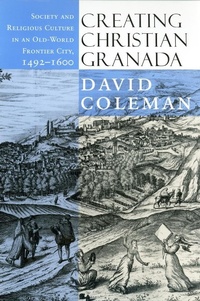
Creating Christian Granada
Society and Religious Culture in an Old-World Frontier City, 1492-1600
Published on 15. August 2013
272 pages
978-0-8014-6875-9 (ISBN)
Description

Creating Christian Granada provides a richly detailed examination of a critical and transitional episode in Spain's march to global empire. The city of Granada-Islam's final bastion on the Iberian peninsula-surrendered to the control of Spain's "Catholic Monarchs" Isabella and Ferdinand on January 2, 1492. Over the following century, Spanish state and Church officials, along with tens of thousands of Christian immigrant settlers, transformed the formerly Muslim city into a Christian one.
With constant attention to situating the Granada case in the broader comparative contexts of the medieval reconquista tradition on the one hand and sixteenth-century Spanish imperialism in the Americas on the other, Coleman carefully charts the changes in the conquered city's social, political, religious, and physical landscapes. In the process, he sheds light on the local factors contributing to the emergence of tensions between the conquerors and Granada's formerly Muslim, "native" morisco community in the decades leading up to the crown-mandated expulsion of most of the city's moriscos in 1569-1570.
Despite the failure to assimilate the moriscos, Granada's status as a frontier Christian community under construction fostered among much of the immigrant community innovative religious reform ideas and programs that shaped in direct ways a variety of church-wide reform movements in the era of the ecumenical Council of Trent (1545-1563). Coleman concludes that the process by which reforms of largely Granadan origin contributed significantly to transformations in the Church as a whole forces a reconsideration of traditional "top-down" conceptions of sixteenth-century Catholic reform.
With constant attention to situating the Granada case in the broader comparative contexts of the medieval reconquista tradition on the one hand and sixteenth-century Spanish imperialism in the Americas on the other, Coleman carefully charts the changes in the conquered city's social, political, religious, and physical landscapes. In the process, he sheds light on the local factors contributing to the emergence of tensions between the conquerors and Granada's formerly Muslim, "native" morisco community in the decades leading up to the crown-mandated expulsion of most of the city's moriscos in 1569-1570.
Despite the failure to assimilate the moriscos, Granada's status as a frontier Christian community under construction fostered among much of the immigrant community innovative religious reform ideas and programs that shaped in direct ways a variety of church-wide reform movements in the era of the ecumenical Council of Trent (1545-1563). Coleman concludes that the process by which reforms of largely Granadan origin contributed significantly to transformations in the Church as a whole forces a reconsideration of traditional "top-down" conceptions of sixteenth-century Catholic reform.
Reviews / Votes
David Coleman seeks to bridge the gap between local and institutional history in his study of the transformation of the Spanish city of Granada in the century after its conquest by Isabella and Ferdinand on January 2, 1492, by asking when and how Granada became a Christian city. To answer these questions, Coleman takes his readers on a far-flung trip that begins and ends at Granada but in the meantime takes us all over the Iberian Peninsula and as far as the Council of Trent.... By suggesting that Granada is a case study for understanding the emergence of empire, Spain's treatment of religious minorities, and the development of the sixteenth-century church, Coleman opens his book up to a wide range of readers.... Students of European expansion into the Americas will find the case of Granada interesting as a possible prototype of colonial expansion.- Lucy K. Pick (Journal of Modern History) David Coleman's richly detailed book takes the conquest of Granada in 1492 not as the culmination of a military campaign, but instead as the first step in the century-long Christianization of an ethnically diverse and socially dynamic Spanish city.... It is to Coleman's credit that this valuable book captures the city's unique frontier atmosphere at the same time that it illuminates Granada's role in the wider Catholic Reformation.
- David Carrico Wood (Sixteenth Century Journal) In this thoughtful and much-needed history, David Coleman examines the recreation of the former Nasrid capital of Granada as a newly Castilian, newly Christian city on Spain's southern frontier. In the process, he demonstrates the necessarily interrelated nature of Granada's status on the one hand as a newly repopulated city with a long list of institutional challenges, cultural conflicts, and religious innovation, and on the other hand as an incubator of some of the most influential religious figures in Iberia in the sixteenth century.... This readable book takes the history of Granada as its standpoint, from which to address much larger questions about the nature of religious, social, and political identity in sixteenth-century Spain. The result is an important contribution to the historiography of Old Christian-morisco relations, of early modern Spain, and of Catholic Reform in the sixteenth century.
- Gretchen Starr-LeBeau (Renaissance Quarterly) There is much to praise in this book: its amenable style, its rich documentation (much of it unused before), its fascinating story-line, its lively pageant of individuals from the Jewish convert Juan de la Torre, who made a fortune in the silk trade which allowed him to become lord of a nearby village and to purchase a seat on Granada's municipal council for his son, to another judeoconverso Juan de Avila, who was the principal figure in the reform movement that would shape the future of the Catholic Church in Europe, to Granada's first saint Joao Cidade, who through his acts of charity and the founding of hospitals for the poor would become San Juan de Dios.
- Trevor J. Dadson (Islam and Christian-Muslim Relations) This book invites us to look afresh at the relationship between church and society, a relationship that excelled as a formative, dynamic one.
- Helen Rawlings (European History Quarterly)
More details
Language
English
Place of publication
Ithaca
United States
Product notice
Reflowable
Illustrations
4 maps, 4 tables, 6 halftones - 4 Maps
ISBN-13
978-0-8014-6875-9 (9780801468759)
Copyright in bibliographic data and cover images is held by Nielsen Book Services Limited or by the publishers or by their respective licensors: all rights reserved.
Schweitzer Classification
Other editions
Additional editions
David Coleman
Creating Christian Granada
Society and Religious Culture in an Old-World Frontier City, 1492-1600
Book
08/2013
Cornell University Press
€28.50
Shipment within 10-20 days
David Coleman
Creating Christian Granada
Society and Religious Culture in an Old-World Frontier City, 1492-1600
Book
10/2003
Cornell University Press
€69.44
Shipment within 10-20 days
Person
David Coleman is Professor of History at Eastern Kentucky University.
Content
IntroductionChapter 1. A Frontier SocietyChapter 2. Mudejares and MoriscosChapter 3. A Divided City, A Shared CityChapter 4. The Emergence of a New OrderChapter 5. Creating Christian GranadaChapter 6. Defining ReformChapter 7. Negotiating ReformChapter 8. Rebellion, Retrenchment, and the Road to the SacromonteNotes
Bibliography
Index
Bibliography
Index
