

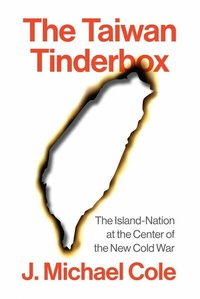
The Taiwan Tinderbox
Description

Renowned Taiwan expert and former intelligence officer J. Michael Cole explains how this Pacific nation has become a tinderbox that could ignite a full-scale global conflict. Drawing on unparalleled access to Taiwanese government sources and two decades of on-the-ground observation, he explores the root causes of the conflict between Taiwan and China - from the identity politics that make "peaceful unification" inconceivable, to the rise of Xi Jinping, the most powerful and authoritarian Chinese leader since Mao Zedong. With in-depth analysis of how the war in Europe is influencing preparations by Beijing, Taipei, and Washington for a potential cross-Strait confrontation, The Taiwan Tinderbox is an impassioned plea for the defense of Taiwan as a priority for the international community and the future of democracy.
More details
Other editions
Additional editions
Person
Content
Acknowledgments
Abbreviations
Preface
Introduction
1. The Unbridgeable Divide
2. Xi's Unbridled Ambitions
3. Attacking Taiwan's Democracy
4. The Impact of Ukraine
5. The Catastrophe: War in the Taiwan Strait
6. Avoiding the Nightmare
7. Taiwan and the Battle for Democracy's Future
Notes
Index
Introduction
The current crisis in the Taiwan Strait, a tinderbox that many fear could spark a hugely destabilizing great power confrontation between China and the United States, does not find its roots in recent history, although developments over the past decade and half or so - the main focus of this book - have unquestionably taken us ever closer to the precipice.1 Rather, the conflict, which pits democratic Taiwan, the world's twenty-first largest economy, with a population about the size of Australia's, at 23.5 million people, and its principal security guarantor, the United States, against authoritarian China arguably originated in the late nineteenth century. More specifically, at the conclusion of the First Sino-Japanese War, when China's Qing dynasty, on the losing side of that war, was forced to "cede" Taiwan to the Japanese victors as part of the Treaty of Shimonoseki.2 The treaty launched what Beijing would later refer to as the "century of humiliation" at the hands of foreign powers. Chief among them was Japan, which over the first half of the next century engaged in predatory practices - and a war of annihilation - on a scale similar to the worst depredations of Western colonial powers, which in many ways it sought to emulate.
From Shimonoseki in 1895 until Japan's defeat in World War II, Taiwan was therefore part of the Japanese empire. Thus, during World War II, Taiwan was part of the Axis. My wife's maternal grandmother, growing up in Chiayi County in southern Taiwan, would always remember the terror she experienced as American B-29 and B-32 heavy bombers groaned in the skies above her on their way to bombing runs in southern Taiwan - the same American military that, today, plays a key role in ensuring Taiwan's defense against the People's Liberation Army (PLA). Her wedding photos are striking for the fact that, in the background, flags of the rising sun and swastika are displayed on a wall. Before she died, whenever we visited her at home, she would have the Japanese TV channel NHK on, and for her entire life, she, like many people of her generation, was always more comfortable speaking Japanese than Mandarin, despite rigid attempts by the Chinese Nationalist Party (KMT) to impose the language (and ban others).
All this is not ancient history. All within a lifetime. During World War II, a 3-year-old boy who would have been my spouse's oldest uncle on her mother's side died of an infection due to lack of medication caused by shortages resulting from the war. A friend of the family recalls losing a sister in the U.S. nuclear bombings in Japan - both he and his sister jumped into a river to avoid being burned by the blast, but she didn't make it. Another friend of the family remembers, as a curious boy growing up in Pingtung, in southern Taiwan, defying warnings from his parents to stay away from an altercation and, drawn to it, looking between the legs of a circle of KMT soldiers gathered in the city as they shot a number of locals to death as Taiwan's period of "White Terror" began. After relocating to Taipei, my spouse's maternal grandparents lived across the street from the family of Chen Wen-chen, whom Garrison Command is accused of murdering in 1981 after a period of detention and interrogation.
During the period between 1895 and 1945, the people of Taiwan were treated as colonial subjects, subject to the vagaries of a regime that never made them full citizens of the empire. And yet, Taiwan benefited from the colonial power's modernizing instincts to turn it into a model colony. It was early during that half century of colonial subjugation that the first inklings of a Taiwan independence movement emerged, a consciousness that would carry into the twenty-first century as Taiwan continued to exist in a limbo of sorts, even after it achieved the full requirements for statehood.
Throughout its existence, and well before Japan incorporated Formosa into its empire, its people were confronted with external designs upon their land, including European powers and Chinese dynasties (the term Formosa was first used by Portuguese sailors, who upon seeing Taiwan called it the "beautiful island," or "Ilha Formosa," which Dutch colonists subsequently appropriated). Besides the Aboriginal people who first occupied the land, waves of settlers came from what is now known as China; some did so temporarily, while others, tired of the constant warring in their homeland, made Taiwan a more permanent home.
Thus were sown the first seeds of a contest of identity that continues to characterize, and in some ways to haunt, politics in Taiwan today. After World War II, this would be compounded by a second wave of Chinese settlers, this time in the form of Chiang Kai-shek's fleeing Nationalists (KMT) after their defeat by Mao Zedong's Chinese Communist Party (CCP) in the Chinese civil war.
At the 1951-2 San Francisco Peace Treaty, defeated Japan was forced to "cede" sovereignty of Taiwan. However, to whom it was ceded was never clearly established. Nevertheless, the Republic of China (ROC), which had been founded in 1912 when Taiwan was a possession of the Japanese empire, assumed de facto control of the island and its people. After losing control of the mainland in 1949, Chiang's Nationalists relocated to Taiwan, where they hoped to rebuild their forces and, one day, reconquer their homeland. The arrival of more than a million demoralized Nationalist forces in Taiwan was at first cautiously embraced by the people on the island, though the relationship between the local population and, as it would soon become clear, their new colonial masters, quickly soured as KMT rule proved more repressive, and much less organized, than what they had experienced under the Japanese.
Nothing put the new reality of life under the KMT in starker contrast than the incidents of February 1947, two years before Chiang and the remains of his government fled across the Taiwan Strait. In February that year, Nationalist forces retaliated militarily to popular protests which the regime characterized as an insurrection. In what came to be known as the 228 Massacre, Nationalist forces killed and imprisoned thousands of Taiwanese. Using fears of communism in a fledgling Cold War, Chiang's regime declared Martial Law, a period of "White Terror," as it came to be known, that would last thirty-eight years - one of the longest in a twentieth century marked by widespread state repression.
Until Martial Law was lifted in 1987, thousands upon thousands of people in Taiwan would be interrogated, detained, disappeared, exiled, or murdered by the state apparatus. That regime of fear even followed the Taiwanese who lived in exile, in the form of "professional students" employed by the KMT to spy on "agitators" on university campuses.
To an extent that would only become clearer decades later, the White Terror was a foundational development in Taiwan's identity, which over time would come to define itself by that which we are not, and that which we aspire to. For fifty years, the people of Taiwan struggled against authoritarian rule, contesting a regime that, for much of the Cold War, was regarded by the West as an ally in the "free world's" battle against the ideologues in Moscow, Beijing, and other capitals behind the Iron Curtain. Consequently, while the Taiwanese found allies among civil society and religious groups abroad, their fight for freedom often was treated as an inconvenience to decision makers in Western capitals, who often had no compunction in allying themselves with right-wing regimes as long as they joined the fight against communism.
From the end of World War II until the Korean War, Taiwan existed in a geopolitical limbo, an afterthought for the great powers as the dividing lines of the Cold War were beginning to harden. After the North invaded the southern part of the Korean Peninsula, the Truman administration came under pressure - both from Republicans and members of the Truman administration, including Dean Rusk, Louis Johnson, and General Douglas MacArthur - to include Taiwan within the U.S. "defense perimeter" in East Asia. The move was intended to prevent both an invasion of the mainland (China) by Chiang Kai-shek and an attack by Mao's communist forces upon Taiwan at a time when the U.S. and the U.N. were distracted with the crisis in Korea. Truman also agreed to dispatch the 7th Fleet to the Taiwan Strait to prevent any escalation.3 More than seventy years later, that U.S. "defense perimeter" remains in place.
In a presage of future tensions, the Taiwan Strait became one of the Cold War's most dangerous flashpoints during the Second Taiwan Strait Crisis of 1958. The crisis was sparked by the shelling of the Taiwan-controlled outlying islands of Quemoy (Kinmen) and Matsu by the PLA.4 As it rushed to support its ally, the U.S. began drawing up plans to use nuclear weapons against the People's Republic of China (PRC). Such plans were never activated, nuclear strikes were not launched against the communists, and the crisis stabilized into a low-intensity conflict, with the PLA shelling the islets until 1979.
From 1966 until Mao's death in 1976, China descended into the chaos of the Cultural Revolution, a period during which the PRC went into self-imposed isolation.
And yet, at some point during the Cold...
