

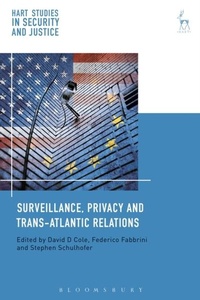
Surveillance, Privacy and Trans-Atlantic Relations
1st Edition
Published on 9. February 2017
248 pages
978-1-5099-0543-0 (ISBN)
Description

Recent revelations, by Edward Snowden and others, of the vast network of government spying enabled by modern technology have raised major concerns both in the European Union and the United States on how to protect privacy in the face of increasing governmental surveillance.
This book brings together some of the leading experts in the fields of constitutional law, criminal law and human rights from the US and the EU to examine the protection of privacy in the digital era, as well as the challenges that counter-terrorism cooperation between governments pose to human rights. It examines the state of privacy protections on both sides of the Atlantic, the best mechanisms for preserving privacy, and whether the EU and the US should develop joint transnational mechanisms to protect privacy on a reciprocal basis.
As technology enables governments to know more and more about their citizens, and about the citizens of other nations, this volume offers critical perspectives on how best to respond to one of the most challenging developments of the twenty-first century.
This book brings together some of the leading experts in the fields of constitutional law, criminal law and human rights from the US and the EU to examine the protection of privacy in the digital era, as well as the challenges that counter-terrorism cooperation between governments pose to human rights. It examines the state of privacy protections on both sides of the Atlantic, the best mechanisms for preserving privacy, and whether the EU and the US should develop joint transnational mechanisms to protect privacy on a reciprocal basis.
As technology enables governments to know more and more about their citizens, and about the citizens of other nations, this volume offers critical perspectives on how best to respond to one of the most challenging developments of the twenty-first century.
More details
Series
Edition
1. Auflage
Language
English
Place of publication
London
United Kingdom
Publishing group
Bloomsbury Publishing PLC
Target group
Professional and scholarly
ISBN-13
978-1-5099-0543-0 (9781509905430)
Copyright in bibliographic data and cover images is held by Nielsen Book Services Limited or by the publishers or by their respective licensors: all rights reserved.
Schweitzer Classification
Other editions
Additional editions
David Cole | Federico Fabbrini | Stephen Schulhofer
Surveillance, Privacy and Trans-Atlantic Relations
Book
06/2019
Hart Publishing
€45.00
Shipment within 15-20 days
David Cole | Federico Fabbrini | Stephen Schulhofer
Surveillance, Privacy and Trans-Atlantic Relations
Book
02/2017
Hart Publishing
€117.20
Shipment within 15-20 days
Persons
David D Cole is Hon George J Mitchell Professor in Law and Public Policy at Georgetown University Law Center, and National Legal Director of the American Civil Liberties Union. He writes regularly for The Nation, the New York Review of Books, and many other publications.
Federico Fabbrini is Full Professor of Law at the School of Law & Government of Dublin City University. He holds a PhD in European Law from the European University Institute.
Stephen Schulhofer is Robert B McKay Professor of Law at New York University Law School. He is the author of More Essential Than Ever: The Fourth Amendment in the Twenty-first Century.
Federico Fabbrini is Full Professor of Law at the School of Law & Government of Dublin City University. He holds a PhD in European Law from the European University Institute.
Stephen Schulhofer is Robert B McKay Professor of Law at New York University Law School. He is the author of More Essential Than Ever: The Fourth Amendment in the Twenty-first Century.
Content
- Intro
- Contents
- List of Contributors
- 1
- Introduction: Privacy and Surveillance in Transatlantic Perspective
- Part I Domestic Perspective
- 2
- Rights-based Review of Electronic Surveillance after Digital Rights Ireland and Schrems in the European Union
- I. Introduction
- II. Summary of Digital Rights Ireland and Schrems and Their Wider Context Within the EU"s System for the Protection of Fundamental Rights
- III. The Parameters of Rights-based Review of Surveillance
- IV. Institutional Implications: Towards More Pluralistic Forms of Review?
- V. Conclusion
- 3
- Domestic Surveillance of Public Activities and Transactions with Third Parties: Melding European and American Approaches
- I. Introduction
- II. Targeted Investigations and Mosaic Theory
- III. Panvasive Systems and Political Process Theory
- IV. Conclusion
- Part II Comparative Perspective
- 4
- Privacy Federalism in the United States and the European Union: The Role of State Institutions
- I. Introduction
- II. Institutional Analysis of Data Privacy in the United States
- III. Institutional Analysis of Data Privacy in the European Union
- IV. Concluding Remarks
- 5
- From DRD to PNR: Looking for a New Balance Between Privacy and Security
- I. Introduction
- II. The EU-US PNR Agreements
- III The EU-Canada PNR Agreements
- IV. Applying the ECJ Privacy Doctrine to PNR
- V. From DRD to PNR: Which Balance between Privacy and Security?
- VI. Concluding Remarks
- Part III Perspective of Private Corporations
- 6
- The Possibilities and Limits of Corporations as Privacy Protectors in the Digital Age
- I. Introduction
- II. Corporations and the Rise of Big Data
- III. Corporation as Privacy Protectors
- IV. Corporate Social Responsibility and Privacy
- V. Conclusion
- 7
- The Right to Privacy, Surveillance and the Global Obligations of Corporations
- I. Introduction: The Technological Revolution and the Expansion of Corporate Power
- II. The Right to Privacy and Corporations: Justifying Direct Human Rights Obligations
- III. Specifying the Obligations of Corporations: Privacy And Surveillance
- IV. Conclusion
- Part IV Perspective of NGOs and Oversight Authorities
- 8
- Mass Surveillance and Oversight
- I. Introduction
- II. Mass Surveillance: What"s in a Word?
- III. The Necessity of Mass Surveillance
- IV. What are the Minimum Safeguards that should be in Place?
- V. Obstacles and Opportunities for Oversight of Mass Surveillance
- VI. Concluding Remarks
- 9
- In re EPIC and the Role of NGOs and Experts in Surveillance Cases
- I. In Re EPIC
- II. Opportunities in US Courts
- III. Opportunities for Amici in the ECtHR and the CJEU
- IV. Current Matters
- V. Conclusion
- Part V Transatlantic Perspective
- 10
- A Transatlantic Privacy Pact?: A Sceptical View
- I. Spheres of Privacy-Before and After the Digital Transformation
- II. Emerging Proposals for Reform
- III. Implications for Americans
- IV. The Dangers of Multilateralism
- V. Embracing Sovereignty
- VI. Conclusion
- 11
- Transatlantic Negotiations for Transatlantic Rights: Why an EU-US Agreement is the Best Option for Protecting Privacy Against Cross-border Surveillance
- I. Introduction
- II. The Advantages and Necessity of a Transatlantic Compact
- III. The Interaction of Domestic and Transatlantic Processes: The Schrems Decision and the EU-US Privacy Shield
- IV. Conclusion
- 12
- Concluding Remarks
- I. Introduction
- II. Lessons Learned
- III. EU Charter
- IV. Respect for Private Life
- V. Protection of Personal Data
- VI. National Security
- VII. Enforceability
- VIII. Need for More Effectiveness
- IX. Rebuilding Trust in EU-US Data Flows
- X. The CJEU decision in Schrems
- Index
