

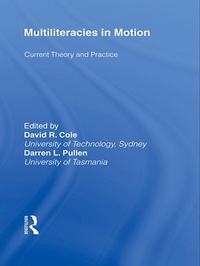
Multiliteracies in Motion
Current Theory and Practice
Published on 4. December 2009
288 pages
978-1-135-18432-2 (ISBN)
Description

The realities of new technological and social conditions since the 1990s demand a new approach to literacy teaching. Looking onward from the original statement of aims of the multiliteracies movement in 1996, this volume brings together top-quality scholarship and research that has embraced the notion and features new contributions by many of the originators of this approach to literacy.
Drawing on large research projects and empirical evidence, the authors explore practical and educational issues that relate to multiliteracies, such as assessment, pedagogy and curriculum. The viewpoint taken is that multiliteracies is a complementary socio-cultural approach to the new literacies that includes pedagogy and learning. The differences are addressed from a multiliteracies perspective - one that does not discount or undermine the new literacies, but shows new ways in which they are complementary.
Computers and the internet are transforming the way we work and communicate and the very notion of literacy itself. This volume offers frontline information and a vital update for those wishing to understand the evolution of multiliteracies and the current state of literacy theory in relation to it.
Drawing on large research projects and empirical evidence, the authors explore practical and educational issues that relate to multiliteracies, such as assessment, pedagogy and curriculum. The viewpoint taken is that multiliteracies is a complementary socio-cultural approach to the new literacies that includes pedagogy and learning. The differences are addressed from a multiliteracies perspective - one that does not discount or undermine the new literacies, but shows new ways in which they are complementary.
Computers and the internet are transforming the way we work and communicate and the very notion of literacy itself. This volume offers frontline information and a vital update for those wishing to understand the evolution of multiliteracies and the current state of literacy theory in relation to it.
Reviews / Votes
"...the authors featured in this collection present a compelling argument for change in educational practices, which would enable students to acquire skills that are appropriate to the complex demands of their everyday lives, while allowing them to utilize the multiliteracy skills they already possess....For educators, the collected essays in Multiliteracies in Motion offer a thought-provoking examination of the meaning of literacy in the world today."--Afterimage"Multiliteracies in Motion: Current theory and practice makes an excellent contribution to understanding the nature of literacy in the 21st century....[the book] opens up our minds to change and introduces us to the challenge of emerging media and diverse ways of teaching literacy. Readers will discover new insights, prompted by the research and thinking of this diverse collection of scholarship."--University of Technology, Sydney
More details
Language
English
Place of publication
London
United Kingdom
Publishing group
Taylor & Francis Ltd
Target group
College/higher education
Product notice
Reflowable
Illustrations
13 s/w Tabellen
13 Tables, black and white
File size
4,00 MB
ISBN-13
978-1-135-18432-2 (9781135184322)
Copyright in bibliographic data and cover images is held by Nielsen Book Services Limited or by the publishers or by their respective licensors: all rights reserved.
Schweitzer Classification
Other editions
Additional editions
Book
11/2009
1st Edition
Routledge
€232.00
Shipment within 15-20 days

Book
11/2009
1st Edition
Routledge
€82.80
Shipment within 15-20 days
Persons
David R. Cole is Senior Lecturer in English & Pedagogy, University of Technology, Sydney, Australia.
Darren Pullen is Lecturer in ICT, Health Science and Professional Studies, Faculty of Education, University of Tasmania, Australia.
Darren Pullen is Lecturer in ICT, Health Science and Professional Studies, Faculty of Education, University of Tasmania, Australia.
Content
Foreword, Theo van Leeuwen & Gunther Kress
Preface
Chapter One: Introduction to multiliteracies in motion: Current theory and practice, David R. Cole & Darren L. Pullen
Part I: Classrooms and multiliteracies in motion
Chapter Two: Uncritical framing: Lesson and knowledge structure in school science, Beryl Exley & Allan Luke
Chapter Three: Image, voice, and the making of the school-literate child: Lessons from multiliterate teaching in China, Bette Zhang Bin & Peter Freebody
Chapter Four: Introducing multimodal literacy to young children learning English as a Second Language (ESL), Len Unsworth & Robyn Bush
Part II: Multiliteracies theory in motion
Chapter Five: New Media, New Learning, Bill Cope & Mary Kalantzis
Chapter Six: Tracking the relationships between technology and users in multiliteracies theory, David R. Cole & Darren L. Pullen
Chapter Seven: Multiliteracies and the politics of desire, David R. Cole
Part III: The pedagogy of multiliteracies in motion
Chapter Eight: Using the Principles of multiliteracies to inform pedagogical change, Michele Anstey & Geoff Bull
Chapter Nine: Disrupting traditions: Teachers negotiating multiliteracies and digital technologies, Elizabeth Stolle & Gustavo Fischman
Chapter Ten: Using multiliteracies to facilitate culturally relevant pedagogy in the classroom, Louanne Smolin & Kimberly Lawless
Part IV: Multiliteracies in practice
Chapter Eleven: Multiliteracies and assessment practice, Ian Brown, Lori Lockyer & Peter Caputi
Chapter Twelve: Young Australians reading in a digital world, Jennifer Rennie & Annette Patterson
Chapter Thirteen: Multiliteracies: Resources for meaning-making in the secondary English classroom, Douglas McClenaghan & Brenton Doecke
Chapter Fourteen: A virtual school for rethinking learning, Julie Faulkner & Gloria Latham
Afterword, Donna E. Alvermann
Contributors
Preface
Chapter One: Introduction to multiliteracies in motion: Current theory and practice, David R. Cole & Darren L. Pullen
Part I: Classrooms and multiliteracies in motion
Chapter Two: Uncritical framing: Lesson and knowledge structure in school science, Beryl Exley & Allan Luke
Chapter Three: Image, voice, and the making of the school-literate child: Lessons from multiliterate teaching in China, Bette Zhang Bin & Peter Freebody
Chapter Four: Introducing multimodal literacy to young children learning English as a Second Language (ESL), Len Unsworth & Robyn Bush
Part II: Multiliteracies theory in motion
Chapter Five: New Media, New Learning, Bill Cope & Mary Kalantzis
Chapter Six: Tracking the relationships between technology and users in multiliteracies theory, David R. Cole & Darren L. Pullen
Chapter Seven: Multiliteracies and the politics of desire, David R. Cole
Part III: The pedagogy of multiliteracies in motion
Chapter Eight: Using the Principles of multiliteracies to inform pedagogical change, Michele Anstey & Geoff Bull
Chapter Nine: Disrupting traditions: Teachers negotiating multiliteracies and digital technologies, Elizabeth Stolle & Gustavo Fischman
Chapter Ten: Using multiliteracies to facilitate culturally relevant pedagogy in the classroom, Louanne Smolin & Kimberly Lawless
Part IV: Multiliteracies in practice
Chapter Eleven: Multiliteracies and assessment practice, Ian Brown, Lori Lockyer & Peter Caputi
Chapter Twelve: Young Australians reading in a digital world, Jennifer Rennie & Annette Patterson
Chapter Thirteen: Multiliteracies: Resources for meaning-making in the secondary English classroom, Douglas McClenaghan & Brenton Doecke
Chapter Fourteen: A virtual school for rethinking learning, Julie Faulkner & Gloria Latham
Afterword, Donna E. Alvermann
Contributors
