

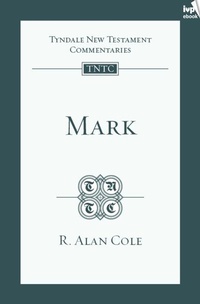
Mark
Tyndale New Testament Commentary
Published on 26. March 2015
356 pages
978-1-78359-311-8 (ISBN)
Description

Who is Jesus? What is salvation? What is the good news? Our earliest written account of Jesus' ministry is widely acknowledged to be that of the Gospel of Mark. If so, it remains key in our answering these questions.
Alan Cole treads a careful path between exclusively this-worldly or other-worldly interpretations of this landmark Gospel. His commentary provides a helpful starting point for all contemporary preaching and teaching from this Gospel. This classic commentary has been completely retypeset and presented in a fresh, vibrant new large paperback format, with new global branding.
Alan Cole treads a careful path between exclusively this-worldly or other-worldly interpretations of this landmark Gospel. His commentary provides a helpful starting point for all contemporary preaching and teaching from this Gospel. This classic commentary has been completely retypeset and presented in a fresh, vibrant new large paperback format, with new global branding.
More details
Language
English
Place of publication
Nottingham
United Kingdom
Product notice
Reflowable
ISBN-13
978-1-78359-311-8 (9781783593118)
Copyright in bibliographic data and cover images is held by Nielsen Book Services Limited or by the publishers or by their respective licensors: all rights reserved.
Schweitzer Classification
Other editions
Additional editions
Book
05/2007
Inter-Varsity Press
€44.75
Article exhausted; check for reprint
Person
The late R. Alan Cole was lecturer in Old Testament at Moore Theological College, Sydney, and Trinity Theological College, Singapore.
Content
- Intro
- Tyndale New Testament Commentaries
- Mark
- Contents
- General Preface
- Author's Preface to the First Edition
- Author's Preface to the Second Edition
- Chief Abbreviations
- Select Bibliography
- Introduction
- 1. Who was 'Mark'?
- What does tradition say?
- 2. Priority of Mark among the synoptists
- 3. Mini-history of gospel criticism
- 4. How should Mark's Gospel be viewed?
- A. Modern views of Mark
- i. Marxsen
- ii. Trocmé
- iii. Belo
- iv. What can we learn from these modern approaches?
- B. Signs of Peter's influence
- C. Some early criticisms
- D. The answer: Mark's concept of a gospel
- 5. Aramaisms of Mark
- 6. Who was Jesus, according to Mark?
- 7. What was the good news of the kingdom?
- Preaching the good news
- 8. Is Rome the background?
- 9. The status of women
- 10. Signs and wonders
- 11. The structure of Mark's Gospel
- 12. Chief motifs
- A. The secrecy motif
- B. Suffering in Mark
- C. Mark's interest in Galilee and Gentile mission
- D. Summary of main motifs
- Analysis
- 1. PREPARE THE WAY: THE PREPARATION FOR THE EVANGEL (1:1-13)
- 2. HIS OWN DID NOT RECEIVE HIM: THE EARLY GALILEAN MINISTRY (1:14-3:6)
- 3. ALL WHO RECEIVED HIM: THE CALL AND TRAINING OF THE DISCIPLES (3:7-8:26)
- 4. HE FIRMLY SET HIS FACE: THE ROAD TO JERUSALEM (8:27-10:52)
- 5. ZEAL FOR YOUR HOUSE: THE JERUSALEM MINISTRY (11:1-13:37)
- 6. THE PASSION NARRATIVE (14:1-15:47)
- 7. THE THIRD DAY: THE RISEN LORD (16:1-20)
- Commentary
- 1. Prepare the Way: The Preparation for The Evangel (1:1-13)1
- A. The title of the book (1:1)
- B. The forerunner (1:2-8)
- C. The baptism of Jesus (1:9-11)
- D. The temptation (1:12-13)
- 2. His Own Did Not Receive Him: The Early Galilean Ministry (1:14-3:6)
- A. The kingdom of God in Galilee (1:14-45)
- i. The first Galilean preaching (1:14-15)
- ii. The call of the disciples (1:16-20)
- iii. Jesus at Capernaum (1:21-28)
- iv. Peter's mother-in-law (1:29-31)
- v. The evening healings (1:32-34)
- vi. From Capernaum to Galilee (1:35-39)
- vii. The cleansing of the leper (1:40-45)
- B. The beginning of conflict (2:1-3:6)
- i. The healing of the paralysed man (2:1-12)11
- ii. The ministry of Jesus (2:13)
- iii. The call of Levi (2:14-17)
- iv. Controversy about fasting (2:18-22)
- v. Controversy about the sabbath (2:23-28)
- vi. The man with the withered hand (3:1-6)
- 3. All Who Received Him: The Call and Training of the Disciples (3:7-8:26)
- A. The conflict increases (3:7-35)
- i. The breach with the religious leaders (3:7-12)
- ii. The call of the twelve (3:13-19)
- iii. Mounting opposition: the Beelzebul controversy (3:20-30)
- iv. The true relatives of Jesus (3:31-35)
- B. Parables of the kingdom (4:1-34)
- i. The parable of the sower, and the reason for the use of parables (4:1-25)
- ii. Two more parables of growth (4:26-32)
- iii. The summing up of the parables (4:33-34)
- C. Ministry round the lake of Galilee (4:35-7:23)
- i. Jesus calms the storm (4:35-41)
- ii. The Gadarene demoniac (5:1-20)
- iii. Two more healing miracles (5:21-43)
- iv. His own city rejects him (6:1-6)34
- v. The sending out of the twelve (6:7-13)
- vi. Herod's estimate of Jesus (6:14-16)
- vii. The martyrdom of John the Baptist (6:17-29)
- viii. The feeding of the five thousand (6:30-44)
- ix. The walking on the water (6:45-52)
- x. Healings at Gennesaret (6:53-56)
- xi. A further clash with Judaism (7:1-23)
- D. Ministry in northern Palestine: return to Galilee (7:24-8:26)
- i. The Syrophoenician woman 55 (7:24-30)
- ii. The deaf and dumb man (7:31-37)
- iii. The feeding of the four thousand (8:1-9)
- iv. The Pharisees demand a sign (8:10-13)
- v. The danger of yeast (8:14-21)
- vi. The blind man of Bethsaida (8:22-26)
- 4. He Firmly Set His Face: The Road to Jerusalem (8:27-10:52)
- A. Confession and transfiguration (8:27-9:10)
- i. Peter's confession: the first passion-prediction (8:27-33)
- ii. The cost of discipleship (8:34-38)
- iii. The transfiguration (9:1-10)
- B. The passion foretold again (9:11-50)
- i. 'Elijah returned' (9:11-13)
- ii. The epileptic boy (9:14-29)
- iii. The second passion-prediction (9:30-32)
- iv. The greatest in the kingdom (9:33-37)
- v. The man casting out demons (9:38-40)
- vi. Stumbling-blocks (9:41-48)
- vii. The salt of the earth (9:49-50)
- C. Departure from Galilee (10:1-34)
- i. The local setting (10:1)
- ii. The teaching of Jesus on marriage (10:2-12)
- iii. Let the children come (10:13-16)
- iv. The rich man (10:17-31)
- v. The third passion-prediction (10:32-34)
- D. The sons of Zebedee (10:35-45)
- E. Blind Bartimaeus (10:46-52)
- 5. Zeal for Your House: The Jerusalem Ministry (11:1-13:37)
- A. Entry into Jerusalem (11:1-14)
- i. The entry (11:1-10)
- ii. The return to Bethany (11:11)
- iii. Cursing the fig tree (11:12-14)
- B. The cleansing of the temple (11:15-19)
- C. Exhortation and debate (11:20-12:44)
- i. The meaning of the withered fig tree (11:20-26)
- ii. By what authority? (11:27-33)
- iii. The wicked tenant farmers (12:1-12)
- iv. Tribute to Caesar (12:13-17)
- v. The Sadducean question (12:18-27)
- vi. The greatest commandment (12:28-34)
- vii. The son of David? (12:35-37)
- viii. The warning against the scribes (12:38-40)
- ix. The widow's gift (12:41-44)
- D. The 'little Apocalypse' (13:1-37)
- i. The doom on the temple (13:1-4)
- ii. The signs of the end (13:5-8)25
- iii. The beginning of the troubles (13:9-13)
- iv. The 'desolating sacrilege' (13:14-20)
- v. False Christs and false prophets (13:21-23)
- vi. The coming of the Son of man (13:24-27)
- vii. The parable of the fig tree (13:28-29)
- viii. The date of the coming (13:30-32)
- ix. The end of the discourse (13:33-37)
- 6. The Passion Narrative (14:1-15:47)1
- A. The last supper (14:1-25)
- i. The death of Jesus is decided (14:1-2)
- ii. The anointing at Bethany (14:3-9)
- iii. The betrayal by Judas (14:10-11)
- iv. The owner of the upper room (14:12-16)
- v. The prophecy of the betrayal (14:17-21)
- vi. The Lord's Supper (14:22-25)
- B. The agony in Gethsemane (14:26-42)
- i. The road to Gethsemane (14:26-31)
- ii. The agony in the garden (14:32-42)
- C. Jesus is taken prisoner (14:43-52)
- D. The fall of Peter (14:53-72)
- E. The trial before Pilate (15:1-15)20
- i. The stage is set (15:1)
- ii. Pilate condemns Jesus (15:2-15)
- F. The crucifixion (15:16-47)
- i. The mockery (15:16-20)
- ii. Carrying the cross of Jesus (15:21)
- iii. The cross (15:22-32)25
- iv. The death (15:33-41)
- v. The burial (15:42-47)
- 7. The Third Day: The Risen Lord (16:1-20)
- A. The resurrection (16:1-8)
- B. The longer ending (16:9-20)
- Chapter 1
- Chapter 2
- Chapter 3
- Chapter 4
- Chapter 5
- Chapter 6
- Chapter 7
- Bibliography
