

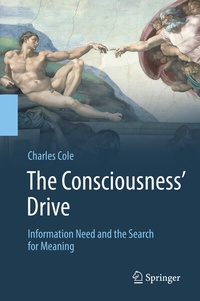
The Consciousness' Drive
Information Need and the Search for Meaning
1st Edition
Published on 18. September 2018
X, 247 pages
978-3-319-92457-1 (ISBN)
Description

What is the uniquely human factor in finding and using information to produce new knowledge? Is there an underlying aspect of our thinking that cannot be imitated by the AI-equipped machines that will increasingly dominate our lives? This book answers these questions, and tells us about our consciousness - its drive or intention in seeking information in the world around us, and how we are able to construct new knowledge from this information.
The book is divided into three parts, each with an introduction and a conclusion that relate the theories and models presented to the real-world experience of someone using a search engine. First, Part I defines the exceptionality of human consciousness and its need for new information and how, uniquely among all other species, we frame our interactions with the world. Part II then investigates the problem of finding our real information need during information searches, and how our exceptional ability to frameour interactions with the world blocks us from finding the information we really need. Lastly, Part III details the solution to this framing problem and its operational implications for search engine design for everyone whose objective is the production of new knowledge.
In this book, Charles Cole deliberately writes in a conversational style for a broader readership, keeping references to research material to the bare minimum. Replicating the structure of a detective novel, he builds his arguments towards a climax at the end of the book. For our video-game, video-on-demand times, he has visualized the ideas that form the book's thesis in over 90 original diagrams. And above all, he establishes a link between information need and knowledge production in evolutionary psychology, and thus bases his arguments in our origins as a species: how we humans naturally think, and how we naturally search for new information because our consciousness drives us to need it.
The book is divided into three parts, each with an introduction and a conclusion that relate the theories and models presented to the real-world experience of someone using a search engine. First, Part I defines the exceptionality of human consciousness and its need for new information and how, uniquely among all other species, we frame our interactions with the world. Part II then investigates the problem of finding our real information need during information searches, and how our exceptional ability to frameour interactions with the world blocks us from finding the information we really need. Lastly, Part III details the solution to this framing problem and its operational implications for search engine design for everyone whose objective is the production of new knowledge.
In this book, Charles Cole deliberately writes in a conversational style for a broader readership, keeping references to research material to the bare minimum. Replicating the structure of a detective novel, he builds his arguments towards a climax at the end of the book. For our video-game, video-on-demand times, he has visualized the ideas that form the book's thesis in over 90 original diagrams. And above all, he establishes a link between information need and knowledge production in evolutionary psychology, and thus bases his arguments in our origins as a species: how we humans naturally think, and how we naturally search for new information because our consciousness drives us to need it.
Reviews / Votes
"This is an important book, well worth the effect necessary to absorb the, at times, complex arguments. It certainly ought to be a candidate for the ASIST Best Information Science Book Award . I am sure it will become a highly cited text and of great value to researchers in the field . . It is well written, dealing with complex topics in a readily understandable fashion, with the aid many diagrams and illustrations." (T. D. Wilson, Information Research, Vol. 23 (04), December, 2018)More details
Series
Language
English
Place of publication
Cham
Switzerland
Publishing group
Springer International Publishing
Target group
Professional and scholarly
Illustrations
X, 247 p. 125 illus., 88 illus. in color.
File size
13,96 MB
ISBN-13
978-3-319-92457-1 (9783319924571)
DOI
10.1007/978-3-319-92457-1
Schweitzer Classification
Other editions
Additional editions
Book
10/2018
Springer
€80.24
Shipment within 10-15 days
Person
Charles Cole
has been an information science researcher-writer-editor on information retrieval topics for over 25 years. This is his 3rd book for Springer (plus a fourth published by ASIST). Since receiving his Ph. D. in 1994 (University of Sheffield), Cole has published 50 articles in peer-reviewed journals, including in the Journal of the Association of Information Science & Technology (19), Information Processing & Management (12), as well as Library Quarterly, and Research Quarterly (RQ). He is currently a Researcher, Affiliate Member, at McGill University's School of Information Science.
Content
1 Human Exceptionality: How We See Ourselves in Relation to the World.- 2 Framing - Lessons from Vermeer.- 3 Episodic Memory: Lessons from the Scrub Jays.- 4 Episodic Memory: Subjective Time-travel.- 5 Episodic-to-Mimetic Transition.- 6 Framing: The Mimetic-to-Mythic Transition.- 7 Framing: The Mythic-to-Theoretic Transition.- 8 Problem Set-Up: Minsky's Frame Theory.- 9 Individual Frame Level: Meno's Paradox.- 10 Group Frame Level: Information Avoidance.- 11 Nation Frame Level: The Dark Side.- 12 Solution: Opening the Information Loop: Constructing Information Channels.- 13 Solution: Belief-Begets-Knowledge: Definitions.- 14 Belief-based Information Search.- 15 The Model of the Consciousness' Drive: Information Need and the Search for Meaning.
