

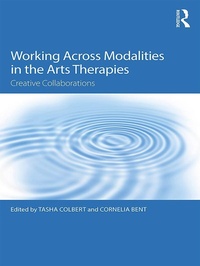
Working Across Modalities in the Arts Therapies
Creative Collaborations
Published on 6. September 2017
212 pages
978-1-317-19660-0 (ISBN)
Description

Working Across Modalities in the Arts Therapies: Creative Collaborations offers an in-depth insight into cross-modality and transdisciplinary practice in the arts therapies. Including contributions from drama, music, dance movement and art therapists, as well as professionals from related disciplines, it vividly demonstrates how the alchemy of these collaborations produces innovative interventions and new approaches to working with clients.
Compelling examples of collaborative practice cover a variety of client groups, ranging from Syrian refugee children and women with eating disorders, to homeless war veterans and sex offenders. Together, the authors make the case for the effectiveness of cross-modal and transdisciplinary approaches when working with otherwise hard-to-reach and complex populations.
This book is a guide to good practice and an invaluable resource for both experienced arts therapists and those new to the field. It will also be of benefit to healthcare and education professionals, arts practitioners, and anyone with an interest in the subject.
Compelling examples of collaborative practice cover a variety of client groups, ranging from Syrian refugee children and women with eating disorders, to homeless war veterans and sex offenders. Together, the authors make the case for the effectiveness of cross-modal and transdisciplinary approaches when working with otherwise hard-to-reach and complex populations.
This book is a guide to good practice and an invaluable resource for both experienced arts therapists and those new to the field. It will also be of benefit to healthcare and education professionals, arts practitioners, and anyone with an interest in the subject.
Reviews / Votes
"This book is a cause for celebration. It documents therapeutic stories that will help us to learn about our own disciplines and those in related fields, and I recommend it to a wide range of health professionals. It presents a diverse picture of collaborative clinical work, and provides creative ideas for the continued development of practice"Tessa Watson
At a time when walls are built, and social 'divorces' are in the making, this book comes as a thoughtprovoking
and hopeful alternative to remind readers that collaborations across modalities,
disciplines and borders of all kinds are possible and useful. Inspiring examples are offered of how to
work with clients who are struggling with fragmentation, the long-term impact of ill health, disability
or social adversity, placing interventions within the wider context of the multidisciplinary team, the
family and the wider community. This is a book about the struggles and the benefits of being with
others, opening up possibilities and creating connections. And as such a valuable guide of how to
counter-act fear, disempowerment and isolation for clients and therapists alike. Well done to Tasha
Colbert and Cornelia Bent for bringing to the foreground and to the public domain all these, well
selected, examples of collaborative working.
Prof Vicky Karkou, Chair of Dance, Arts and Wellbeing, Edge Hill University
Co-author of the Arts Therapies: A Research-Based Map of the Field
More details
Language
English
Place of publication
London
United Kingdom
Publishing group
Taylor & Francis Ltd
Target group
Professional and scholarly
Illustrations
5 s/w Abbildungen, 22 s/w Photographien bzw. Rasterbilder, 2 s/w Zeichnungen
2 Line drawings, black and white; 22 Halftones, black and white; 5 Illustrations, black and white
File size
39,93 MB
ISBN-13
978-1-317-19660-0 (9781317196600)
Copyright in bibliographic data and cover images is held by Nielsen Book Services Limited or by the publishers or by their respective licensors: all rights reserved.
Schweitzer Classification
Other editions
Additional editions
Tasha Colbert | Cornelia Bent
Working Across Modalities in the Arts Therapies
Creative Collaborations
Book
08/2017
1st Edition
Routledge
€231.50
Shipment within 10-20 days
Tasha Colbert | Cornelia Bent
Working Across Modalities in the Arts Therapies
Creative Collaborations
Book
08/2017
1st Edition
Routledge
€76.20
Shipment within 10-20 days
Persons
Tasha Colbert PG(dip), RDMP, UKCP is a registered dance movement psychotherapist who has practiced for over fifteen years with a variety of client groups in the NHS, education and private practice. She lectures on dance movement psychotherapy programmes in the UK and internationally, and facilitates various continued professional development (CPD) trainings. She is an experienced clinical supervisor and psychotherapist with a private practice in West London.
Cornelia Bent MA, HCPC, BAMT is a UK registered music therapist who has worked for over ten years with a wide range of client groups in a variety of settings, including the NHS, education and charity sector. Within her current clinical practice in adult mental health, she often collaborates with other arts psychotherapists, contributes clinically to music therapy research trials and presents at conferences internationally.
Cornelia Bent MA, HCPC, BAMT is a UK registered music therapist who has worked for over ten years with a wide range of client groups in a variety of settings, including the NHS, education and charity sector. Within her current clinical practice in adult mental health, she often collaborates with other arts psychotherapists, contributes clinically to music therapy research trials and presents at conferences internationally.
Content
List of Contributors Foreword Introduction
Part I: Cross Modality Practice and Research in the Arts Therapies 1 Not Doing What it Says on the Tin: A family awareness group in a high security hospital 2 Moving Colour: Combining dance movement psychotherapy and art psychotherapy in a NHS community women's group 3 Staying Connected: Combining music therapy and dance movement psychotherapy in an acute mental health setting 4 Facing Rupture and Nurturing a Creative Space: A dramatherapy and art therapy group on an acute ward in a medium secure forensic hospital 5 Ambivalence, Boundaries, Edges and Expansion: Relatedness and collaboration in a dance movement psychotherapy and music therapy group for adults with learning disabilities 6 Stretch Marks: An exploration of a joint dramatherapy and music therapy group 7 An Innovative Collaboration: Combining art and music therapy interventions for adults with learning disabilities 8 Holding Hope: Rehabilitation of Syrian refugee children through art, music and dance movement therapy
Part II: Transdisciplinary Practice and Research in the Arts Therapies 9 Regaining Balance through Family Art Psychotherapy 10 A Transdisciplinary Approach: Working with individuals in a sex offender treatment programme 11 The Boy Who Cried Wolf: A collaborative approach to long term segregation 12 Left Overs: Exploring Body Image 13 Almost Paradise: A creative arts collaboration helping US veterans recover from homelessness
Part I: Cross Modality Practice and Research in the Arts Therapies 1 Not Doing What it Says on the Tin: A family awareness group in a high security hospital 2 Moving Colour: Combining dance movement psychotherapy and art psychotherapy in a NHS community women's group 3 Staying Connected: Combining music therapy and dance movement psychotherapy in an acute mental health setting 4 Facing Rupture and Nurturing a Creative Space: A dramatherapy and art therapy group on an acute ward in a medium secure forensic hospital 5 Ambivalence, Boundaries, Edges and Expansion: Relatedness and collaboration in a dance movement psychotherapy and music therapy group for adults with learning disabilities 6 Stretch Marks: An exploration of a joint dramatherapy and music therapy group 7 An Innovative Collaboration: Combining art and music therapy interventions for adults with learning disabilities 8 Holding Hope: Rehabilitation of Syrian refugee children through art, music and dance movement therapy
Part II: Transdisciplinary Practice and Research in the Arts Therapies 9 Regaining Balance through Family Art Psychotherapy 10 A Transdisciplinary Approach: Working with individuals in a sex offender treatment programme 11 The Boy Who Cried Wolf: A collaborative approach to long term segregation 12 Left Overs: Exploring Body Image 13 Almost Paradise: A creative arts collaboration helping US veterans recover from homelessness
