

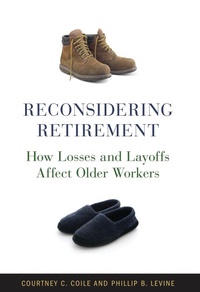
Reconsidering Retirement
Description

The economic downturn that began in 2008, the most severe in decades, has hit older Americans hard. Many have seen huge losses to their 401(k)s. In numerous cases the value of homes¿the largest investment most older Americans have ever made¿has diminished considerably. In addition, large numbers of American workers, including those 50 and older, have lost their jobs and may have difficulty replacing them. Suddenly the future seems a whole lot less certain, throwing years of planning into doubt. In Reconsidering Retirement, economists Courtney Coile and Phillip Levine go beyond the headlines to explain how the economic crisis will affect the future plans and well-being of older Americans.
Amid well-publicized reports that older workers needed to stay on the job because of the crisis, the number of U.S. workers claiming Social Security retirement benefits actually rose substantially from 2008 to 2009. The authors maintain that job loss has been the culprit, leading to premature retirement, and while this trend may have been less noticed, it is perhaps the more significant outcome of the crisis.
Coile and Levine examine the three major characteristics of the recession thought to influence retirement behavior: decline in the stock market, reduced housing values, and a weak labor market. The authors find that lower home prices did not actually affect retirement behavior but that the decline in the stock market did lead some workers to delay retirement, while a weakened labor market actually forced more older workers with fewer skills into retirement. As a result, these early retirees, who rely on Social Security, face a lifetime of lower benefits.
The legacy of recessions is that those most in need usually are last to reap the benefits of an economic recovery. While the lion's share of media coverage after the economic downturn of 2008¿09 has gone to the plight of older workers who remain employed, Courtney Coile and Phillip Levine exami
More details
Other editions
Additional editions
Persons
Courtney C. Coile is the Class of 1966 Associate Professor in the Department of Economics at Wellesley College, a research associate of the National Bureau of Economic Research (NBER), and a member of the National Academy of Social Insurance (NASI). She serves as an editor of the Journal of Pension Economics and Finance and has published numerous articles on retirement behavior.
Phillip B. Levine is the Catherine Coman and A. Barton Hepburn Professor in the Department of Economics at Wellesley, an NBER research associate, a research affiliate of the National Poverty Center, and a member of NASI. From 1996 to 1997, he served as a senior economist at the White House Council of Economic Advisers. His publications include an undergraduate econometrics textbook and Sex and Consequences: Abortion, Public Policy, and the Economics of Fertility (Princeton, 2004).
Content
- Front Cover
- Copyright Information
- Table of Contents
- Acknowledgments
- Prologue
- Introduction
- Defining and Explaining Retirement
- Detecting the Impact of Market Conditions
- Impact of the Stock Market Crash
- Impact of the Housing Market Crash
- Impact of the Labor Market Crash
- Implications for Retiree Well-Being
- Discussion and Policy Implications
- Appendix
- References
- Index
- Back Cover
