

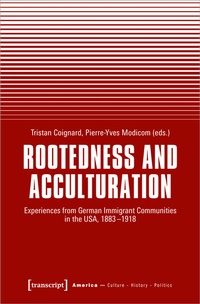
Rootedness and Acculturation
Experiences from German Immigrant Communities in the USA, 1883-1918
1st Edition
Published on 2. August 2024
216 pages
978-3-8394-7359-7 (ISBN)
Description

German-Americans represent the largest self-declared ancestry group in the United States of America. The period from the 200th anniversary celebration of Germantown's founding in 1883 to the end of the First World War was an age of intense turmoil within the ranks of German-American communities. These decades were marked by a massive political and cultural realignment as well as major contributions to the (self-)definition of German-Americanness. Historians and sociolinguists with backgrounds in German or American studies offer a fresh look at a critical period in the history of German-American communities.
More details
Other editions
Additional editions
Tristan Coignard | Pierre-Yves Modicom
Rootedness and Acculturation
Experiences from German Immigrant Communities in the USA, 1883-1918
Book
08/2024
1st Edition
transcript
€46.00
Shipment within 5-7 days
Persons
Tristan Coignard, born in 1977, works as a professor for German studies and history of ideas at Université Bordeaux Montaigne (France). He is a former Junior Fellow at Institut Universitaire de France (2018-2023) and received a fellowship of the German Historical Institute for a research stay at the Joseph P. Horner Memorial Library in Philadelphia (2015). His current research focuses on debates about cosmopolitanism and education and on German immigrants in the USA.
Pierre-Yves Modicom, born in 1988, is a professor for Germanic linguistics at the Linguistic Research Center - Corpus, Discourse and Societies (CEL) at Université Jean Moulin - Lyon 3 (France), where he is chair of the Institute for German Studies. His recent work focuses on contrasts and transfers between Germanic languages.
Pierre-Yves Modicom, born in 1988, is a professor for Germanic linguistics at the Linguistic Research Center - Corpus, Discourse and Societies (CEL) at Université Jean Moulin - Lyon 3 (France), where he is chair of the Institute for German Studies. His recent work focuses on contrasts and transfers between Germanic languages.
Content
- Cover
- Contents
- Rooted, Acculturated, Assimilated?
- 1. Discussing the Contribution to the American Nation
- 1.1 The Argument about the Legacy of the Forty-Eighters
- 1.2 The Abolitionist Cause
- 1.3 What is a German-American Citizen?
- 1.4 Can the USA rely on the Loyalty of German-Americans?
- 2. What is German-American Identity?
- 2.1 Acculturation Options
- 2.2 Resisting Assimilation
- 2.3 The Key Role of the Debate on the German Language
- 2.4 Being Part of American History
- Part I: Discussing the Contribution to the American Nation
- Germans? Americans? German-Americans?
- The Antislavery German
- 1. Debating Slavery
- 2. Cause and Condescension
- 3. Better Than All the Rest
- Deserters? Bona fide Citizens?
- 1. Introduction
- 2. Changing Conceptions of "Citizenship" in a Transnational Perspective
- 2.1 Dual Citizenship as a Threat
- 2.2 The Bancroft Treaties: Recognizing Transfers of Allegiance?
- 3. Proving Citizenship: Temporary Returns, Desertion and the Role of Consulates
- 3.1 Avoiding Military Service (twice): Josef Reinhardt and Peter Rauch (1899)
- 3.2 Enlisting Sons of German-born Fathers: John Groves (1902) and Henry Meyer (1904)
- 4. Bona fide Intention of Return: Overcoming the Presumption of Expatriation after 1907
- 5. Conclusion
- The German-American Experience in World War I: A Reassessment
- Part II: What is German-American Identity?
- English or German?
- 1. Census Data in Sociolinguistics
- 2. US Census Data as a Sociolinguistic Source
- 2.1 The US Census
- 2.2 Census Questions
- 2.3 Questions on Language in the US Census 1890-1940
- 2.3.1 Questions on Language 1890-1900
- 2.3.2 Questions on Language 1910-1930
- 2.3.2.1 Mother Tongue 1910
- 2.3.2.2 Instructions 1910
- 2.3.3 Questions on Language 1940
- 2.3.4 Published Census Information on Language 1890-1940
- 2.3.5 Mother Tongue and Race as Census Categories
- 2.3.6 Resume
- 2.4 Limitations of Census Data on Language
- 3. Computing US Census Data Regarding German
- 3.1 US Census Data Offered by IPUMS
- 3.2 German as a Mother Tongue
- 3.3 What made German Immigrants speak English?
- 4. Conclusions
- Identity Crisis and German-American Historiography
- 1. Complementary Concepts of Historiography
- 1.1 Cumulative Research and Personal Commitment in Rattermann's Historiography
- 1.2 The Scientific Militancy of Julius Goebel
- 2. Diagnoses about the Status of Germanness in the 1880s
- 2.1 First Diagnosis: The Feeling of Being Weakened by a Lack of Recognition
- 2.2 Second Diagnosis: Tensions and Grievances within the Community
- 3. Writing History and Prospects for the Future: In Search of Answers to Challenges
- 4. Conclusion
- Heinz Kloss as an Interpreter of German-American Language History
- 1. Perspectives
- 2. Kloss's Life in the Twentieth Century and its Relationship to the Sociolinguistic Description of "German-Americans" between 1883 and 1918
- 2.1 Short Biography of Heinz Kloss, a Sociolinguist
- 2.2 Kloss's Epistemics on the German-Americans
- 2.3 Kloss's Findings on German-Americans
- 3. Linguistic Formulation Innovation and Interpretation Problems
- 3.1 Fabled Formulations or Real Conceptual Work?
- 3.2 Theoretical Developments Alongside or Independent of the Destinies of German-Americans?
- 4. Ideological Attachment to the Mother Tongue or Early Approach to Language Rights?
- 4.1 Historical Context
- 4.2 Kloss and the Mother Tongue
- 4.3 Forward-looking Views on Language Rights or Backward-looking Ideology?
- 5. Conclusion
- Heinz Kloss and the German-American Past
- 1. "E pluribus Deutschamerikanertum"?
- 2. In Awe of Assimilation
- 3. Reading Kloss Today
- Index of Names
